Home Blog Page 823

Technology for Transparency

S Raju,
Additional Chief Secretary, Government of Uttarakhand
S Raju, Additional Chief Secretary, Government of Uttarakhand
S Raju,
Additional Chief Secretary, Government of Uttarakhand

Implementation of technology brings about transparency in the process of governance and augments citizen services. S Raju, Additional Chief Secretary, Government of Uttarakhand, in conversation with Manish Arora of Elets News Network (ENN), enumerates the advantages of IT implementation vis-a-vis various initiatives undertaken in the State

What are the various initiatives undertaken by the State Government to ease the process of citizen service delivery?

The transfer of teachers had been a major issue, which emerged as a huge issue in the past. But now, introduction of the system of display of their marks on website brought about the much-needed transparency and helped people know as to where they stand.

So, disputes relating to the transfer of teachers have now become almost nil. Feedback from the teachers regarding transfer system has also been quite good.

What has the government been doing to reduce complaints regarding pension distribution?

technology -for-transparencyEarlier, lots of people kept running around government offices for their pension and complained of delays in pension disbursements. It was due to manual and long process of releasing pensions.

The payments of pension have now been made online. We have implemented an IVR-based system, in which anyone can call and find out whether his pension has been released or not. It has helped us in easing the process of pension distribution and the people also don’t have to keep standing in office queues.

‘We have introduced a web-based system for tracking the status of work projects. This has helped us track why one is not able to meet the deadline, and we can easily identify and rectify the problem’

Implementing court orders has been always tough for the government. How has IT helped in doing that?

We have put all the court orders on a web-based system where one can see the deadlines for their implementation. Based on these, delays in implementation of the court orders have seen a huge reduction. We are trying regularly to improve that system in the coming days. We have also introduced a web-based system for tracking the status of work projects. This has helped us track why one is not able to meet the deadline, and we can easily identify and rectify the problem.

Ideating for smart education

Ashish Khare, General Manager and Business Head, System Integration Solution, Wipro

Consumer behaviour, advancement in content publishing, adoption of technological solutions in the education sector to make it smarter are driving significant changes in the education sector. Presently, with the focus on 100 smart cities, Wipro is all set to deliver smarter solutions for smart education in a smart city model. Ashish Khare, General Manager and Business Head, System Integration Solution, Wipro, in an exclusive chat with Bhawna Satsangi of Elets News Network (ENN) finds out the roadmap of the company developed for smart education

What will be the model of smart education in a smart city?

Ashish Khare, General Manager and Business Head, System Integration Solution, Wipro
Ashish Khare,
General Manager and Business Head, System Integration Solution, Wipro

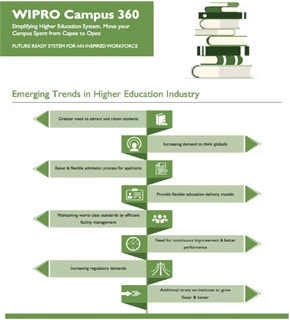
Education is a combination of two partsone to enable educational institutes on a self-sustainability completely and include a smart education aspect, which includes smart classrooms, web-based education, online evaluation, enabling the whole education process on a smarter platforms.

The second part is making a campus smart which includes campus surveillance, campus Wi-Fi, campus network, working out the Real Time Location Services (RTLS) which is one of the important aspects of education. We have developed the solution for a women’s only institute in Saudi Arabia around four years back. In BITS Pilani, we have deployed RTLS solution in women’s hostel. There’s sensitivity involved and that’s the reason, security and access becomes an important part of educational institutes.

Another aspect is to enable overall curriculum and evolution system online. If these two things are taken care of, then the coverall education system can be taken care of. These days Idea Internet Network (IIN) is gaining grounds. But then what IIN teaches is a concept and if these are structured programmes, it becomes smart education. IIN is more of a web search. But better and organised way is that you have more structured sessions which are mass communication without the dependence on the quality of a teacher sitting in front of students. Today, the biggest issue in the education in schools as well as in colleges is that education is dependent on the kind of professor or lecturer you have. By enabling these kinds of online sessions and facilitating that will help students.

Will depending upon only online education not fade away the traditional mode of teaching?

It’s always a mix. IIN might be okay from an understanding point of view but a proper education needs a moderator. You can always have an intervention from an expert from the report as a part of smart education but a moderator in front makes a huge difference, especially in smaller classes.

What is the framework that you have developed for the smart solutions for smart education?

This is the area where we work along with our ecosystem partners and one of them is Samsung. The focus is more on enabling technology part. Content is something which we are not focusing at present. While we have an e-learning application, which organises learning session for various people, we also have evolution systems which are largely used within Wipro. We have 1,70,000 people and everyone has to go through certification process internally and that’s the qualification for people to continue in the job. As a process, it is anyway established and working. We do provide that platform but then the focus of Wipro is primarily enabling various technologies.

In your opinion, how will smart city facilitate the education sector?

Smart cities are coming up with various themes. Especially on the green field, education is one good theme which is with the least risk. In the brown field, it may not make a difference. Like Lavasa was initially considered as a leisure city but now they are trying to bring education institutes and that has actually changed the basis. Education is going to be a good and easy enabler for greenfield cities or the upscale cities.

What opportunities does Wipro see while developing smart solutions for smarter education in a smart city?

Wipro-campusWipro plans to be a technology enabler and that’s why we will go in smart cities and many other educational institutes as an application. We deployed some solutions in Jindal Global School three years back but now looking at them, there are various other universities which want similar solutions. Having a basic communication platform with internet enablement has become a base in most of the higher educational institutes. So, for us growth is in the education segment, from a smart education perspective is not limited to smart city institutes but also in other institutes. As a business company, we look at overall business and not just fixed to some 100 smart cities projects.

Are you also focusing tier 2 or 3 cities to deploy education solutions?

Yes, we are also deploying our education solutions in tier 2 and 3 cities. As an organisation, we are working for the smart campus as an initiative which will include educational institutes as a key driver. We will also work on smart refineries and smart manufacturing plants. Smart cities are one, the smart campus is another from a solution development perspective.

What are the features of smart campus?

smart-ducationThe smart campus is basically developing overall community in a smart campus. Most of the modules which come in a city can easily be adapted in a smart campus because the environment is much more controlled and those cross-functional issues are not there. Today, India’s biggest problem in the smart city is that there is no single head. Municipality head is heading three verticals, for telecom there is somebody else, for electricity there’s someone else. In campuses, integrated solutions are easier to adopt. So, a true smart city replica will actually come in smart campuses or greenfield cities.

How does a smart school play an important role in improving the physical performance of the smart city?

Smart education is a term which is related to basic opportunities available in a city. A smart education needs safety and security inside the campus, where you can monitor, surveillance, access to safety system within that building to make sure students are secure.

You can also use the network layer to get best of the knowledge and best of the data technology into your institutes. From an inclusion standpoint, the local concept within the smart city is not going to be relevant, what will be relevant is the smart education that child needs and the seats available in the school. All this can be integrated as a solution and can help in terms of better education.

A smart city is not a debate, it’s a reality today. And then you need to have this component in the smart city to cater to the needs of the people.

Enabling online transparency

In one of its kind e-initiative endeavours, the Rajasthan Public Service Commission (RPSC) has launched MEMORY-My Exam My Online Review, which enables students to take review of the exam they appear from the comfort of their homes, writes Akhilesh Mittal

RPSCIn order to safeguard the interests of the citizens of the State, the government’s every recruitment authority’s main objective is to adopt transparency for each and every process at each level. The Rajasthan Public Service Commission took e-initiatives since 2011 and regularly upgrading themselves with latest technology and innovations so that the demands for the services and solutions can be made available to the all with transparency.

Unlike in online exams, candidate of offline exams have the advantage to take home the question paper and carbon copy of OMR sheet. In online exams, candidate feels lack of transparency as neither the question paper nor OMR copy is in their hands, leaving them with lot of uncertainty. For example candidates could have doubts, like why negative marking was done when they didn’t even attempt those specific questions, or some questions were out of syllabus among others.

For last few years, RPSC had been trying to find some innovative solutions for such issues in online examination where the candidates can see the answers they give. Finally the commission has come up with a system, developed by an Associate Online Examination Consultant that takes care of the candidates’ concerns.

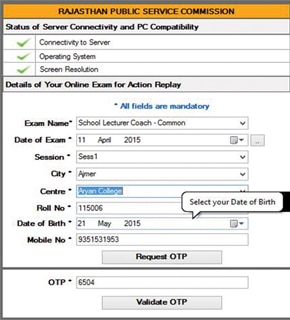
MEMORY – My Exam My Online Review- software has been designed and developed in such a manner that after completion of online examinations, the candidates can view start-to-end automatic action replay of their examination on the RPSC website.

The Public recruitments are quite a critical and sensitive task and the MEMORY software increases chances of transparency in an unique and innovative way.

Online-examThe RPSC launched the software from School Lecturer (COACH) exam, which was held on April 11, 2015 and garnered good response from the candidates.

The software runs on windows platforms and the size of software is known to be less than 150kb, only in unzipped form. In addition to that, this software has ensured highest security and 24x7availability across geographies. The commission has kept simultaneous log in limits for three candidates. They can log in with the allotted roll numbers and the one time passwords that would be received on the candidate’s registered mobile number.

The MEMORY will take candidates through all action and activities executed across by them during examination period and time spent time on the examination screen. With this innovative move, RPSC has taken online examinations to next level of digititsation.

Safeguarding Education GATEWAYS

SafeguardingOnline learning and technology based education has become an important part of the curriculam today. The technology has revolutionised the way we learn, teach and collaborate. Schools have embraced BYOD and internet as key tools in the advancement of education. Bhawna Satsangi of Elets News Network (ENN)  nds out from the key stakeholders about the importance of network security and anti-malware protection within schools

The use of Information Technology in education has seen a surge over a period of time. Today IT is no longer just a field or vertical that people just study or work for. It is being used almost in all the sectors to make the most out of the technology to keep the business going. And education sector is not far behind, where the use of IT is so prominent that no one would dream of working without the use of it.

The adaptation of IT in education is particularly noteworthy as in this field IT is not only taught to the youth but it is also used as a medium through which education is imparted. Nowadays, educational institutes aim to provide an environment in which every pupil can achieve their full potential. Many schools impart education using online sources. The dependence on the Web places greater emphasis on the importance of anti-virus and network security protection within schools.

Deepak Maheshwari, Director, Government Affairs, Symantec believes, “With the technology adaption in the education space children are getting additional spaces and opportunities for learning through the use of computer labs, smart classes, tablets etc. and even at home they access these technology. The scope of learning has gone way beyond teachers, parents or friends today and with the use of technology they could be learning anything from different sources and exposes them to lot of security challenges, safety and vulnerabilities especially for the under aged.”

According to Cyberoam, schools and higher education institutions strive to build adaptive and cost-effective network infrastructures to support the current sophisticated styles of teaching and learning. Use of technology and Internet access has become an essential part of a student’s curriculum to encourage comprehensive learning. IT is no longer used as a mere research tool, but most of an institution’s processes have gone online: whether we consider attendance, examinations, creating and submitting assignments, declaring results, and various other tasks. Use of laptops and tablets for classroom assignments has turned out to be a necessity.

Cyberoam security enables educational institutions to maintain network security while keeping security investments low and protecting students from malware and inappropriate content. It enhances productivity and minimises bandwidth consumption by controlling unproductive surfing, music video downloads, gaming, chat and social networking.

 Key-HighlightsKey Highlights

CIPA Compliance-controls indiscriminate surfi ng Cyberoam’s web filtering and application visibility and control prevent indiscriminate surfing by blocking direct access to inappropriate websites

WebCat

It enables educational institutions to enforce an internet safety policy that filters inappropriate internet usage helping compliance with federal CIPA requirements.

Shared Computer environment – User identification and control

Cyberoam’s unique Layer 8 Technology with identitybased security identifi es the username despite the dynamic Wi-Fi and shared endpoint environment in educational institutions. This allows the institutions to enforce flexible, yet effective controls based on the type of user, study requirements, level of access required and time of the day.

Layer 8 identity-based reporting

Off ers visibility into the institution’s surfing trends, bandwidth and system utilisation, internet usage in addition to intrusion alerts and more.

Committed bandwidth to users

Identity based bandwidth management assigns committed bandwidth based on users, users groups, web category and applications with bandwidth allocation based on study requirement and time of the day, ensuring optimum bandwidth utilisation.

Secure Wi-Fi access

The unique layer 8 technology identifi es internal source and destination of WLAN traffic by username, preventing rouge users from connecting to the institutional Wi-Fi network and avoiding detection.

Educational challenges

Educational institutions are a hot target for hackers who seek student’s personal information or simply to tamper with results or grades. Network of educational institutes are particularly vulnerable because they tend to be more open and less secured as compared to other verticals. Lesser experienced IT staff and undervalued IT budget are some of the main factors contributing to this gap.

Compuert-uder-attackThe education sector face challenges related to unproductive, inappropriate use of the internet, managing traffic from a myriad of BYOD devices, managing different internet requirements for different users at different time schedules. All schools often the most rigorous malware environments, schools and universities help shape not only the minds of the children, but also the character of the communities. ESET helps educational organisations around the globe achieve their missions. Pallav Agarwal, Marketing Director, Eset informs, “Educational institutes represent a more challenging IT and network security issues than corporate networks. As the students are more prone to internet threats, a virus or worm on one student’s computer can quickly spread throughout the entire campus. So, it is of utmost importance for the school staff to deploy anti-virus solutions to keep the malware attacks at bay. Also it is important to give students proper training to tackle the Trojan or malware.”

Every educational institute needs a strategy to secure its information resources and balance the utilisation of this technology to its full potential for academic purpose and avoid misuse. Hackers today have become very sophisticated.

To safeguard from intrusion and other malware it is important to use an anti-malware product which is best suited as per the requirement of an institution. Cyberoam’s firewall acts as armour around the network periphery, shielding it from any hostility from outside. The intrusion prevention system acts as a second layer of defense.

Rana-GuptaWith new technologies in the market available, it is only imperative to use such innovations for a suitable security system in educational institutions. There should be awareness about the potential dangers/risks associated with the use of IT which if not understood or addressed can very well become a reality and can come to haunt you.Rana Gupta,

Vice President, APAC sales for Identity and Data Protection (IDP) business at Gemelto

To tackle the intrusions from outside, it is also necessary for the institutes to restrict the use of internet surfing so that they do not spend their quality time in unproductive activities like social networking, gaming, chat, porn sites, etc. which could take a toll on the academic performance.

“Over the past few years, the focus have been mostly in just getting the access, which means getting the computers in the classrooms, at home, getting internet connectivity etc. so the security and safety of the children have become more of an afterthought and rather rare. So in many cases, if a student is going to a computer lab, they would allow access to any site. However, students should be going only to certain sites which schools allow to access,” feels Maheshwari.

Protecting educational environment

Safeguarding the interest of the students and the educational institutes, Alok Gupta, Director, Unistal who has also launched Protegent Suraksha, an anti-virus for the BYOD world. It is a combination of multiple products which has internet security, activity monitoring. It is important to maintain the secrecy of the work that is done or the sensitive data to be secured. So, this helps in retracing the error. This product also helps in device tracking and also tracks the IP address. There is speed enhancer and data recovery software included in the product. So, it has a combination of six modules.”

The activity monitoring helps the teacher and parent to identify the sites that the child has browsed. This will help in safeguarding the child. With this software, student can use any site but the entire browsing pattern of the work will go to the mail-id of parents or the teacher. There is a monitoring of the student’s work.

“We are running a course on data recovery with assured placement for the students who want to make their career in security industry. The fee of the course is `50,000 and if the government gives its own infrastructure we take `30,000 as the fee from per student. We have initiated the proposal with the government. The duration of the course is two months and 96 hours. The salary scale starts from `10,000 onwards,” informs Gupta.

Anti-virus is necessary and one cannot survive without anti-virus product. The adoption of the anti-virus product has been 100 per cent today. 80 per cent of the machines are pre installed with the anti-virus and by the time their buying time comes, they become habitual of using anti-virus.

“The government has got a flagship project on security which is called National Mission on Education through Information and Communication Technology. We did a report which is called Norton report and we learned that one out of two children in India were victims of cyber crime or online negative situation. We also learned that one out of five children in India are being cyber bullied while 84 per cent of the parents believe that no such thing existed. So, the fact is that often times the parents and the teachers might be in a state of denial that they may not even perceive that these are the types of dangers the children are facing. For us it is important to bridge this gap,” informs Maheshwari.

As a global security leader space, Symantec do take its responsibility very seriously and be committed to educate consumers towards cyber crime and keep them protected against many challenges. Symantec play a key role in providing institutions sources to help them discuss appropriate online behaviour with teachers and parents.

“We are providing Norton safe search which helps children when they are surfing the net. We also have Norton facebook which scans the facebook news feed for dangerous links, infected downloads and unsafe website. This is something which improves the safety for those children,” says Maheshwari.

The real benefit of using anti-virus is directly related to the consequences of not having the anti-malware protection. Viruses are the most well known computer attackers, and they can do all sorts of damages. So protecting from spyware and identity theft is utmost important. Spyware is a kind of software specifically designed to infect your computer and spy on you. This means that spyware will all your personal information stored in your computer.

    Anti-virus rules

CDo have a written anti-virus policy that details the responsibilities of management and staff , how antivirus is to be maintained, and specific instructions on what to do in an emergency
  • Do make sure that anti-virus software is installed on every machine, even if the machine is not capable of running e-mail. Viruses can sit undetected in fi les on any machine.
  • Do update anti-virus signature fi les and scanning engines regularly. A weekly update is good, although daily is better. If your company has a central anti-virus server, it can install updates on other machines on the network. However, a computer must be turned on for this to work. If a machine was not turned on at the time of the update, it will have to be updated manually.
  • Do update anti-virus signature fi les and scanning engines regularly. A weekly update is good, although daily is better. If your company has a central anti-virus server, it can install updates on other machines on the network. However, a computer must be turned on for this to work. If a machine was not turned on at the time of the update, it will have to be updated manually.
  • Do run the anti-virus program in full-time, background, automatic, auto-protect, or similar mode.
  • Do enable scans of the memory, master and boot records, and system fi les upon start up of every machine. It doesn’t take long for an anti-virus program to complete these scans and it’s just plain silly not to enable these features.
  • Do configure the anti-virus program to scan all files — not just executable programs. Viruses come in all sorts of fi les and just scanning executables is not enough.
  • Do enable the anti-virus heuristic controls (if they are available). A heuristic scan takes longer, but not so much longer that it makes much diff erence to users.
  • Don’t allow Windows Scripting Host (WSH) to run on machines that don’t need it. Although some Windows programs need WSH to run, most machines can have this removed without harm. WSH controls the Visual Basic Language and many viruses have been written with it. By removing WSH, the virus can’t operate.
  • Do enable Macro Virus Protection in all your Microsoft Offi ce programs.
  • Do disable the Preview Pane view in Outlook and Outlook Express. Some viruses can be launched by simply previewing them, even if the message is never opened. Disabling this feature saves you a lot of grief.


Uttarakhand eyeing Private Varsities

Radhika Jha, Secretary, Higher Education, Government of Uttarakhand
Radhika Jha, Secretary, Higher Education,
Government of Uttarakhand

Uttarakhand, known as the education hub of the country faces the challenge of last-mile connectivity, but the State Government is determined to overcome it at the earliest, so that all schools and colleges get connected through ICT. The Government is infact focusing on PPP model and wants the private sector to come to Uttarakhand to set up private institutions, says Radhika Jha, Secretary, Higher Education, Government of Uttarakhand, in an exclusive interview with Gautam Debroy of Elets News Networks (ENN)

What is the overall scenario of education sector in Uttarakhand?

Uttarakhand as a state is very favourably placed. It is the State, which is actually known as the education hub of the country. It’s a state, which has several premier educational institutions. Whether it is the IAS Academy, Military Academy, Doon School or any other school, our government is keen to leverage advantage of such institutions.


In terms of our people and their temperaments also, we have a lot of interest towards education. There are some great personalities, who hailed from Uttarakhand. So, our government wants to make Uttarakhand the hub of higher and school education. The government is also taking steps to encourage private institutions to invest in Uttarakhand. If the level of education is higher, the overall growth of a state follows.

What is the extent of use of ICT in the education sector of Uttarakhand?

We have not done so well in ICT, as we could have done. In schools, we have made a good start in terms of upper primary and secondary education. We have computer labs in lots of our schools. But we have lots of problems in terms of electricity, infrastructure, etc. There are several areas in our state which are remotely located. But our government is very keen. Our Chief Secretary reviews the situation every fortnight, along with the Secretary-IT, Secretary-School Education and Secretary-Higher Education to explore the possibilities of taking the IT infrastructure to the remotest corner of the State.

The last-mile connectivity is, in fact, a challenge for us, but we are determined to accomplish that, so that all our schools and colleges get connected through ICT. In higher education, we have a good programme called EDUSAT. Through this system, our teachers can deliver live lectures to a number of colleges, even if no teacher is present at a particular time in a given college. Now the State Government is in a mood to review the EDUSAT, so that each and every college in the remotely-located areas can avail the facility through the webbased classes.

In what other ways the PPP model can benefit the education scenario in the State?

We are in fact focusing on PPP model. When we talk of facilitating a private partner, we want a private partner to come to Uttarakhand. We want the private partners to also look at our local needs in terms of employment opportunities, in terms of demand and supply, etc. We encourage them and facilitate them, because if you have good educational institutes and job opportunities in your own state, people will not migrate. Apart from ensuring development, we also want to arrest migration, we also want the state’s economy to grow.

privateHow can private players play a role in developing the education sector of Uttarakhand?

Uttarakhand is one of the pioneering states in this sector as far as encouraging private universities to come here is concerned. We have a single-window clearance system available for private universities. We have given lots of relaxation to the private players interested in setting up educational institutions in the hills. There is a high density of these institutions in the plain areas, but there is lack of such institutions in the upper reaches per say. So, the government is pro-actively encouraging the private players to come to the State.

In fact, we do it in a collaborative way. If any private player comes, we make them understand the vision of our government, so that they could adjust to our aspirations. We always encourage private players. However, we make sure that if a private institution comes up, it must give priority to admission of the local people.

Does Uttarakhand see a large number of students going to other states to pursue higher studies?

This is true. In fact, we have a peculiar situation; people from all across the country come to Uttarakhand to get school education, as we have some very good schools in Mussoorie, Dehradun and Nainital. But for college education, our students go to places like Delhi, Mumbai, etc. This is really a matter of concern for the government.

We want to maintain that edge which we have in terms of school education. So our government has decided to set up very good universities. We have the University of Energy and Petroleum Studies, which is one of the finest universities in the energy sector in the country and has very good placements. We have Sanskrit Vishwavidyalaya, which is doing very good in its domain. We need to have many more specialised universities, so that there is fewer outward movement of students.

We, in fact, want to attract people from neighbouring states and countries to our educational institutions. Uttarakhand boasts of the Doon University, which is based on the pattern of JNU. It has very good schools of language and management. It has good school of life sciences as well. But we also want private sector participation.

Changing literacy dynamics

childTo ensure quality education for the future of India, the government sought to innovate literacy policy

The National Policy on Education was framed in 1986 and modified in 1992. Since then, several changes have taken place that calls for a revision of the Policy. The Government of India would now, like to bring out a National Education Policy to meet the changing dynamics of the quality education, innovation and research, aiming to make India a knowledge superpower by equipping its students with the necessary skills and knowledge and to eliminate the crunch manpower in the field of science, technology, academics and industry.

The Ministry of Human Resource and Development website talks about ‘Themes and Questions for Policy Consultation on School Education. The entire document highlights the changes in elementary education, improving the drop out ratio in the school, strengthening of vocational education, reforming school examination systems, revamping teacher education for quality teachers, accelerating rural literacy with special emphasis on women, SCs, STs and Minorities through adult education and National Open Schooling system to ensure proper education system in the country.

Ensuring learning outcomes

As per the document, despite improvements in access and retention in elementary education, the learning outcomes for a majority of children continue to be an area of serious concern. According to a research, children are not learning the basic skills during their schooling. Many children who reach grade V cannot even read and do simple arithmetic calculations. The states are implementing reforms such as early grade reading, writing, comprehension and maths programmes in conjunction with defining and measuring learning outcomes. The NCERT has completed three rounds of National Level Achievements Survey for Classes –III, V, & VII/VIII. States have been given funds to conduct state-level achievements surveys.

Extending outreach

With Universal Elementary education becoming a reality, near universalisation of secondary education is the next logical step. Further, universalisation of quality secondary education implies creating secondary schooling provisions of a defined standard irrespective of the location and management of the institution to accomodate all those eligible grade VIII and grade X students, who are willing to participate in the secondary and higher secondary education.

A wide range of centrally sponsored schemes are being run by different secondary school institutions and bodies so as to ensure greater geographical coverage, social and gender inclusion and use of ICT for quality enhancement.

Emphasising vocational learning

A knowledgable and skilled workforce is seen as the most important human capital required for the development of a country. Both vocational education and skill development are known to increase productivity of the individuals, profitability of employers and national growth. Vocational education aims to develop skilled manpower through diversified courses to meet the requirement, primarily in the unorganised sector and to inculcate self-employment skills in children through a large number of diversified vocational courses. Only 7 to 10 per cent of population is engaged in formal sector of economy. The development of vocational education will provide skilled labour force in the informal sector which would further enhance the productivity.

Reforming examinations

Examination reform that focus on problem solving, critical thinking and reasoning skills are critical to improving quality at the elementary and secondary levels. Such reforms will change the teaching and learning processes. CBSE has introduced a wide ranging examination reforms in schools affiliated to it, like for eg the class X board exams has been made optional, a system of grading in place of marks has been introduced. Comprehensive Evaluation has been strengthened so that the students are accessed on an ongoing basis for their holistic development. State Boards have also made efforts to update curriculum and impose examination systems.

Quality teaching

Quality of teachers has been a major cause of worry in the education system and one of the basic pre-requisites to improve quality. Competence of teachers and their motivation is crucial for enhancing it. Several initiatives are being taken for addressing the shortage in number of teachers, shortages of secondary school teachers in mathematics, science and languages, improving the pre-service teachers and in-service teachers professional development, enhancing the status of teaching as a profession.

Cracking threats with Kaspersky

With the use of Internet increasing on several devices, cyber threats are also expected to increase in the long run. Altaf Halde, Managing Director- South Asia, KasperSky Lab, in conversation with Nirmal Anshu Ranjan of Elets News Network (ENN) talks about the various solutions to get rid of these risks

Altaf-Halde
Altaf Halde
Managing Director- South Asia
KasperSky Lab 

Tell us something about your security solutions.

Kaspersky have been into the business of providing security for digital assets for the past 17 years. We started with the consumer security segment, then headed towards home users, followed by small offices. After that, we stepped towards the SMB space. Having covered these three segments, now we are getting into the enterprise segment.

Which are the segments you primarily cater to?

Our traditional solutions include endpoint security, which talks about antivirus in a device. So, irrespective of verticals, a virus or malware can attack any of the segments. As of now, we are quite strong in education space and are thinking of getting into the enterprise. Our focus is going to be IT/ITeS, BFSI and government segments.

Cloud is a big thing these days. Do you off er security solutions for that as well?

About a year ago, we did not have a Cloud solution, but now we have two of them. The first one is for the consumers, which we don’t sell them directly. We appoint a service provider for that, like Airtel or Vodafone. These will charge subscription for end point anti-virus security on the Cloud just like it takes charges for a ringtone on a monthly basis. We had recently launched it globally. Now, we have done the first step of tying up with one service provider who is based in Mumbai right now. The MoU is going to be released in 10-15 days time.

With initiatives like Digital India, cyber threats are also set to increase. How do you react to it?

Earlier, we used to sell our solutions only to Local Area Network companies. However, now people have got several devices like tablets, smart phones etc to access internet leading to the increase of threats. Today, there is no solution which can offer 100 per cent security. Nonetheless, what the customer should look at is, if there is a problem, how fast the company reacts to give him a solution, and that is where we feel lies our expertise. We have a very strong team of researchers who are looking out for threats which are coming up. KasperSky is one of the organisations which comes with the maximum number of detections.

What is the next big thing at KasperSky?

For us, protecting our users is the biggest thing. Further, we need to sell our solutions to get into this particular space putting the money back again. KasperSky is an organisation which develops its own solutions. For instance, if you look at Symantec, it acquires a company and thus integration becomes a huge problem. In KasperSky, we have developed everything. Our mobile device management (MDM), data encryption, virtualisation security, system management, all are developed now. So, what we believe in is that we are probably developing everything ourselvses making integration much easier.

We have also got a programme called KasperSky Kids, which we run with schools to provide newsletters or do events in schools and to talk about how to be safe with Internet. We believe in educating the users. These involve not only the corporates but also the children, who are going to be the next generation Internet users.

Enhanced technology encourage duping?

TechnologyAbout a dozen major question paper leaks reported recently has affected lakhs of students across India. The latest scandal of the hi-tech cheating in the All India Pre-Medical Test, resulted in cancellation of the entire exam by the Supreme Court, shaking the moral ground of the academic world, and compelling experts to opine that cheating in India has gone beyond personal ethics to practice such a crime through enhanced use of technology.

Here is a disturbing reality. In the past one year, about a dozen of major question paper leaks have been reported, affecting lakhs of students across India. From the latest All India Pre-Medical Test (AIPMT) to the Uttar Pradesh Combined Premedical Test in 2014 and Jamia Millia’s BTech and BDS courses entrance exams, cheating has organised itself into an industry. CCTVs, mobile jammers, armed guards, India is taking a host of measures to stop cheating in examinations. Flying squads with police protection, surveillance cameras are deployed to stop students from copying, but still, it remains rampant.

The recent scandal of All India PreMedical and Pre-Dental Entrance Test (AIPMT) shook the education industry, and an uncertainty prevails in uprooting this viral problem. The Supreme Court cancelled this year’s AIPMT after some tech-savvy students attempted to cheat in the examination by getting answers through electronic devices, which were smuggled into the test centres across the country.

In today’s digital times, high-technology forging strategies are mostly being misused by the students, and it seems like a cakewalk for them too, with numerous ideas and several electronic goods available on websites, providing a fodder for the criminal bent of mind.

For example, the ‘Spy Bluetooth Glasses Earpiece Set’, is a product that markets itself at users who want to “pass exams without a hassle, and conduct successful business negotiations overtaking competitors or simply strike others by their knowledge…” In fact, the company has offices in several major Indian cities. Another hi-tech device is a wireless earpiece, which can be placed into your auditory canal for receiving a signal through your cell phone for a stretch of five hours, an ideal device for any agent lurking outside the school with a copy of the question paper.

In fact, these products are known to be extremely popular and in demand among the desperate students who wish to just crack the exam by hook or by crook, resulting in finishing of the stocks fast.

However, this does not mean that the traditional mass cheating is out of fashion or authorities are not part of the these unfair plots. There have been instances in various states where students resorted to violence when the control machinery such as flying squads tried to stop them from indulging in unfair practices of passing examination.

Furthermore, cheating has become so institutionalised that even the rates are fixed. The situation is worse as students take plunge in committing suicide if they are unable to clear the examinations, like consuming poison and set themselves on fire. States like Uttar Pradesh score high on being notorious for such high percentage of such institutionalised cheating.

In 1991, the then Education Minister of the State that Rajnath Singh had instituted the Anti-Copying Act that made cheating a non-bailable offence. While all states have legislations pertaining to examination malpractices, this is the only one specific to ‘copying’ from another student’s paper.

Today, experts claim that cheating has long gone beyond the issue of personal ethics, and gained a prominent position in the system. Today, cheating is a bailable offence. There is an ardent need of a mechanism which needs to be put into practice to stop cheating at such a large scale. The question still remains — should we blame our education system, which has stooped down on a level just to help gain marks and get a degree through unfair practices?

Protecting growing threats

Rajesh Babu, CEO and Founder, Mirox Technology

The importance of Internet has come a long way and has been constantly growing in its approach to the end users. Today, the world is inevitably connected to the internet for online networking and operations. Rajesh Babu, CEO and Founder, Mirox Technology shares with Elets New Network (ENN) about the growing usage of Internet and threats observed that pose a severe threat on the education sector.

What is the scope of providing security solutions in education sector?

Rajesh Babu, CEO and Founder, Mirox Technology
Rajesh Babu,
CEO and Founder, Mirox Technology

In future the education industry is one of the largest users of Internet and Advance Wi-Fi mobility communications. This will give birth to the great demand in high speed connectivity and security tools. With wireless connectivity on campuses there is an increase in threats, particularly educational institutions who want to ensure full proof defence against any attacks. New technologies in mitigating such attack by implementing advanced security system such as Next Generation UTM, IDS, APT, SIEM, Device and Applications Control have wide scope in education sector. There is an ample opportunities in providing security solutions. Nurseries, kindergartens, schools, universities, technical colleges, further education institutes and research establishments- no matter how large educational facility but still there is more chances of unexpected and expected threat.

What are the threats and security issues in education institutions?

Education sector has long struggled to find a balance between academic freedom, supporting local communities and cyber security. Cyber security challenges in educational sphere is more. The educational institutions play a great role in their communities, and in cyberspace. Nowadays, most of the educational institutions face common information security issues- insufficient funds, mobile devices, lack of security risks awareness. These common challenges make easy for hackers to target institutions. More and more users are online using unprotected and vulnerable devices. They don’t understand threats and their impact consequence. But technically malicious software (malware), phishing, unwanted downloads, infrastructure attacks, social network targeting, and peer-to-peer (P2P) information leakage are daily potential threats.

Most universities’ systems are accessible through a campus network. Similarly, student records, many employment-related records, library use records, management-client communications, and certain research and other intellectual property-related records are housed on campus servers. As such, they are vulnerable to security breaches that may compromise confidential information and expose the university extremely sensitive research information.

Multiple personas and legacy access: Faculty, students and staff require access to different administrative systems, many of which contain sensitive information such as two students records, performance evaluations or donor data. As the personas shift, outdated and inappropriate legacy access pose security risks when not removed. A student who spent a semester through a work-study programme with the registrar’s office should not retain access that was provisioned for that role if she is placed in the Development Office the next semester. Institutions can leverage their identity management systems to better track who has access to what and ensuring that this risk is mitigated by deprovisioning access in a timely manner.

Rogue data in the cloud: Institutions have already signaled to their users that cloud-based data is ok. However, users don’t understand the contractual protections provided for these services, or the absence of these protections when they adopt free or low-cost solutions simply by signing up and storing institutional data in the cloud. This cybersecurity threat must be addressed on two fronts: educating and training end-users on the security issues and working with procurement and finance to flag these kinds of purchases for review.

Opening doors to the community: Many institutions of higher education view themselves not just as resources for their students, faculty and staff, but also to their local communities. The range of services provided to the wider community include programming, use of libraries and access to free Wi-Fi The dangers for a university or college network can lurk everywhere from e-mail to the Internet infrastructure itself.

Keeping track of the cyber security threats in higher education is not an easy task, but is imperative to protect the integrity of institutional assets, the network and infrastructure.

How can your solutions help education sector to be secure and safe?

protectingMirox offer a range of services and solutions, at a level of perfection that not many others can provide, from the most ordinary to the most extreme. Our services are always more than satisfactory to our clients. We allott right person for the right job and dedicate ourselves to deliver before deadlines, we forever try to go further with every new project we undertake. Our goal is not to set records or prove a point, it’s just an effort to keep up with the global market and an effort to achieve perfection.

Educational institutions of all sizes are contending with a growing list of cyber security challenges. They are not only responsible for protecting the personal information of students and faculty, but research three institutions like medical, technology – are encountering sophisticated cyber espionage campaigns from overseas governments and corporations.

Nowadays, most of the educational institutions face common information security issues- insufficient funds, mobile devices, lack of security risks awareness. These common challenges make easy for hackers to target institutions.

Moreover, cyber security professionals with school districts, colleges and universities are contending with vanishing budgets, an explosion of mobile devices, reckless users, infected machines, unpatched software and more. The challenge to provide students with the access to the latest technology, while keeping networks secure is an everyday reality. From end point protection to cutting-edge defenses against today’s most sophisticated malware – like APTs, targeted attacks and Zero-days – Mirox has the next generation customised campus comprehensive security solutions such as IDS/IPS, Encryption, DLP, Risk and Compliance Management, IDS/IPS, UTM, Firewall, APT, Antivirus/Antimalware, SVM/SIEM, Disaster Recovery, DDoS Mitigation, Web Filtering, Security Services to secure campuses – from small center to the largest universities

Cementing the learning gap

Sameer Ahmad, CEO, LearnOn Technology

To identify the distress areas in schools while bridging the gap between the teachers, students and parents, C-Link, a cloud-based solution by LearnOn Technology Solutions provides a platform to integrate into the existing pedagogy, ensuring teachers to spend optimum time on students, says Sameer Ahmad, CEO, LearnOn Technology

Could you brief us on the reason behind starting LearnOn Technology Solutions?

As parents, we always wanted to be more engaged in our children’s education than what the schools were able to provide. We realised that while most teachers wanted to really provide individual attention to students, they were loaded with a lot of mundane and administrative work that didn’t quite add any value to the students or teachers.

Classroom sizes were also another issue because with the limited time the teacher had in the classroom it was simply impossible to identify concept understanding for every student in the classroom itself.

While the technology available today did provide a lot of content for the teacher to use in the classroom, there was no way to identify learning levels and customise and distribute content-based on those learning levels without changing the way the classroom was taught.

Therefore, we have developed C-Link a cloud-based learning platform that can be seamlessly integrated into the existing pedagogy, automating a lot of the administrative work freeing up teachers time so they can spend more time preparing learning strategies and plans based on each student’s learning level.

The product is supported by powerful analytics that will allow teachers, students, parents and management to understand various facets of a child’s learning. Teachers can now start to identify the specific needs of every student through C-Link, strengthening the bond between the teacher and the student.

What were the difficulties encountered on the ground level?

The schools we spoke to were all very much interested in implementing our product however, a major concern in getting schools to move to cloud-based platforms are the availability of reliable internet connections in general.

What is the market size of the services offered in India at present?

Experts have pegged the Indian education market to be 5.9 trillion in 2014-15 and growing fast.

LinkingWhat are the major benefits for organisations adopting your solutions?

C-Link benefits all stakeholders involved in the learning process. Teachers can easily identify learning gaps in the classrooms, distribute customised study material based on specific learning levels. The automated assessment evaluations will free up a lot of teacher time and they can focus on developing learning strategies and holistic development of students.

Students will be more engaged because they will start receiving study material catered to their personal learning levels, no more heavy school bags since all the books can now be accessed from the tablet or the laptop, students will start taking ownership of their learning as reports will help them understand their strengths and areas of improvement.

Parents can continuously engaged in their child’s learning and development through the automated reports, letting them know what was taught in class, what their child’s learning levels are and how they have been progressing. Class diaries will be a thing of the past as teachers and parents can easily communicate through the notifications module. Parents can come better prepared for discussions with teachers with regards to their child’s overall development.

For management, C-Link creates a platform to share best practices among teachers, over time the school will create a knowledge database of notes and question banks that will be of immense value for the teachers and students in the future. C-Link facilitates to create a more engaged teacher-student-parent community which will bode well for the brand of the school. Implementing C-Link will provide an opportunity to explore increasing class sizes without impacting quality because a lot of the teacher time will now be free.

What is the vision of your company for next two years?

Our vision is to revolutionise the way technology is used in the classrooms by ensuring the educators are equipped with solutions that allow them to provide the individual attention that every child deserves. In the next two years, we aim to implement C-Link in 100 plus schools in at least 50 plus countries globally.

How you can differentiate your services from competitors?

C-Link is a cloud-based platform that will work on any device (laptop, tablet or a desktop). Unlike existing services, C-Link does not require students to purchase a new device to use the product. We are encouraging schools to allow students to bring their own device.

We believe that teaching methodologies followed by different schools are unique, therefore, C-Link provides an open platform allowing teachers to easily create their own content and reuse existing content available at the school. Our analytics will lead the path of making the methodologies even better since now the decisions can be based on data.

Linking learning: C-Link benefits all stakeholders involved in the learning process. Teachers can easily identify learning gaps in the classrooms, distribute customised study material based on specific learning levels. The automated assessment evaluations will free up a lot of teacher time and they can focus on developing learning strategies and holistic development of students.

What are the ways of engaging the customers with you?

Any case study you wish to share? Our training team regularly meets with teachers and the school management to help them understand the information from the various reports and how to maximise the product features to improve the learning experience for students. These sessions also provide feedback that we use to enhance product features.

What are the major stakeholders and sectors you are focusing on?

We are currently focusing on the K-12 segment.

What are the various initiatives taken by your organisation to emerge as a market leader?

We are constantly looking at ways to add features to the product that will make it easier for teachers and students to use. This is done through discussions with teachers and school management.

JMR Infotech was brought in as a key stakeholder in LearnOn to leverage their global footprint, they have clientele in 50 plus countries and a direct presence in 22 plus countries. With such an extensive sales coverage, we will be able to take this solution globally in a short span of time.

LATEST NEWS