Home Blog Page 832

Indian Innovators win top honours at the Intel ISEF

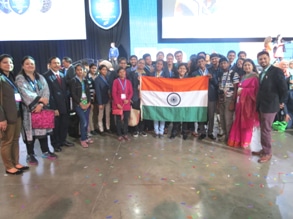
Indian InnovatorsSeventeen innovators from India has bagged five grand awards and six special awards at the Intel International Science and Engineering Fair (Intel ISEF). These young innovators represented team India at the Intel ISEF, which was held this year in Pittsburg Pennsylvania, USA in May 2015.

Arsh Shah Dilbagi from DAV Public School, Panipat won First Awards of $1000 and $500 from the American Intellectual Property Law Association and Patent and Trademark Office Society respectively. He was also awarded an Intel ISEF Third Grand Award of $1000 in the Embedded Systems category, and a Third Award of $500 from the American Psychological Association for the project, ‘Breath into Speech for the Disabled’.

Onkar Singh Gujral from La Martiniere for Boys School in Kolkata won a First Award of $1,000 from the Association for Computing Machinery, and an Intel ISEF Second Grand Award of $1,500 in the Systems Software category for his project ‘Image Processing Algorithms towards Optical Detection of 2D Nanomaterials’.

An Intel ISEF Third Grand Award of $1,000 went to Ravi Pradip from the Dayapuram Residential School in Kerala for his project ‘Plumeria Blooms for Organic Electronics!’ in the Materials Science category.

In the Plant Sciences category, Maharaja Agarsain Public School Delhi’s Mansi Aggarwal and Harshit Jindal received the Intel ISEF Fourth Grand Award of $500 for their project ‘Begonia nepalensis: An Effective Herbal Ointment against Enterobiasis.’ Also winning the Intel ISEF Fourth Grand Award of $500 were Aditya Bhargava and Komal S from Sharada Vidyanikethana Public School, Mangalore, for their Materials Science project ‘Highly Sensitive Nano-Ferrite for Detection of Carbon Monoxide in Air’.

“Intel believes young people are key to future innovation and that in order to confront the global challenges of tomorrow, we need students from all backgrounds to get involved in science, technology, engineering and math,” said Kumud Srinivasan, Intel India President. “We hope these winners will inspire other young people to pursue their interest in these fields and apply their curiosity, creativity and ingenuity to the common good.”

“We are extremely proud of this remarkable achievement by these young scientists from India. Their success at Intel ISEF is a celebration of the spirit of innovation and scientific inquiry that will bring relevant, practical and innovative solutions to social situations by intelligently leveraging technology,” said Dr. Rajiv Sharma, Executive Director, Indo-US Science & Technology Forum (IUSSTF).

“These young people are the future of India; and it is when they go beyond the boundaries of the country to explore their potential on the world stage that they truly gain exposure and experience and prove their mettle” said Dr. B P Singh, Head, NCSTC Department of Science and Technology (DST) Government of India.

This year’s Team India at Intel ISEF featured 20 bright students from the country- the winners of the Initiative for Research and Innovation in Science (IRIS) national fair 2014. This year Department of Science and Technology (DST) in association with Indo-US Science and Technology Forum (IUSSTF) sponsored 10 student observers from IRIS and affiliated national fairs to Pittsburgh USA, to attend the Intel ISEF and experience a week-long scientific exposure visit in Washington DC after the fair.


SC cancels the result of AIPMT paper leak

studentsAn organised gang has leaked the All India Pre-Medical Test paper held on May 3, 2015. Investigations are still on and the Supreme Court on Monday cancelled the results of the AIPMT following a month long investigation into allegations of large scale irregularities, leakage of answer keys.

According to the report, Rohtak Police has picked up 44 candidates who allegedly used electronic devices, including mobile phones to appear in the examination.

Police have registered the FIRs against three candidates from Jamshedpur district. Besides out of 41 candidates, 21 admitted having received answer keys. A notice to 20 more candidates have been sent by the Police.

The total number of candidates appeared for the examination are 44 out of which 15 appeared from Siliguri in West Bengal, 11 from Rohtak in Haryana, 4 from Ajmer in Rajasthan, 3 each in Delhi and Jamshedpur, one each in Shimla, Dehradun, Patna, Gurgaon,Chandigarh, Bhubaneswar, Bagdogra and Nagpur.

Rohtak police have got 358 suspected mobile numbers of the beneficiaries from different parts of the country. 166 numbers which were registered on genuine addresses. The verification of the remaining 148 numbers is still under process.

Telangana varsity moves to CBCS system

delhi-universityThe Choice Based Credit System, which has been given go-ahead by the University Grants Commission (UGC) at undergraduate and postgraduate levels, Telangana University Registrar R. Limbadri while interacting with the teachers on the reopening of the colleges after 45 days summer vacation, informed that the university will introduce the choice based credit system (CBCS) from the start of the session.

A simplified education system will enable the students to pursue courses of their choice and subject would be made available at the college of their choice through CBCS.

He has asked the teachers to present academic calendar and plan before to get the NAAC accreditation.

Students still waiting for admissions in Maharashtra schools

classroomStudents who desired to get admission through Right to Education (RTE) online admission process might have to wait for some more time as it is delayed because of a conflict between some schools and state government.

It is to be noted that the admissions under RTE are conducted through a lottery system by BMC, and the second phase of the lottery is still 15 days away.

The schools which are in conflict with the State government want to admit children under RTE quota to pre-primary classes, but the state government wants admissions to take place from the first standard.

Now, the matter is in the Bombay High Court and BMC has been asked to disclose how many children are yet to get admissions in schools, and how many schools have vacant seats under 25 per cent quota.

K Narayan, Secretary, Anudanit Shikshan Bachao Samiti met the Deputy Director of School Education to demand that the department should take action against those schools which has refused admissions to students under RTE.

DU students demand hostel accommodation

delhi-universityA group of students, alumni and teachers of Delhi University started a campaign demanding a right to accommodation for students coming from other states to study in Delhi University. The shortage of seats in hostels at the campus has stir another controversy among the students.

The inadequate availability of seats and absence of standardised rating system, the students and teachers are demanding implementation of Delhi Rent Control Act, 1995. At present the University has total 15 off-campus hostels and nine colleges with boarding facilities in the premises. Out of these nine only five colleges have accommodation for women.

According to the data, the University gives admission to nearly 54,000 students every year. On the contrary, there are only 9,000 seats available in the DU hostels for undergraduate and postgraduate students.

The protest on the right to accommodation has been going since last three years, but an increase in seats and implementation of Rent Control Act still remains the issue for students. Delhi University Teachers’ Association (DUTA) too has supported the movement and took the matter to HRD Ministry.

Microsoft named Pearson Vue Certified Practice Test Provider

pearson vue Microsoft has expanded its partnership with Pearson VUE by appointing it as the worldwide Microsoft Certified Practice Test Provider. Microsoft Official Practice Tests, powered by MeasureUp, provide candidates with critical, customised assessment and remediation tools, helping them gain confidence, master technical content, and make the best use of their certification preparation time.

“We are excited to partner with Pearson VUE as our worldwide Microsoft Certified Practice Test Provider,” said Alison Cunard, General Manager of Microsoft’s Learning Experiences group. “Our goal is to provide MCPs and candidates with a full solution from preparation to examination, and Pearson VUE’s portfolio of practice tests is an additional preparation tool to aid in their certification success.”

The MeasureUp practice test platform is recognized for its innovative use of simulation question types, comprehensive explanations, complete coverage of exam objectives and in-depth reporting. The practice test functionality provides candidates the opportunity to customize their experience so they can drill down to the exact areas where they are weakest, allowing them to maximise study effectiveness. In addition, MeasureUp’s recent technology updates allow users to enjoy the ease of studying using multiple devices — including their desktop, laptop, tablet or smart phone.

IIMK students developed mobile app to help police

image004Students from Indian Institute of Management Kozhikode (IIMK) has developed Spider, a new mobile application that can act as a communication bridge between Ernakulum Rural Police and the public. The app will be launched at Aluva on 13th March by the Minister of Home and Vigilance, Ramesh Chennithala.

The mobile app will be available on the android platform. One of the key features of this application is that the users can report the incidence of crime or violations of law by a single touch of a smartphone. The report would automatically contain the information of the location of the user.

The application also has provisions to add photographs, as evidence, if the users wish to do so. Another key feature of the application is that there is an option for checking the status of the petitions online by entering the appropriate petition number.

Users are also aided with emergency contact information of the Ernakulam Rural Police, which they can dial on a single touch. They can see important rules regarding traffic fines, regulations etc. in the application. Ernakulam Rural Police can reach the public with notifications and news items through this application, as well.

The application was developed as a part of the Social Development Project (SDP) of the Executive Post Graduate Program (EPGP) of Indian Institute of Management Kozhikode (IIMK). The project team was led by the Ernakulam Rural SP, Yathish Chandra GH IPS. It was mentored by Professor Satish Krishnan of IIMK. Professor Anubha Shekhar Sinha and Professor Priya Nair Rajeev of IIMK are the coordinators of the SDP programme. The team consisted of students of EPGP 2013-2015 batch of IIMK Kochi Campus viz. Antony TM, Banarji B, Geo Joe Mathew, Nirmal Sajo Thomas and Renjith Viswanath.

Smart ideas for smart education

Ashish KhareConsumer behaviour, advancement in content publishing, adoption of technological solutions in the education sector to make it smarter are driving significant changes in the education sector. And now with the focus on 100 smart cities, Wipro is all set to deliver smarter solutions for smart education in a smart city model. In an exclusive chat with Ashish Khare, General Manager and Business Head, System Integration Solution, Wipro, Bhawna Satsangi of Elets News Network (ENN) finds out the roadmap of the company developed for smart education

What will be the model of smart education in a smart city?

Education is a combination of two parts- one to enable educational institutes on a self-sustainability completely and include a smart education aspect, which includes smart classrooms, web-based education, online evaluation, enabling whole of the education process on smarter platforms.

The second part is making a campus smart which includes campus surveillance, campus Wi-Fi, campus network, working out the Real Time Location Services (RTLS) which is one of the important aspects of education. We have developed the solution for a women’s only institute in Saudi Arabia around four years back. In BITS Pilani, we have deployed RTLS solution in women’s hostel. There’s sensitivity involved and that’s the reason, security and access become an important part of educational institutes.

Another aspect is to enable overall curriculum and evolution system online. If these two things are taken care of then the overall education system can be taken care of. These days IIN is one of the talks but then what IIN teaches is a concept and if these are structured programmes it becomes a smart education. IIN is more of a web search. But better and organised way is that you have more structured sessions which are mass communication without the dependent on the quality of a teacher sitting in front of students. Today, the biggest issue in education in schools as well as in colleges is that education is dependent on the kind of professor or lecturer you have. By enabling these kinds of online sessions and facilitating that will help students.

But depending upon only on the online education will not fade away the traditional mode of teaching?

It’s always a mix. IIN might be okay from an understanding point of view but a proper education needs a moderator. You can always have an intervention from an expert from the report as a part of smart education but a moderator in front makes a huge difference especially in smaller classes.

What is the framework you have developed for the smart solutions for smart education?

This is the area where we work along with our ecosystem partners and one of them is Samsung. The focus is more on enabling technology part. Content is something which we are not focusing at present. While we have an e-learning application, which organise learning session for various people, also have evolution systems which are largely used within Wipro. We have 1,70,000 people and everyone has to go through certification process internally and that’s the qualification for people to continue in the job. As a process, it is anyway established and working. We do provide that platform but then the focus of Wipro is primarily enabling various technologies.

In your opinion how will smart city facilitate the education sector?

Smart cities are coming up with various themes. Especially on the green field, education is one good theme which is with the least risk. In the brownfield, it may not make a difference. Like Lavasa was initially considered as a leisure city but now they are trying to bring education institutes and that has actually changed the basis. The education is going to be good and easy enabler for greenfield cities or the upscale cities.

What opportunities does Wipro see while developing smart solutions for smarter education in a smart city?

Wipro plans to be a technology enabler and that’s why we will go in smart cities and many other educational institutes as an application. We deployed some solutions in Jindal Global School three years back but now looking at them there are various other universities which want similar solutions. Having a basic communication platform with internet enablement has become a base in most of the higher educational institutes. So, for us growth is in the education segment, from a smart education perspective is not limited to smart city institutes but also in other institutes. As a business company, we look at overall business and not just fixed to some 100 smart cities projects.

Are you also focusing tier 2 or 3 cities to deploy education solutions?

Yes, we are also deploying our education solutions in tier 2 and 3 cities. As an organisation, we are working for the smart campus as an initiative which will include educational institutes as a key driver. We will also work on smart refineries and smart manufacturing plants. Smart cities are one, the smart campus is another from a solution development perspective.

What are the features of smart campus?

The smart campus is basically a developing overall community in a smart campus. Most of the modules which come in a city they can easily be adapted in a smart campus because the environment is much more controlled and those cross-functional issues are not there. Today, India’s biggest problem in the smart city is that there is no single head. Municipality head is heading three verticals, for telecom there is somebody else, for electricity there’s someone else. In campuses, integrated solutions are easier to adopt. So, true smart city replica will actually come in smart campuses more or greenfield cities.

How does a smart school will play an important role in improving the physical performance of the smart city?

Smart education is a term which is related to basic opportunities available in a city. A smart education needs safety and security inside the campus, where you can monitor, surveillance, access to safety system within that building to make sure students are secure.

You can also use the network layer to get best of the knowledge and best of the data technology into your institutes. From an inclusion standpoint, the local concept within the smart city is not going to be relevant, what will be relevant is the smart education that child needs and the seats available in the school. All this can be integrated as a solution and can help in terms of better education.

A smart city is not a debate, it’s a reality today. And then you need to have this component in the smart city to cater to the needs of the people.

World Education Summit 2015

Skilling Youth, Skilling India

Come, be a part of the global knowledge sharing platform!

Nominate for Awards

Schools, Colleges , Universities , Government bodies and Corporates can nominate their Innovative practices , projects and products for World Education Awards 2015

Register as Delegate

If you want to join as a delegate to be a part of the conference to meet education leaders in school and Higher education, register here!

Join as Sponsor

Showcase your products and services to the right Audience in school, colleges and for skill development in education.

Who’s Who at World Education Summits

Education Policy Makers, Ministers, Secretaries

Vice Chancellors, Directors, Deans, Registrars and International Higher Education

Education Regulatory Bodies and Professional Association Representatives Education

School Principals, Key Management, Senior Functionaries and Global K-12 Representatives

Edupreneurs, Entrepreneurs, Private Equity Investors, Venture Capitalists

Education Technology Providers


Visit Website

Campus preparedness report 2015 highlights importance of technology

campusCampus Management, global provider of technology solutions for higher education sector worldwide has launched a Campus Preparedness Survey Report 2015 that highlights the state of campus preparedness for meeting out the goals and challenges of institutional advancement amidst emerging global trends in higher education.

Having done from the perspective of “From the Future – To the Future,” the report is an in-depth study of emerging global trends and something higher education is looking for at this critical juncture of national resurrection.

In terms of emerging global trends, the report highlights the emerging competition from various quarters, improving the student experience and employability (70 per cent) tops the list of concerns followed closely by the focus on attracting and retailing quality faculty (55 per cent), accessing research & consulting projects (51 per cent), accessing a broad base of students (46 per cent) and adding the potential employer base (36 per cent) complete the deck of key concerns and priorities when it comes to meeting out the global competition.

On the delivery front, Indian institutions agree the most on the need of curriculum optimization (58 per cent) followed closely by student engagement initiatives (51 per cent), flexible terms (39 per cent), on-ground hybrid & online learning models (39 per cent) and eventually non-traditional education (31per cent).

The key institutional outcomes as envisaged by the Indian institutions of higher learning can be classified into nine clusters dealing with diverse concepts & themes pertaining to Research (11), industry (5), faculty (4), curriculum (6), infrastructure (1), students (7), pedagogy (15), global (11), and interface & linkages (2).

GOALS & CHALLENGES

Further Effectiveness of Faculty- 85 per cent

Faculty is playing an eventual role in institutional advancement. Barring a paltry 15% of the institutions, institutions have a dominant priority to further faculty effectiveness. The core evaluation criteria for faculty induction remain the competency and propensity to teach, vetted by some 55% of the institutions; the stellar academic record appeal to 51% of them. A mere 17% of them deny the existence/ importance of tools for managing faculty operations. There is vivid range of opinions, structures & systems for faculty evaluation, counting to around to around 49 distinct concepts.

Improving Ranking- 78 per cent

The goal of Improving Institutional Ranking ranks quite high amongst the Indian Campuses. A mere 22 per cent of campuses feel that this goal does not exist in their priority. This simply implies 78 per cent of the Indian higher education campuses are marching towards creating elaborate datasets and ensuring their due analysis & presentation, which are critical in improving the well-established signalling factor of institutional report and performance.

Consolidating Infrastructure- 80 per cent

The evolutionary impressions pertaining to institutional infrastructure range from core academic ones to those beyond academics to diverse ones. Merely 20 per cent of the institutions do not accord any priority to the development and due management of physical infrastructure. A whopping 96 per cent of them claim that they have been able to optimally utilise and manage their existing infrastructure, while an impressive 81 per cent of them say that they do have some of a tracking and maintenance solution for their infrastructure development and maintenance. Infrastructure being the starter tangible asset for accentuating higher education which has been the key differentiator for long, make everyone feel to be in due control of the same. These high figures of excellence and optimisation in infrastructure somewhere suggest of that over-confidence.

Focus on Research- 78 per cent

When it comes to the dominant focus on research as a priority for institutional advancement, the experiences vary from getting defensive to utterly differentiate. A vast majority of institutions harbor the conventional viewpoints, while some have been able to initiate applied experiences with some of them embarking on a progressive tail. The Campus Preparedness survey could record 31 unique enunciations in the aforesaid clusters. A mere 22 per cent of the institutions deny according to substantial priority to research. 46 per cent of them are engaged in applied research, 34 per cent of them have quest in advanced themes while 20 per cent are inclined in appropriate research. Contrary to the traditional critique of Indian Scholarship evading from elaborate documentation, 94 per cent have recognised the importance of documentation and 50 per cent of them are attempting to have an automated information flow & ecosystem to document the entire research life-cycles.

Adopting Information Technology- 74 per cent

The role and importance of technology in meeting out the various goals and challenges of institutional advancement has been unequivocally accepted by institutions of all genre in all zones. 74 per cent of the institutions have accepted it to increase their operational efficiency. However, the vivid views range from those of sheer admittance to application to impact as well as off the mark ones. The preference for a One Time Capex on Technology infrastructure investments supersedes those of recurring opex and capex one. Institutions have more preference for a Build and Buy mode rather than a simple pick up one for technological adoption. The section on IT further delves into this interesting emerging quest of India’s higher education.

Enhancing Placements- 73 per cent

The Indian higher education landscape is dotted with as many as 59 key strategies and methodologies for ensuring due placements for their students. All these emanate from the perspective of structure, process or focus. A mere 7 per cent of the Indian campuses consider that enhancing placements is not a dominant priority. The use of IT tools in managing this diverse activity is gaining prominence at all levels whereby as many as 42 per cent of them are using some or the other type of CRM tool. An impressive 41 per cent of them are in the process of fully adopting and relying on hierarchical online dashboards to monitor and supervise this multi-stakeholder activity.

Institutional Outreach- 65 per cent

In an increasingly interconnected global order, institutions are adopting a myriad mix of means to reach out to the prospective students. From the various means of information dissemination to those of engaged interactions to long lasting engagement programmes, every innovation is being tried and tested. The Campus Preparedness Survey documents 28 such means. Interesting, only 65 per cent of them seem to the inclined in furthering their institutional outreach. May be, they didn’t want to explicitly come on record as this smacks of the taboo of commercialisation of higher education, or may be the institutions have evolved to some unprecedented levels. 43 per cent of them still prefer to spend on print media closely followed by electronic (32 per cent). Encouragingly online and social has captured the attention of 57 per cent of institutions. Despite the huge visual clutter across Indian cities and towns of bill boards and hoardings, they have reduced inclination of a mere 10 per cent of the institutions.

Operational Efficiency- 57 per cent

With as many as 20 constructs defining the top level decision making stakeholders at various institutions, 57 per cent of them consider it worthwhile to focus their attention towards enhancing operational efficiency to reduce costs. E-mail has found a whooping acceptance in 73 per cent institutions for internal reporting with a sizeable 45 per cent of them still continuing with manual paper based ones. 73 per cent are gearing up to adopt some kind of software and an online dashboard for this purpose.

Revenue Growth- 55 per cent

The inherent dichotomy of the Indian mind to accept the dominant material realities of the day get duly pronounced when a significant 45 per cent of the institutions of higher education claim that the priority for catapulting institutional growth in terms of revenue does not exist at their institution. From introducing multi-disciplinary campuses (55 per cent) to consulting projects (36 per cent) to setting up campuses in multiple geographies (30 per cent) to alumni endowments (29 per cent) to qualifying for various governmental schemes (28 per cent) to adding dimensions (26 per cent) to exploring research grants (25 per cent), institutions are exploring all modes of enhancing their revenue growth.


LATEST NEWS