Home Blog Page 842

Mission Entrepreneurship

Dr Prachi Gharpure

Dr Prachi GharpureDr Prachi Gharpure, Principal, Bharatiya Vidya Bhavan Sardar Patel Institute of Technology (S.P.I.T), Mumbai, believes that there is sufficient demand for quality engineers

Institutes across the world are coming up with new ways of imparting education.How are you bringing innovation in pedagogy at your institute?

Our primary pedagogy is still classroom teaching but we are trying to use alternate pedagogy for relevant courses such as making use of project based laboratories for computer and electronics subjects. We are also using outside class experience such as “speakers club” for enhancing communication skills. We put students into industry projects right from second year by through our tie ups with several start-ups. We also conduct workshops for circuit design and build for electronics and telecommunication students for skill enhancement.

How important is to have a strong academia-industry linkage for an engineering institute and how it is beneficial to the students?

It is very important to have a sustain-able strong and live linkage with industry. At S.P.I.T we implement this in two ways. First is using the summer internship programme. Although we are still an affiliated college and hence have constrains of university schedule but we have a very vibrant summer intern-ship culture and companies like Micro-soft, Credit Susie, Barkley, JP Morgan, Siemens recruit interns from our college. Secondly, through IIIC initiatives at S.P.I.T we have created an Industry Interaction Laboratory in college where students who intern for start-ups work during not only summer but on all weekends too.

Please share some of the unique initiatives taken by your institutes?How can the gap between industry and academia be bridged?

We have the following initiatives that make us unique.Technology Business Incubator (SP TBI): S.P.I.T‘s mission statement is to promote entrepreneurship and true to the mission we have been running a Business Incubator since 2009. The biggest advantage of such in campus initiative is that we are slowly building a culture of entrepreneur thinking amongst our students. They not only get to interact with budding entrepreneurs on daily basis but also get an opportunity to work with them.

We keenly encourage our students for participating in project (Texas Instrument) competition, coding competition (Amezon, IEEE Extream, ROBOCON)

Strong Student Teacher Connect: We run a unique initiative of offering Teaching Assistantship (TA) to bright students. These TA’s conduct practice sessions for the junior classes.

India may get the full-fledged membership status of the Washington Accord by June, enabling global recognition of Indian degrees and improving mobility of students and engineers. In your opinion, how it is going to help Indian students and engineering education system?

If taken positively, it will pave way for student exchange with credit transfer for many autonomous institutes and private universities. Our UG degree being recognised for international jobs (currently only IIT degree is recognised) will open doors for global placements.

BHARTIYA VIDYA BHAVAN SARDAR PATEL INSTITUTE UNDERSTANDS WELL THE IMPORTNACE OF INCUBATION

What is the importance of an incubation centre and tells us about your plans to install one?

The importance of these centres is tremendous. We understood this and are running an incubator since 2009. We will establish a DST funded incubator shortly. S.P.I.T’s mission statement is to promote entrepreneurship and true to the mission we have been running a business incubator since 2009. The biggest advantage of such in campus initiative is that we are slowly building a culture of entrepreneur thinking amongst our students. They not only get to inter-act with budding entrepreneurs on daily basis but also get an opportunity to work with them.

Students complain that most engineering institutes pay more attention towards imparting theoretical knowledge rather than giving practical assignments. Has this trend changed in the last few years?

This trend has not changed much in affiliated colleges so far.

How has been your college’s placement in recent years? Do you think there is sufficient demand in the industry for the engineering graduates?

There is sufficient demand for quality engineers. Our placement has been excellent always with above 90 per cent and almost all the placed students get multiple offers. There is enough demand for all the colleges imparting quality education. But the frenzied recruitment trend seen in year 2002-2006 has died and now recruiters are very selective about whom to recruit.

What are the new engineering courses becoming popular?

In new engineering programme – Mecatronics seems to be gaining popularity.

What is your policy expectation from the Government?

One of the most harassing aspect of policies is they change as soon as government or officer in-charge changes. Rarely a long term thought is being given. We in Maharashtra for example are still playing with admission policies for last several years. Also the regulatory authorities, be it in managing approvals, admissions , fees and the university do not work in tandem. This often creates a situation where we find exactly opposing requirements from these authorities.

In India, there are multiple agencies which look into the accreditation but majority of them have failed to bring quality. In your opinion, does accreditation perse helps in enhancing the quality of education?

If accreditation is taken only as a process then it does not help but if it is adapted as life style (which involves mindset change) then it helps because it makes us create processes and mechanisms for quality and quality control of every aspect of education. This could be in teaching learning or in transparency in administration.

Please share your institute’s expansion plans in the coming years? What are the challenges, which you face nowadays?

We have no expansion plans currently at Undergraduate level. But we will surely like to initiate sharply focused PG programmes once we become autonomous. The major challenges are faculty readiness for such an initiative as any such PG programmes will be very closely associated with industry and faculty will have to continuously adapt and evolve to cope with the fast pace of changes that will feature.

Making Technocrats Industry Ready

BDCET IS BRINGING INNOVATIONS TO ITS PEDAGOGY WITH APPLICATION-BASED EDUCATION

Dr Shri ram Roy, Principal, Black Diamond College of Engineering and Technology(BDCET) shares insights with Elets News Network (ENN) on the institute’s efforts to bridge the skills gap

Please share some of the unique initiatives taken by your institutes?How can the gap between industry and academia be bridged?

We have been giving our students practical insight by exposing the students into the work environment of industries there by transforming the classroom conversation and theoretical. The local industries at the nadir of Jharsugudas how their earnest enthusiasm in this regard by educating the technical students. This theoretical-cum-felt teaching bridges the gap between industry and academia and bolsters the coherent lines of thinking and inquiry. This relationship-building dynamics will optimise technical competence of the students within the context of problem-faced and problem-solved industrial surroundings.

Students complain most engineering institutes pay more attention towards imparting the oretical knowledge rather than giving practical assignments. Has this trend changed in the last few years?

Institutes present today feel the urgency of practically moulded learning. Further, it is seen that the industries are taking initiatives to make the engineering students industry ready. The institute-industry interaction programme is taking acceleration but the pace requires momentum.

Institute across the world are coming up with new ways of imparting education. How are you bringing innovation in pedagogy at your institute?

Dynamics of learning mechanism in technical education has undergone significant transformation. From teacher-centric system to learner-centric one,from chalk and talk method to online based method of teaching. Keep ingrhythm with changing learning, BDCET is bringing innovations to its pedagogy with measures like application based education by interacting with industry and training institute closely to reduce the gap between theory and practice.The industrial exposure with subjective expertise makes the future technocrats industry ready. We also use face-to-face and online blended education to assist learners to develop the best mix of empirical/factual and theoretical/ conceptual learning. At BDCET students are provided online cum classroom teaching enhancing their knowledge and skills.

How important is to have a strong academia-industry linkage for an engineering institute and how it is beneficial to the students?

The urgency to have a strong academic-industry linkage for an engineering institute is more than ever. The mismatch between the two brings imbalances inhuman resource allocation – as there is seen difference in holding a certificate and doing a job. The mutual tie-up can blur the boundary between the oretical knowledge and practical skills and having positive implications for developing old academic-vocational divides.

India may get the full-fl edged membership status of the Washington Accord by June, enabling global recognition of India degrees and improving mobility of students and engineers. In your opinion, how it is going to help Indian students and engineering education system?

Getting full-fledged membership in Washington Accord is a milestone prospect for the country. It will facilitate mobility and international exposure to Indian students. But only some reputed colleges like IITs will benefit from the status because of the stringent criterion of Washington Accord.

What is the importance of an incubation centre and tells us about your plans to install one?

It aims to attract students to develop their entrepreneurial skills. The centreen courages students to develop new ideas and innovative products. The centre also mobilises resources for product designing and undertakes feasibility study on commercial ventures for the products. BDCET is planning to install one incubation centre in near future.

How has been your college’s placement in recent years? Do you think there is sufficient demand in the industry for the engineering graduates?

Every year from our institute, more than40% per cent students are placed in the industry through the college placement programme. To inculcate the industrial skill set, the college trains students from the second year. The basic branches such as civil, electrical and mechanical are in good demand.

What are the new engineering courses, which are be coming popular?

Now-a-days engineering courses like Design and manufacturing Engineering, Biomedical Engineering, Agri Environmental Economics Engineering, Civil Engineering and Mechatronics Engineering are becoming popular.

Dr Shriram RoyIn India, there are multi pleagencies which look into the accreditation,but majority of them have failed to bring quality.In your opinion, does accreditation perse help in enhancing the quality of education?

Accreditation is synonymous with quality enhancement, quality assurance and quality enrichment. Accreditation, to a great extent, leads to infrastructural standard, laboratory installation, inter-net connectivity and pedagogical improvement. The National Accreditation Regulatory Authority (NARA) seeks to make it mandatory for higher technical educational institutes to be accredited by NAAC and NBA.

Please share your institute’s ex-pansion plans in the coming years?What are the challenges, which you face nowadays?

We are preparing for NAAC & NBA Accreditation during the Year 2015-16and then will plan to add M-tech and MBA Courses from 2016 onwards.

What is your policy expectationfrom the government?

The government should take steps tobring curriculum modifications keeping pace with international standards. Syllabus that is taught in technical education is static and it needs updating and should be dynamic.

Incubation Centre could be a Milestone

Dr Harish MittalDr Harish Mittal, Director-Principal, Sat Priya School of Engineering, Rohtak, shares his views with Elets News Network (ENN) on the innovation and initiatives that make his Engineering institute stand apart

Institutes across the world are coming up with new ways of imparting education. How are you bringing innovation in pedagogy at your institute?In the light of changing needs in education system and developments in the global educational landscape, we recognise our crucial responsibility in developing teachers for 21 st century education. We need to focus on developing and motivating teachers for new ways of learning, especially for laboratories and workshops. There is emphasis on making students industry ready by using traditional as well as taking aids of e-learning, virtual classrooms and virtual labs.

How important is to have a strong academia-industry linkage for an engineering institute and how it is beneficial to the students?

More than 90% of students graduating from the institutes are not industry ready, which is the cause of major unemployment. A strong academia industry linkage will help the students and faculty to understand the requirements of industry and also motivate students to be industry ready.

SAT PRIYA SCHOOL OF ENGINEERING FOCUSES ON THE QUALITIES AND SKILLS OF ENGINEERING GRADUATES
SAT PRIYA SCHOOL OF ENGINEERING FOCUSES ON THE
QUALITIES AND SKILLS OF ENGINEERING GRADUATES

Please share some of the unique initiatives taken by your institutes?How can the gap between industry and academia be bridged?

There is a need for the academia and industry to work together to push the boundaries and form a powerful team capable of driving innovation and economic growth. There is also a need for more open communication and association between industry and academia to understand and address the qualities &skills of engineering graduates. The efforts need to expand from research labs into the classroom. Universities and MHRD may play a major role in this regard by allocating funds and taking strong initiatives (implementation needs to be on ground level not for only putting data)for skill development and specially making examination system including practical examinations realistic. I also suggest there should be video recording of all practical examinations in engineering curriculum. We are making efforts towards creating some collaborative programme with industry to train the students and make them aware of industry changing requirements. We also make use of e-learning recourses like virtual classrooms, virtual labs,open source initiatives taken by NPTE Land IITs to groom the students. We also emphasize on research initiatives by holding International level Conferences on recent topics of engineering in order to promote research ideas from last five years.

SATPRIYASCHOOLOFENGINEERINGHow has been your college’s placement in recent years? Do you think there is sufficient demand in the industry for the engineering graduates?

Overall placements scenario in our institute is good enough. However, I believe there has been a drop in packages being offered and also in the number of vacancies in the industry.

What are the new engineering courses becoming popular?

In recent years trends shows some common branches like Civil Engineering,Computer Engineering, Mechanical Engineering, Chemical Engineering and Petroleum Engineering.Some new branches are also coming up like Aerospace Engineering that are becoming popular

Please share your institute’s expansion plans in the coming years? What are the challenges,which you face nowadays?

We are planning to stress on quality education and skill enhancements to make students more and more industry ready.The major challenge we feel is lack of proper awareness at entry level i.e. for graduating students from 12 th level in choosing right course and lack of dedications and enthusiasm in students which is prevailing these days.

Students complain that most engineering institutes pay more attention towards imparting the oretical knowledge rather than giving practical assignments. Has this trend changed in the last few years?

Yes, this is due to our stereotype system adopted by universities for examinations. This has had a reciprocating effect on their skills and consequent employment.

India may get the full-fledged membership status of the Washington Ac-cord by June, enabling global recognition of Indian degrees and improving mobility of students and engineers. In your opinion, how it is going to help Indian students and engineering education system?

This will be an advantage and will definitely help Indian student. How ever, at the same time I believe that our educational system (especially examination system) needs to undergo an extreme change.

What is the importance of an incubation centre and tells us about your plans to install one?

Incubation centre could be a millstone in making students industry ready.

What is your policy expectation from the Government?

Government should take initiatives at various levels like:

  • Policies for making proper awareness for entry level students i.e.graduating students from 12 th level specially to clarify myths.
  • Streamlining admission policies and process.
  • Make clear policies for academia industry collaborations and arrange adequate funding for government as well as private institutes.
  • Making practical and unambiguous polices towards regulations of engineering education.
  • Make Examination system stronger especially for practical assignments.

Nurturing Creative Minds

With a keen focus on holistic education ARK Infosolutions has designed MindBox- an education programme, to develop and expand the creative and life skills of students along with making subjects easy and interesting for them. Nehal Joshi, Curriculum Head, ARK Infosolutions talks to Elets News Network (ENN) about the concept behind Mindbox and how the programme is helping students to enhance their creative sensibilities in the field of robotics, 3D animation, game development and digital painting.

Creative-Minds

Could you share some insights on MindBox Education programme designed for K-12 level?

The concept of Mindbox started from a philosophy we believe in that every student has a different mind, different way of doing work and different way of understanding the subject. Some might be good at academics while others at sports, so there is diversity. Hence we feel that visual language is the medium to connect to different minds and also the strongest means of communication.

We see as a gap among students as they are being given information through various texts. There is an input and no output. Is he able to communicate in same language? Not necessary,and that’s the gap we bridge in. We teach them thinking as a subject and visual communication as a language. Our initiative gives 360 degree solutions in the area of creativity for K-12 level. The programme offers courses in Robotics,3D animation, game development, digital painting, digital photography, digital videography, computer aided design,and digital illustrations.

How does this programme work?Does the programme differ at different level of classes as it caters from classes I to XII?

The programme is divided into grade wise pattern right from first grade till 12th grade. We mapped different programmes for students, which has been designed based on thinking as a subject and visual communication asa language. At MindBox we are giving them the direction, teaching them how to think through various creative subjects. The curriculum promotes interactive learning and help them in engaging through hands on, project based learning.

A STUDENT WORKING ON MINDBOX TECHNOLOGY

We conduct programmes on animation,graphic etc. and teach them how to think of an idea, visualise that idea and how to put them in reality. This helps them in understanding the subject and develops the interest with a logical explanation. Through this endeavour we are helping the schools to make their children future ready.

How does the programme helps in realising their full potential?

 We help them develop their thinking,reach their full potential through our creative programmes designed keeping in mind the course and interest of the students. We prepare them for futurecreative opportunities and help them understand the nitty-gritty of the subject to develop a model on the same.The instructors at MindBox help each student on how particular industry works and through the technological tools how you can add value to the subject.

A STUDENT’S PROJECT CREATING A REPLICA OF DIGITAL WATCH

What is the duration of the programme?

The programme runs for 30 weeks which happens once a week in school with a particular batch of students.

Is there any training the teacher has to go through to make children understand the concept?

We have our own trainer who teaches the students. We come with the industry expertise. We have a research and development department, managers, subject manager who develop the content.When we work with schools we map these programmes to a particular grade.We assign a trainer to the school who takes those classes whom is first trained in-house. We also have cloud based software through which each and every lesson that happens inside the school is given to the trainer and he goes and delivers that. We ensure that our lessons and content is being taught to the students.We also have assessment system to assess the performance of the student.

What is the criterion to assess the student?

We have an online assessment module which is similar to CCE. We assess the student not only on the project you give but we also do quiz, presentations,and have worksheets to be completed by them. There are three ways of assessment one the practical work they do, second the worksheets, third is the A STUDENT’S PROJECT CREATING A REPLICA OF DIGITAL WATCH trainer’s feedback of the student.


Turning the Tide

Prithvijit Roy CEO, BRIDGEi2i

The presence of Big Data in education is helping the sector in finding out the bottlenecks and working upon to improve the dropout rates and other challenges. In an exclusive chat with Elets News Network (ENN), Prithvijit Roy, CEO, BRIDGEi2i Analytics Solutions tells about the positive role of Big Data in education.

What is the role of Big Data in changing the education system?

State’s structural changes in the economy and society have a direct influence on the education system. Even the numbers suggest that the quality of education and across institutions has become a point of major concern. The capacity of the state to finance education, possibilities of driving inclusivity and multidisciplinary approach to education and alternate modes of financing have become an important issues. Nowadays, inmost countries, the share of education in the state’s budget has reached an alltime low resulting in limited resources to drive change. Now, this calls for a judicious usage of resources.

Analytic has addressed this problem for businesses over the years. Now, the dynamic scenario in education sector and the overload of data has made the whole industry to look up to big data in conjunction with analytics. I strongly believe that this problem of scare resource in the field of education can be tackled with the help of Big Data. In a word, it can be the potential savior. It is the right data which needs to be used to draw the insights and deliver impact for education.

We know that big data is a tool to drive innovation in education and that teacher quality impacts student achievement. How can we use big data to improve teacher quality with the ultimate goal of increasing student achievement?

Improving teacher quality can be a great way improving the achievement. There are two aspects to improving quality of teachers, one would be to hire the right type of teachers and the other would be to equip them with right type of tools and help them with right intervention points to create the difference that we are looking at. For a global education company, we analyzed the reasons behind teacher attrition using key driver analysis and identified trigger points to improve the same.

As far as hiring is considered, Big Data is being extensively used today. Gone are the days when hiring was based on grade-point averages, work history and degrees.Now the world as such is moving towards innovative methods including evaluating a candidate based on happiness level and how well a person interacts with others.On the other hand, if a teacher is provided with information on who has potential of dropping out or identify the groups that have a potential of scoring low than an intervention could potentially eliminate the shortcoming thereby resulting in increased student achievement levels.

What are the benefits of adopting big data at University level? Will changes related to Big Data come fast to institutions?

Big data can play a huge role in education industry but the top three would be predicting and preventing dropouts in university, scoring and grading, personalized and adaptive learning.

We saw this for a Global University where using the student demographics and past performance data, we could analyse and predict dropout percentages and help teachers develop better understanding of student success metrics.

Prithvijit Roy CEO, BRIDGEi2i
Prithvijit Roy
CEO, BRIDGEi2i

What is the rate of adoption of big data in education? What are there medial measures to be taken?

Recent studies say that 70 per cent of enterprise organization have either deployed or are planning to deploy big-data related projects and programme. As far as education sector is concerned,there seems to be an increased adoption of data to provide more personalized education and measure the impact of education provided. For example, the recent advent of MOOC’s (define) has resulted in the increase usage of big data technologies.And you can also evidently see that in the increasing trend towards the usage of online education portals.

What is the special nature of Big Data in Higher education context?

The question is not about Big Data alone.Adoption of relevant and right data is the main question facing the education sector. Such data could include enrollment patterns, student demographics,student performance and dropout rates.


MAP & Grow Faster

Dr. Jayaprakash Founder and VP, Nanobi Data and Analytics

To allow institutions to study the patterns of performance of students, quality of teachers and map it easily,Big Data can help in leveraging the positive feedback feels Dr. Jayaprakash, Co-founder and VP, Nanobi Data and Analytics

What is the role of Big Data in changing the education system?

Education has always been viewed as a system that helps the students to create a ‘bent of mind.’ For example a chemical engineer after graduation need not get employed in chemical engineering industry but as a software developer. This is done based on the assumption that the student will cope-up with software coding learning and unlearning chemical engineering. With the growth of big data, the changes are arriving. Students are getting exposures to various updates on industries, opportunities, their interest levels, success and failure stories of a course and opportunities etc.

Such changes give rise to two important changes (a) Dynamism in changing the syllabus according to the changing patterns (b) Improvements in the teaching quality with updated contents than obsolete contents.

We know that Big Data is a tool to drive innovation in education and that teacher quality impacts student achievement. So how can we use Big Data to improve teacher quality with the ultimate goal of increasing student achievement?

The quality of the teacher always depends upon the continuous learning of the teachers. Channelising the required information and updates to the teachers can improve the student achievement.For example, lot of curated public data is available on various segments like health, education etc. and many of them are available for free. In those days,teachers used to refer only the research papers that was published in the past and teach based on the research outcomes.Curated public data enables the teachers with updated information on a specific subject on daily basis with trending patterns.

Similarly techniques like sentimental analysis, word counts enable text mining with more accuracies so that even non-numeric data can also be analysed quickly to provide more information.Teachers when they teach the students and guide them the ways to follow a specific trend can trigger lot of brainstorming sessions among students and create many sparks and solutions.

What are the benefits of adopting Big Data at University level? Will changes related to Big Data come fast to institutions?

Benefits of the technology are reduced drop outs, improvised knowledge for both teachers and students, platform to compare, map the gaps and grow faster,and pose as trendy and updated geeks.

Many leading universities have started work on Big Data, some have started using predictive models and solving some challenges. Such predictive models use both data from college systems and also external data. When more success stories emerge from such universities with one of the reason could be Big Data adoption, many institutions are likely to follow them creating a big market for Big Data.

Dr. Jayaprakash Founder and VP, Nanobi Data and Analytics
Dr. Jayaprakash
Co-founder and VP, Nanobi Data
and Analytics

What is the rate of adopting Big Data in education?

Currently, the rate of adoption is very low. The challenge that I foresee is because of two factors (a) Key decision makers are busy with their regular activities and not finding time to think about it (b) Even if some decision makers want to know and implement, there are lot of confusions about the implementation time frame, budget constraints,adoption level, resistance to adopt etc.

What is the challenge that you see amongst the teachers?

There can be reluctance in getting trained on Big Data Analytics as many a times the teachers have heaps of regular work. The solution to this is to provide the analytics as a mobile app with simple learning curve.

What are your suggestions for predictive models?

Tools have emerged wherein even non-statistical background person can run statistical models on click of the button.Education sector is the best to leverage upon such initiatives.

Big DATA Better LEARNING

Big-DataBig Data can play a crucial role in deciding the core focus of the education sector in the country by providing pointed insights and charting an illustrious path of growth.Bhawna Satsangi digs out the scope of Big Data in education

Change is the only constant factor and that holds true for even in the way education is imparted and that is evident from the ICT initiatives being taken by the education ministry. There interest of using technology is increasing in the institutions and especially in the higher education. One such technology that is leveraging the education arena is Big Data which is helping to improve the performance of the students and raise teachers’ effectiveness, find out reasons for failure, drop outs and much more.

From an education perspective there is a change in a way education is imparted and there are multiple channels that have come in for a holistic approach in education. Today, there is better interaction happening through internet technology and these tools are also driving huge amount of content. With econtent coming in also brings up huge opportunity.

“Technology has a big role to play in education and is important for developing world for an aspiring population and economic prosperity. Traditional education is struggling to provide quality education when it comes to teachers-there is a huge gap and challenge.

Technology can amplify and manage role of teachers. Big Data is a small part of technology and is a specialised area.It refers to fact that explosion of internet of mobile devices created volume of data everyday and this can be used to improve education system. This can help us to make use of scarce resources in most appropriate way to get maximum number of benefit,” explains Udai Singh, President, NIIT Limited.

From the education perspective,how education is being imparted is the area to look upon. Multiple channels have come in e-learning process. There is completely off classroom training programme, there is a better interaction happening through internet technology.It is a supplementary part of a revolution or using internet technologies to deliver a complete course. The moment improvement happen in content and e-content comes in, also gives huge opportunity.

“We need to find out the weakness of the students and analytics can actually evaluate the assignment given to the students based on the responses given by them. The teacher can evaluate how he has performed, how much he has understand, etc. So Big Data is away of implementing analytics that can help to improve the quality of education imparted,” essays Somenath Nag,Director, ISV and Enterprise Solutions,Alten Calsoft.

Value addition

Emphasising on the value addition that Big Data technology brings with it for identifying the problems and its solutions at school level, Santanu Paul, CEOand Managing Director, TalentSprint opines, “It is imperative that educational institutions start paying attention to both collection and analysis of data that has been collected over the past years. A big data analysis could help schools, educators and policy makers get a better handle of not just how to teach but how students would like learn and other related issues playing in the minds of educators – right from getting better attendance at low income group schools and controlling school dropout rates. Analysis of large data can give insights on students, their ability to learn as compared to many factors such as gender, socio-economic group, ethnicity,and even location and culture. This analysis could help create the right incentives for educators, students, parents and other stakeholders to develop the requisite skills in students.”

Market estimation

As the data we generate every micro second grows and accelerates at a rapid velocity, the requirement for making a business decision is shifting from hindsight-based decision making to a foresight-based approach. Companies are banking upon Big Data and analytics.According to an industry report by NASSCOM – in partnership with Blue-Ocean Market Intelligence, the analytics market in India could more than double from the current $1 billion to $2.3 billion by the end of 2017-18.

Technology and result oriented services are thought to be engines of growth across the industry. In education we are starved with data and are comfortable with the fact that we can be data starved but actually it is not possible to survive without data. It is important to have data that allows us to update, change in real time and that’s the power of Big Data. If we have enough data to use it we can actually make changes, recommendations,when it’s meaningful.

Educationists need Big Data to guide their decision making process. Utilisation of the data available, acquisition of analytic capacity to use the growing data, public demand for better evidence for programme impact will drive the increased use of Big Data to empower schools to make data-driven decisions.

Qualitative achievement

No doubt, that big data is driving innovations in education. Researchers too are focusing the connection between teacher quality and student achievement.As put by Shankar Murukutla,Sales Director, South Asia and India,MapR Technologies, “There are two methods to drive innovations and that teacher quality impact student achievement is consistent upgrading of skills like any knowledge base. More and more information keeps up to date. Secondly,the ability to centrally or regionally to study a vast number of students and figure out what is working and what not.Then there is another way particularly with computers, we can monitor the keystrokes and teacher can study their pattern and make out how they are learning. Through this activity teachers can take a corrective action.”

L. Ashok, Managing Director, Future net Technologies says,“Big data coupled with analytics will provide lot of insight in quality of teacher to students’ performance. For example this will also open avenues to do research and deliver lectures in multimedia depends on the type of students.”

There is a need to define a benchmark while giving training, refined teaching experience which only comes when a child is evaluated on the performance.Through innovative teaching teachers can improve students’ performance,identify the need of the student and develop the content accordingly.

“Even before we start using big data insights to improve teacher quality and there by student achievement, the primary challenge in India’s current educations cenario is the absence of data.Tracking teacher’s performance and background on various parameters and mapping them to student outcome on an ongoing basis can give deep insights in terms of impact of teaching style, expertise etc on the student performance.Data collection therefore needs to be the first order of business before we get to the level where we have enough data coming rapidly to label it as big data,” explains Paul.

He further sites with an example, we all know that there are high dropout rates among Indian students, especially in government schools. Do we acknowledge that there is also high absenteeism among teachers in these schools? What is the correlation between teacher absenteeism and student dropout rates?Does the former cause conditions for the latter?

Similarly, does presence of toilets reduce dropouts in secondary schools? To what extent do mid-day meals improve student achievement? Do schools with more computer density achieve more academic success? These kinds of questions can be answered once we are able to capture and analyze the big data buried within the education system.

Better-LearningBenefits

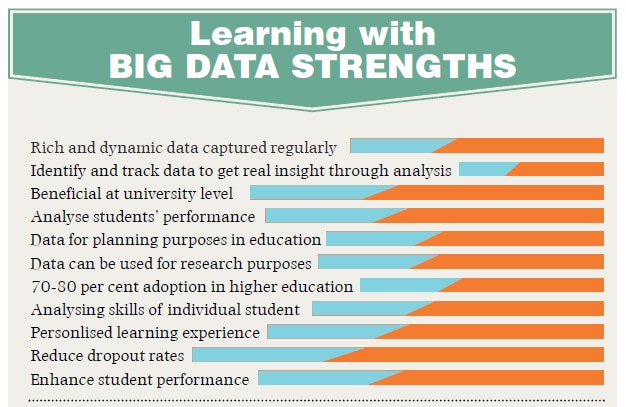
Currently, the big data scenario in India’s educational institutions is not mature enough to harness the power of Big Data, therefore it is hard to say how fast educational institutions will adopt it. Big data can only be helpful if there is rich and dynamic data being captured regularly to qualify as Big Data. Institutions have the task to first identify the kind of data points that they need to track and then put together a process to track and collect a large volumes of data to get real insights through analysis.

As Somnath believes in Big Data might not be used at the K-12 level but it is beneficial for using at the University level. There is a huge cultural difference across the length and breadth of the country. Open universities initiated online courses and using Big Data to analyse students’ performance. Analysing big volume of data and using that data for planning purposes in education sector is the need of the hour.

Universities can benefit more from its many applications. The massive open online courses that are available in plenty, has opened doors for universities to access that data which will provide greater insights into college operations.The data can be used for research purposes at the PHD level. There is an adoption of approximately 70-80 percent at the University level and just 10 percent at the school level.

Big Data will also play a vital role in academic and sports performance of students, professors/teachers’ performance over a period of time. The tool can be used for analysing the skills of an individual student at a macro level and create a personalised learning experience to meet his specific needs.

The analytic tools can help the teachers to see how the student is performing on a particular assignment given. Anin-depth analysis can be done like the amount of time student took to write the answers, how much he understood the assignment, what are his weakness and strengths.

“Any data if analysed carefully and thoroughly has the ability to surprise one with extremely insightful information.The data regarding education has the power to help policy makers take some impactful decision regarding the entire ecosystem of education – syllabus,content, pedagogy, style of teaching, use of digital platforms for teaching etc,”adds Paul.

By enhancing the learning experience of the students at every level, it will reduce the dropout rates at the school and university level and improve their performance.

Security- Big concern

Despite having many benefits of using big data in education the most pressing issue that is being discussed and debated is the security of the data, increasing potential of technologies to make learning popular online.

The huge amount of data that is generating everyday has made it a challenge for education sector to keep abreast of it and use it to the maximum benefit- reasons the computers do not have the capacity to handle large volumes of data.While the network may be fast, the applications can’t keep up. A cognitive computing system could help address this problem.
learning-strengths

Opportunities

  • Transforming learning process
  • Massive amount of information available
  • Learning analytics and educational data mining
  • Analysis of education related data
  • Cost effective
  • Improve overall educational outcomes

Teacher quality = Student achievement

  • Consistent upgrading of skills
  • More and more information keeps upto date
  • Ability to centrally study a vast number of students
  • Figure out what is working and what not
  • Innovative teaching
  • Impact of teaching style

Opportunities a plenty

Using Big Data in education has the power of transforming the learning process. Technology allows to capture the massive amount of information. In education there is a vast amount of data flowing. Online courses like MOOCs have helped in generating a huge amount of data which can be used for the benefit of education sector.

New academic disciplines like learning analytics and educational data mining are emerging to make sense of big data in education. Online teaching to use Big Data reforms education delivery and enhance learning. Online courses gives a personalised experience to learners, create communities to practice,standardization of learning, greater flexibility in the system, and lower dropout rates.

The value of the insights harnessed through analysis of education related data will more than justify the costs involved for such an exercise. For example,it may appear anecdotally that girl students are outperforming boys in certain academic and competitive exams. It may also appear that students from Manipur get more medical seats and win more Olympic sports medals, for the same per capita investment in education.

If such big data can be deeply analysed and validated, such insights would make a strong case for proactive public policy making that can improve overall educational outcomes with existing resources.Instead of one size fits all, there can be a more nuanced and fine tuned approach to public investments in education.


Harbingers of change

India’s demographic dividend has the power to drive the growth of the country and also be the key engine to fuel global growth. However the vast talent pool of the country suffers from either not having the skills to be employable or having an inefficient market place for jobs. The issue of employ ability will determine in the coming times whether India will experience a demographic dividend or a demographic nightmare.

The government is playing its part as it announced the budget proposal to launch a National Skills Mission to create more job-ready youth in the country. The mission will work through the Skill Development and Entrepreneurship Ministry and aims to consolidate skill initiatives spread across several ministries. Also, with the establishment of National Skills University in Raipur, Chhattisgarh underway, work on the ambitious target of a ‘skilled India’ where over a 100 million people will be trained looks to be a job well-begun.The current issue looks at the road ahead for skill development.

Dr Ravi Gupta Editor-in-Chief Ravi.Gupta@elets.in
Dr Ravi Gupta
Editor-in-Chief
Ravi.Gupta@elets.in

Adding on the slew of initiatives, government has been emphasising on imparting quality technical education to the youth of the country to make them job ready. The field of technical education has been expanding rapidly and raising the need for qualified and Prime Minister’s mandate of education for all.mission of education for all a pipe dream.Harbingers of changes killed engineers in the country. With a focus on assisting students and ensure better exposure for the engineering institutes, digitalLEARNING magazine has researched the best engineering institutes providing quality education in the field of technical education.

In our third edition of engineering ranking issue, over 250 engineering institutions have been ranked in different regions and zones of India. With the success of our previous issues on engineering ranking, where we had also discovered and mentioned other ‘Promising Institutions’, we have again tried to bring forth a comprehensive and well-researched list of upcoming engineering institutions. This well-researched and well-rounded analysis is bound to help students make better informed choices about their future career paths.

While skilling is an imperative need staring at us, another focus point that we have tried to explore are some of the key issues that are posing as barriers towards the spread of the Prime Minister’s mandate of education for all.

One of the stumbling blocks has been Right to Education (RTE) Act that is forcing a whopping number of schools to close down pan India. RTE has made it more difficult for children to access education while it was supposed to create more education opportunities for them. At a time when Prime Minister Narendra Modi talks about imparting skill education, there exist a number of roadblocks that are making the mission of education for all a pipe dream.

Hindi language course at US University

Hindi Students in University of Montana, US, are being offering a chance to learn Hindi language during the next academic year. Gaurav Mishra, a Fulbright instructor, will teach the language under the University of Montana’s South & Southeast Asian Studies programme during the 2015-16 academic year. Mishra, from Uttar Pradesh, will arrive mid-August at the university to teach a two-course sequence of elementary Hindi, beginning in fall semester and finishing in the spring.

The university will also try to make Hindi language a regular academic subject.

This development comes in a background where Hindi is the fourth most common language in the world today. Around 260 million people use it as their mother tongue, after Mandarin Chinese (848 million), Spanish (406 million) and English (335 million).

Varsities should set up students counselling system: UGC

UGCUniversity Grants Commission (UGC) has asked all central universities and higher education institutions to put a ‘counselling system’ in place to help students deal with problems of stress, anxiety and homesickness. UGC has said that higher education institutions should mandatorily put in place a broad-based ‘Students Counselling System’ for the effective management of problems and challenges faced by students.

This directive is part of  “Guidelines on Safety of Students on and off Campuses of Higher Educational Institutions”, which have been shared with all varsities by UGC, asking them to amend their ordinances and other relevant statutory provisions to ensure the directions are implemented in the best interests of students.

The UGC guidelines further say that it should be a unique, interactive and target-oriented system, involving students, teachers and parents, resolved to address common student concerns ranging from anxiety, stress, fear of change and failure to homesickness and a slew of academic worries.

Recently, UGC had asked universities will soon have their own police stations for quick handling of crisis and preventing untoward incidents on campus. In a set of guidelines framed for enhancing students’ safety and security on campuses, University Grants Commission (UGC) has said university police station can go a long way in “instilling” a sense of security amongst students and scare amongst “nuisance makers and petty criminals”.

LATEST NEWS