Home Blog Page 845

Edu-Cloud launched by Microsoft in India

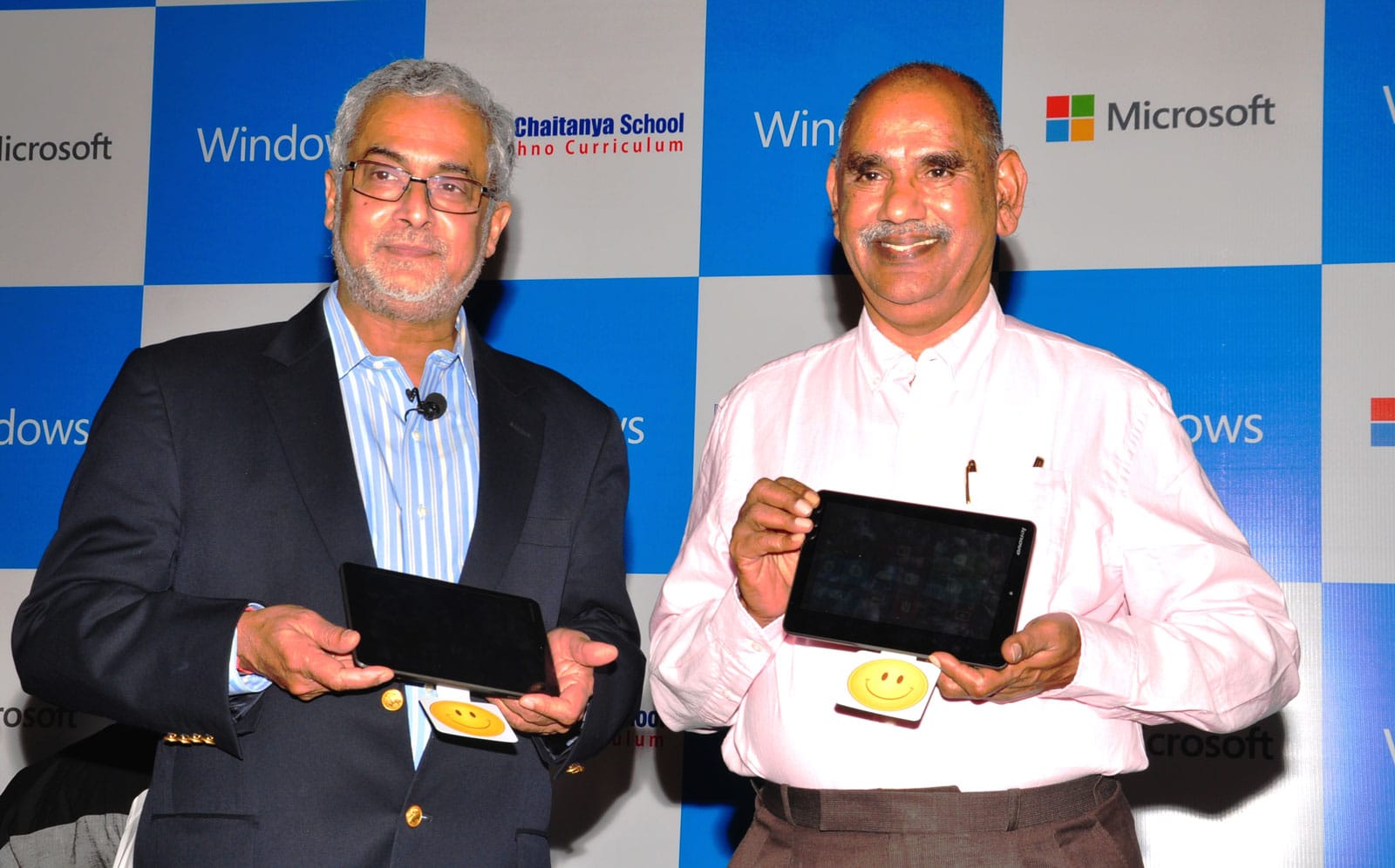
Edu-Cloud launched by Microsoft in IndiaA cloud computing-based offering that will enhance digital learning and teaching in schools and higher education institutions, in India, has been launched by Information technology giant, Microsoft. Edu-Cloud, a K-12 targeted product combining a digital learning platform on cloud and software solutions for schools, all deployed on Microsoft’s Cloud Platform.

Microsoft India chairman, Bhaskar Pramanik, told mediapersons that today’s students are digital natives, and Microsoft helps them imagine the future and realise it. He further said that with the help of cloud computing, they create, deliver and manage content from any device, anywhere, anytime, making learning easy and fun.

Stating that Microsoft was very passionate about education and that it had invested over Rs 670 crore in various education initiatives in the last one decade, touching 50 million people in 20 states in the country, Pramanik said Microsoft wanted to partner Indian schools and colleges in their digital transformation journey.

Microsoft, which is celebrating its 40 years of existence globally and 25 years in India, has drawn up a strategy to become a platform and productivity company for the mobile-first, cloud-first world. Currently Microsoft has joined hands with a chain of educational institutions, Sri Chaitanya Schools being one of them, having network in Andhra Pradesh and Telangana which plans to roll out this service by next year to the students of standard 3, 4 and 5th.

It may be mentioned that K-12 education system has been quickly gaining popularity in India after establishing its footprints in USA and Canada, especially after the launching of free primary education schemes by Indian government. In fact, the current K-12 school system in India is one of the largest in the world with more than 1.4 million schools and over 250 million students enrolled, as revealed in EY-FICCI report on the education sector in India.

Four Maharashtra engineering colleges get HC relief

Engg College - MahaFour of the 15 engineering colleges in Maharashtra who had been placed in the “no admission” category by All India Council of Technical Education (AICTE) for the academic year 2015-2016 have got relief from the Bombay High Court (HC). A division bench of Justice AnoopMohta and Justice K R Shriram in an interim order allowed the four colleges — Pillai engineering college, MGM college and two institutions of Saraswati Engineering — to participate in the Common Admission Process.

Advocate C K Thomas, counsel for Pillai college claimed that the institute did not have any deficiency. The HC is scheduled to hear today the cases of the remaining colleges who have been barred by the AICTE from admitting students for the 2015-2016 academic year due to deficiencies.

It may be mentioned here that some time back, in a major relief for 14 technical institutions, the Bombay high court has stayed the order of the AICTE denying “extension of approval” to the existing institutions and placing them on “No Admission” category for the current academic year, 2014-15.

Principals in Hisar village asked not to admit girls in co-ed schools

Haryana In times where the nation is striving for enhancing the status of girls in the social set-up, a block-level education department in Haryana’s Hisar village has issued directions to school principals to ensure that girls were not admitted to a co-educational school when a separate school was available for them.

The directive came in a letter issued around a week ago. It says that as per the norms of the education department when separate schools were available for girls and boys in a village then admissions should also be made accordingly. The letter was issued to two schools – Government Girls Middle School (Class 1-8) and Government High School Co-Educational (Class 1-10) – of Bhagana village on April 29. It also refers to a resolution adopted by the village panchayat in this regard and directed the principals concerned to take action as per the departmental norms and inform the office.

Speaking in this context, District Elementary Education Officer Baljit Sahrawat has said that the directions were issued due to some “misunderstanding” and the official concerned was directed to withdraw them. He further said that as per the Right to Education Act, the boys and girls are free to study in the school of their choice, and some misunderstanding led to issuance of directions. He added that the official has been directed to withdraw them.

Village sarpanch (Village Head) Rakesh Panghal denied that any such resolution was ever adopted by the panchayat.

It may be mentioned that Prime Minister NarendraModi chose Haryana to launch the nationwide campaign called ‘Beti Bachao-Beti Padhao’ (Save the Girl Child, Educate Her). The scheme focusses on fighting female foeticide and empowering women through education. Haryana has the worst sex ratio (number of females per 1,000 males) and child sex ratio in the country. Out of the 100 worst districts in India for sex ratio, Haryana accounts for 12 districts.

Furthermore, sometime back, to provide monetary assistance to meritorious girls of the state, Haryana government has disbursed Rs. 3.90 crore to 4,595 female students under the education loan scheme.

Coursera, The University of Illinois brings iMBA programme

image004The University of Illinois College of Business will launch an online-only Master of Business Administration degree programme, pending approval by the U. of I. Board of Trustees. The degree, called the “iMBA,” will be the first online graduate business degree offered in partnership with Coursera, the Silicon Valley educational technology company that already offers a number of U. of I. courses through its platform of massive open online courses, more commonly known as “MOOCs.”

The online degree will democratize access to both the coveted business credential and the world-class faculty of the Urbana campus, said Larry DeBrock, the Josef and Margot Lakonishok Endowed Dean of the College of Business. “The University of Illinois has a tradition of excellence and a distinguished reputation as a leader in research, teaching and public engagement, and our faculty is at the heart of that tradition,” he said. “All of the classes for the new degree program will be taught by faculty members from the College of Business as well as industry experts. In leading the new endeavor, they will continue our college’s tradition of excellence.”

According to DeBrock, the 100th anniversary of the founding of the U. of I. College of Business was the impetus behind the development of the program. “We considered it an opportunity to reinvigorate the land-grant mission of the University of Illinois as a public university,” said DeBrock, who noted that the iMBA program will cost one-third as much as a master’s degree from an institution of similar stature. “We’re entering the online MBA field motivated in part to find new ways to return to the tradition of great public universities making an elite education available to all.”

The program also amounts to a total rethink of the online MBA degree curriculum, said Raj Echambadi, the associate dean of outreach and engagement for the College of Business and a professor of business administration. “This will be the first for-credit graduate program from a top university to offer individual certificates in subject areas that can double as building blocks to earning a full MBA degree,” Echambadi said.

The “stackable credentials” will be offered in topics such as digital marketing, accounting and finance – courses that have their own appeal for current professionals, Echambadi noted.

Illinois is also leveraging Coursera’s innovation-friendly platform to reconceptualize business subject areas. “Rather than simply transferring traditional MBA content online, we’re mixing academic disciplines into active learning packages about how businesses work that are pre-assembled for students,” Echambadi said.

Incubation centres at all higher education institutes in Delhi

incubation centreDelhi’s deputy Chief Minister Manish Sisodia has said that the government will set up incubation centres at all higher education institutes, especially technology institutes, across the national capital.

While addressing students at Indraprastha Institute of Information Technology (IIID) in South Delhi, the deputy CM said that the government wants youth to become task masters and solution givers instead of becoming high-salaried engineers. Sisodia further stressed on the urgent need to invent new technology in the country so that we don’t have to look at other countries for technology which is very costly.

Sisodia, who also holds the education portfolio introduced – on a voluntary basis – the concept of stress reduction in government schools. A set of meditation practices – Vipassana and Anapana –were offered. On one occasion, he walked unannounced into a state government run school in the heart of Delhi, and suspended the principal and a teacher after allegedly finding discrepancies in the school’s book keeping and irregularities in the purchase of equipment and in other expenses. Officials also found blank bill books.

Visit by Australian expert to boost education and research linkages

Professor Stephen FityusA leading expert from Australia in mining and geotechnical engineering from the University of Newcastle, Professor Stephen Fityus, will be visiting India to collaborate with prominent Indian higher education institutions, research centres and industry bodies.

Professor Fityus will deliver lectures at the Indian School of Mines, Dhanbad; the Indian Institute of Engineering Science and Technology, Kolkata, the CSIR-Institute of Minerals and Materials Technology; the Society of Geoscientists and Allied Technologists, Bhubaneshwar; and Coal India Ltd. Prof. Fityus has said that this visit has enabled a deeper two-way understanding of the mining capabilities in both the countries and he has witnessed immense potential in academic and research collaboration in this area between Australia and India.

The visit is taking place under the Australia India Education Council’s (AIEC) Eminent Researcher Lecture Programme. The AIEC is a bi-national body co-chaired by the Australian and Indian Education Ministers for driving the Australia India education, training and research agenda.

Australia’s High Commissioner to India, Patrick Suckling had explained that mining is an area of mutual interest to Australia and India. He stressed that this visit will address the Prime Ministers’ of both the countries, and the desire to explore partnerships with the Indian School of Mines in Dhanbad, as indicated in their joint statement during Prime Minister Modi’s visit to Australia.

This development comes in the backdrop where huge linkages in the field of education are being strengthened between Australia and India. Recently, the Australian Capital Territory (ACT) Government, through Study Canberra, and the Australian National University (ANU) has launched a new joint funded scholarship programme for students from India who have chosen Canberra as their study destination. Furthermore, after Prime Minister Narendra Modi’s visit to Australia, a large number of collaborations have been taking shape between Indian and Australian educational institutes.

Assam Government has joined hands with Australia-based Curtin University for setting up of a centre for advancement in education and research in the state with active participation of the varsity. Macquarie, one of the leading Universities in Australia has inked two strategic pacts with prominent business schools in India.

It may be mentioned that Professor Fityus has made contributions to a wide range of research areas. He is also the Principal Researcher in the Priority Research Centre for Geotechnical and Materials Modelling at the University of Newcastle.

Testbook tools gives accurate learning experience

The world is changing and quickly moving to mobile devices, and so are we, says Ashutosh Kumar, CEO, Testbook, who explains that the Testbook venture is migrating to a primarily mobile-based platform to increase usage and user engagement.

Give us the brief of the various reasons behind starting the venture Testbook?

The main reason to start Testbook was to address the growing need for affordable quality education and testing. Data is the key element to make learning more personalised, engaging and informative. Testbook employs a vast array of data analytics and machine learning techniques to give users the most accurate learning experience.

There is an excellent market opportunity. The majority of big exams are conducted online now. Students need platforms where they can practise and learn in simulated testing environments.The Internet is reaching each and every palm very fast and mobility is key in getting students to multi-task while doing mundane things like travelling.

We are migrating to a primarily mobile-based platform to increase usage and user engagement. The world is changing and quickly moving to mobile devices, and so are we.

What are the various difficulties encountered in doing business on ground level?

It was very difficult to create quality content which students could rely on and fortunately we have nailed it. Getting good, skilled people in a competitive industry to work in your startup with a small account balance is challenging. You need to inspire them with good ideas and a credible promise of great things ahead.

All of us are young entrepreneurs and most of the strategies we execute are based on trial and error, but are logical. And luckily we hit right on the target with most of them and as a result we have been able to achieve steep growth with close to 1 lakh user base in just 14-15 months.

What is the market size of the services offered by you in India at present?

We support a wide range of exams in the post-graduate market. From continuing higher studies, to public sector recruitment, students come to us for a variety of their needs. Currently the test prep market size stands at over 18 million students, with an annual growth rate of 20-25 per cent. At an average ticket size of Rs.10,000 the market value currently stands at around Rs.18,000 crore.

Testbook has been testing markets to discover that there is an untapped market. It aims at expanding to markets not covered under these. Currently, due to the unavailability of affordable classroom education, a lot of candidates do not end up taking these exams. Testbook aims at rectifying this.

What are the major benefit for organisations and individuals adopting your solutions?

Students can learn and test themselves from anywhere and at any time at just the price of a cup of coffee. Analysis and recommendations provided by Testbook help them locate their weak points accurately and get the edge over their competitors.

User experience on testbook.com has been found to be a happy learning experience. Our user engagement in terms of daily time spent on the site is more than thrice that of any other site in the e-learning space. In fact, according to Alexa, it is more than that of Youtube. We think it says something about us that an e-learning site can engage users the way bigwigs like Youtube can.

We have the  ability to scale into classrooms. We partner with institutes and teaching establishments to bring the Testbook advantage to students everywhere.

Institutions can manage and track the performance of their students in a very smart way which would turn a good result for them.

What is the vision of your company for the next two years?

Create the best learning platform on mobile and web-app is the focus. It will be of international standard, personalised, adaptive and will support all the major competitive exams being conducted in India and abroad.

What are the various methods you are using to increase the visibility of your organisation?

We have a Campus Ambassador Programme where we have two-three representatives in each college and they represent Testbook’s activities on their campuses. Currently we have the Campus Ambassadors’ network in over 150 colleges pan India and will reach 1500 by end of this year. Our Campus Ambassadors are young entrepreneurs in training who utilise novel techniques to accelerate our growth in these places.

Content Marketing is fetching us growth organically at high pace and social media has proved one of the high visibility platforms.

How you can differentiate your services from your competitors?

Testbook has the best interface and comparative test analysis. Students love and choose us over our competitors for this. Content quality is always at the highest priority in all of Testbook’s efforts and we have been complimented with the ‘best content’ in the market by our users.

Engaging blog and social media posts that support our content marketing strategies. Our tie-ups with educational institutions have made us the leader in the industry. As the only e-learning institute with the capacity to scale with market needs, we have firmly established ourselves as the go-to for many educational institutions.

Tell us about the ways of engaging the customers with you. Any special Case study?

As our team has grown to over 30 people now, all of us have made it a habit to regularly get in touch with our customer base to get their feedback on different aspects of Testbook.com like content and platform. We are regularly surprised with the amount of appreciation they have for Testbook.com.

We connect with our users via email, live chat, phone and text. Every time an exam is conducted we get lot of mails from users saying that they found same questions from our tests in their final exam which is very motivating for us.

For the GATE 2015 test series, we offered a host of rewards to encourage and motivate students. These included Macbook Air laptops and HP Android Tablets to toppers. But apart from all these, we also offered cashback to users for every correct answer in the test series in order to incentivize learning. These proved to be a success. We had students aiming for accuracy in their tests, treating them like the actual GATE exam.

What are the major stakeholders and sectors you are focusing on?

We are primarily focused on competitive exams being taken by students after they graduate like GATE, Bank PO, Bank Clerk, Insurance, CAT and Campus Placements. All together over 1.8 crore students takes these exams every year.

Major stakeholders are offline coaching centres which have localised presence in different parts of country. But for the wide range of exams we are targeting, there is no single nation wide brand.

What are the various initiatives taken by your organisation to emerge as a market leader?

In education space, content is king and in order to sustain for long to be the market leader, you must focus on content quality. As mentioned earlier, we promise to deliver the best content in the industry.

Technology changes so fast that you need to be innovative to sustain for long and we do exactly that. We tweak our platform on a daily basis to give our users the best experience.

Looking at the volume of students for all these competitive exams, we focus more on growth than on revenue and this will definitely give us the lead in the market. That we have the luxury to do so, talks a lot about investor confidence in our venture.

Quality education to every student is KoolKampus’s mantra

AparnaThakker_CoFounder_KoolKampus KoolKampus with a motive to give back to society has introduced the community concept in institutes that would get the students, teachers, parents and schools on one platform. In a tete-a-tete with Elets News Network, Aparna Thakker, co-founder, KoolKampus informs that the company now plans to share content with rural schools for free. 

Give us the brief of the reasons behind starting KoolKampus?

KoolKampus was started as a way of giving back to society. Having been part of the Indian and Western education system, we wanted to bring about a change that benefitted students the most.

Allowing students to learn at their own pace and empowering teachers to be creative while teaching are the two prime factors that define KoolKampus.

We wanted to introduce the community concept in institutes that would get the students, teachers, parents and schools on one platform. Interschool sharing of teaching content is also an important aspect of KoolKampus. Apart from this, we wanted to make quality education available to all. We plan to share content with rural schools for free.

What are the various difficulties and hurdles encountered in doing business at the ground level?

Conceptualising a unique programme, then developing your vision of a better e-learning system and finally deploying the product have been the easier part of our journey. Our biggest challenge has been the human nature to resist change. Convincing principals about the changing trends in e-learning and getting them to be the change has been tough. Even tougher has been to edify teachers to adopt technology in their routines. Our end users, students and parents have in fact been very open to embracing the change.

What is the market size of the services offered by you in India at present?

Pan India schools and institutes are potential business. Quality education to every student is our mantra.

What are the major benefits for organisations and individuals adopting your solutions?

Among an array of benefits, our top value for schools and institutes are putting a stop to the school’s dependence on content and hardware vendors, improve student learning at a deeper level, high cost savings for the school, empowering teachers to experiment with new teaching methods like Flip The Classroom and automated tests, and grading allow teachers to focus on teaching.

What is the vision of your company for the next two years?

Provide technology and content to 50 reputed schools and institutes and adopt equal number of rural schools.

What are the various methods you are using to increase the visibility of your organisation?

Apart from regular sales, marketing and branding efforts, we rely on references from our satisfied customers.

How you can differentiate you services from your competitors?

Among others, we provide a cloud based secure environment for schools and institutes. Our platform is very flexible and can be customised for each customer, and our services can be availed anytime and anywhere

What are the ways of engaging the customers with you? Any special Case study.

KoolKampus believes in partnering with education institutes and assisting them in every possible way to reduce cost and improve quality of education.

What are the major stakeholders and sectors you are focusing on?

We are targeting any school that believes in the importance of technology in education.  Being a B2B business, we do not directly target our end users. We build relationships with schools and institutes.

What are the various initiatives taken by your organisation to emerge as a market leader?

As an early stage company we are aware that there are already players on the field. But we strongly believe that our offering is exceptional and rewarding to all the stakeholders. All our efforts are towards improving the features of the platform to make learning ‘kool’ for students.

DU: not violating statutory norms in CBCS implementation

Higher Education Delhi University (DU) has claimed that it has not violated any statutory norms in the implementation of the Choice Based Credit System (CBCS) from the upcoming academic session and said it was in process of complying by the same. It may be mentioned that the DU has decided to go ahead with the introduction of Choice-Based Credit System (CBCS) from the upcoming academic session, apparently without the “mandate” of the varsity’s Executive Council.

The varsity authorities have said it is in process of complying with the norms. Speaking in this context, DU Registrar Ram Dutt said in an official statement that the implementation cannot happen unless the EC accords approval to the draft ordinance that the AC has proposed and this is in the process. In the interim, all Heads of the Departments have been asked to take cognisance of and send their suggestions, as sought by the UGC, on the syllabi that have been proposed by the UGC. The registrar held that the university is well prepared for the transition.

He further added that no academic scheme in the university can ever be implemented without approval of all statutory bodies and DU has scrupulously adhered to these regulations at all times.

It may be mentioned that last month, a section of DU teachers has written to the UGC raising concerns over the implementation of a CBCS from the upcoming academic session saying it was being “hastily pushed”. Writing to the University Grants Commission, the Delhi University Teachers Association (DUTA) had conveyed academicians’ concern on the issue and said “reforms” brought without discussion has proved “disastrous”.

Alumni can’t interfere in St Stephen’s matters, says College Council

St.stephen A resolution has been passed by Delhi University’s St Stephen’s College’s Supreme Council stating that its alumni have not right to interfere in its internal matters. This comes in the backdrop where a group of former students, Association of Old Stephanians, have alleged “rampant illegalities” in the functioning of the college.

The college’s Supreme Council, which is the decision making body of the institution, resolved that certain alumni are resorting to “false propaganda” and the college shall not be forced to deviate from “its time-tested traditions, conventions and convictions, nor forego its Constitutional rights, through any tactic or strategy based on it.”

The alumni body, which is not recognised by the college, has released a ‘White Paper’ detailing alleged financial and administrative illegalities in the college and also sent copies of the same to the PMO and the HRD Ministry seeking their intervention. The ‘White Paper’ has raised several allegations including the appointment of Thampu being illegal in view of improper qualifications, illegal appointment of college chairman, improper functioning of the Governing Body and victimisation of several persons by principal leading to litigation in courts.

The alumni association has been joined by Delhi University Teacher’s Association (DUTA) which alleged inaction by DU Vice Chancellor Dinesh Singh despite repeated complaints to him regarding principal Thampu. The association’s media coordinator, Ashish Joshi, has said that given the rampant illegalities that plague the running of the college, it had become imperative for urgent intervention by the HRD Ministry as well as a comprehensive audit by the office of CAG.

Furthermore, an administrative officer of St Stephen’s College who had earlier accused principal Thampu of forcing him to convert to Christianity has now served him a legal notice alleging that he was being made to work in a store room.

“It is pertinent to mention that the office allotted to (Subhas Kumar Dash) was in the nature of a store room…wherein laptops (over 350 laptops) that were issued by Delhi University to be distributed to students since 2013 were being stored as the same were not allotted,” the notice read.

LATEST NEWS