

Home Blog Page 887

UK woos Indian students, promises more cooperation

Greg_Clark

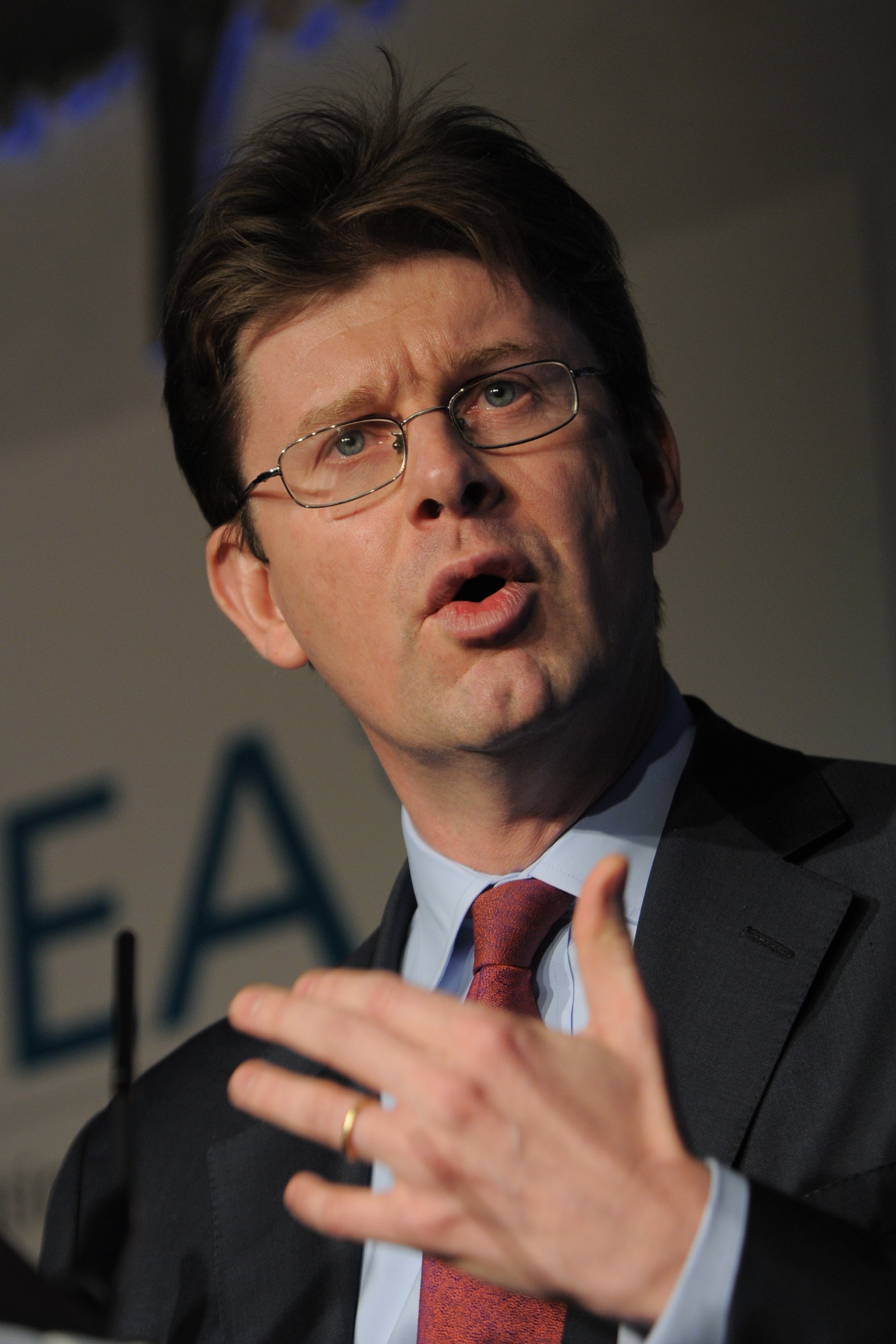
Hit by a drop in Indian students in its universities due to stricter visa regime, the United Kingdom tried to reverse the unwelcoming image of Britain. Greg Clark, Minister of State for Universities, Science and Cities, The UK, who is leading a delegation to India, announced that the British Government had initiated a programme, under which 25000 young people would be sent to India to study in the next five years. “The first batch of students will reach Indian shores next summer”, he said here at the 10th FICCI Higher Education Summit 2014 on the theme ‘Higher Education Vision 2030: Making it Happen’.

Later at the Sixth India-UK Education Forum Smriti Irani, the Union Minister of Human Resource Development, and Clark, co-chaired the meeting. Both the countries discussed the existing bilateral cooperation initiatives in education and also agreed to further strengthen it by taking up several new initiatives. Both sides also acknowledged the cooperation mechanism through joint UK-India Education and Research Initiative (UKIERI).

It was also decided to constitute a Joint Working Group consisting of officers from both sides to deliberate and work on modalities of future collaborations in education. The JWG will meet frequently and the first meeting will be held by December 2014.

Both sides also discussed the Chevening Scholarships for Indian students; two-way student mobility; Generation UK-India programme which will support up to 25,000 young people from the UK to come to India over the next 5 years and initiatives supported by DFID. The UK delegation confirmed that they will put in four times more resources for the Chevening scholarships for Indian students and make it the largest Chevening Programme in the world.

The Indian delegation emphasized that, along with students from UK, they would also like to welcome teachers and faculty members under its new programme, Global Initiative for Academics Network (GIAN), the response to which was extremely positive from the Minister leading the UK delegation.

After taking over of the present Government, the issue of equivalence of India’s 10+2 qualifications with “A” level qualification of UK was taken up at very high levels. UK side has acted promptly on it and it was conveyed today in the Forum meeting that most of the UK institutions recognize the 10+2 qualifications for admission of Indian students into the higher educational institutions in UK. The UK delegation also welcomed more Indian students in the British Universities and also assured of addressing the barriers in student mobility.

A Joint Statement was also signed by both the Ministers highlighting the educational cooperation between India and the United Kingdom and the future areas of collaboration. The areas of leadership development; research, innovation, technology and knowledge transfer; Skill Development and Entrepreneurship; enhancing people to people links and two-way mobility; quality improvement in education; use of ICT in education; development of MOOCs and e-Library and launch of UKIERI-III in 2016 have been highlighted in the Joint Statement.

HRD Minister releases Knowledge Paper at FICCI Higher Education Summit 2014


FICCI HRD Minister

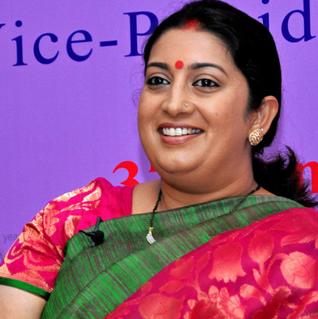
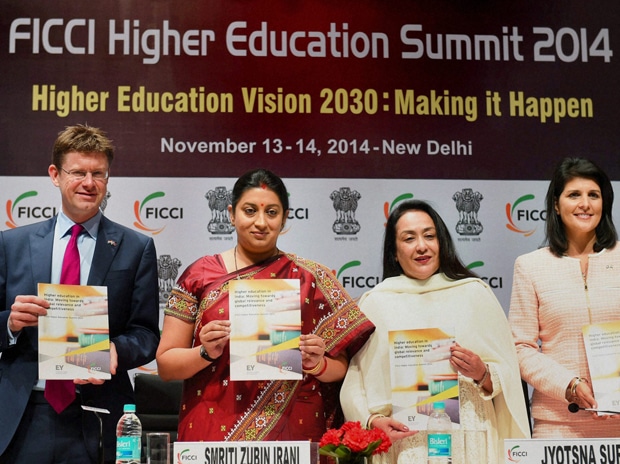
Smriti Zubin Irani, Union Minister for Human Resource Development, released FICCI-EY Knowledge Paper on the theme ‘Higher Education in India: Moving towards Global Relevance and Competitiveness’ at the inaugural session of FICCI Higher Education Summit 2014.

The knowledge paper reveals India’s vision to build a 21st century model for higher education that is of high-quality, equitable and affordable, and be a model of a higher education system that is not just the best in the world but the best for the world.

The paper suggests key imperatives to realize this vision such as developing higher education institutes with an international outlook and global impact; providing world-class teaching, research and conducive learning environment; relaxing complex regulatory requirements; incentivising transnational education; developing skilled, job-ready and productive graduates; enabling higher education graduates with global skills, who can be employed by or serve workforce-deficient countries; developing research-focused universities that deliver high-quality research output and research-focused graduates; increasing R&D funding by Government, promoting increased industry participation in research and innovation and creating a conducive educational, financial and regulatory ecosystem to promote entrepreneurship.

It notes that the global economy is undergoing structural transformation. There will be need for a workforce of 3.3 billion by 2020, increasingly in the services and capital intensive-manufacturing sectors. The phenomena is also expected to play out in India – by 2020, 90 per cent of India’s GDP and 75 per cent of employment is expected to be contributed by the services and manufacturing sectors.

Technological advancement will make several jobs redundant while also creating new job roles. This structural shift in employment will increase demand for sophisticated workers, innovators, and thinkers who can thrive in a globally-connected and dynamic economy. India, with its large workforce and increasing pool of higher education graduates, is strategically positioned to reap the benefits of this shift. However, the ‘demographic dividend’ will be squandered unless India is able to create a “globally relevant and competitive” higher education system that serves the requirements of both the domestic as well as global economy.

While the Indian higher education system has made considerable progress in terms of capacity creation and enrolment especially in the last decade, it lags significantly in terms of “global relevance and competitiveness”. The FICCI-EY paper highlights the following gaps in the system:

? Low employability of graduates, driven by several factors including outdated curricula, shortage of quality faculty, high student-teacher ratios, lack of institutional and industry linkages, and lack of autonomy to introduce new and innovative courses.

? Low impact research output and patents filed given relatively low government and corporate spending on research, insufficient doctoral students, missing research focus and culture in most institutions, and lack of international research collaborations

? Limited focus on entrepreneurship on campus as reflected in the fact that there are few institutes that offer programs in entrepreneurship and have active incubation / entrepreneurship cells

? Complex regulatory requirements and hurdles, poor institutional governance standards, and lack of professional management While we acknowledge that the Government has proposed and is also taking several measures to improve the system on the above aspects, there are some steps it could take to make the Indian higher education system a role model for other emerging systems. Institutions, on their part, would need to adopt a transformative and innovative approach across all levers of higher education: from curricula and pedagogy to the use of technology to partnerships, governance and funding, to become globally relevant and competitive. In this report, we have looked at some world-class institutions and country systems that could hold important lessons for government and institutions.

To make India “globally relevant and competitive”, the paper recommends that higher education in the country needs to be promoted as follows:

? India prominently placed on the global higher education map in terms of more globally-reputed Indian institutions, significant student and faculty mobility, presence of / collaborations with quality international institutions

? India as a hub for talent that is able to drive competitiveness of the Indian economy and is fit to work in or serve international markets

? A culture of research, innovation and entrepreneurship that can power high economic growth in the country

Centre to roll out innovation initiatives

BJP leader Smriti Irani in Ahmedabad

The Government will roll out the ‘Rashtriya Avishkar Abhiyan’ next year with a view to arresting the falling trend of learning outcomes in mathematics and science of students in classes 6-8 and upgrade the skills of teachers in line with the needs of modern-day society.

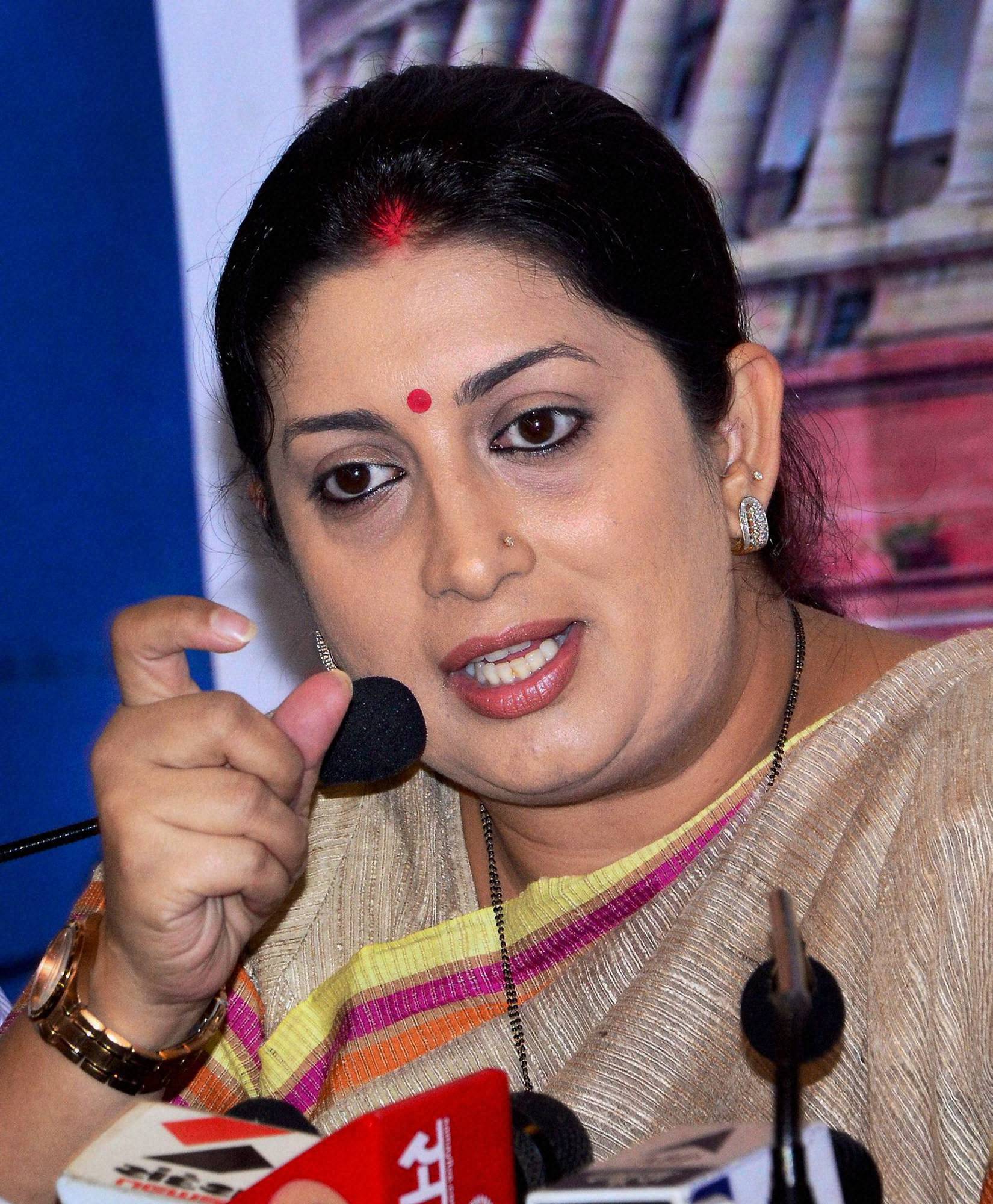
This was announced here today by Smriti Irani, Union Minister for Human Resource Development while inaugurating the 10th FICCI Higher Education Summit 2014 on the theme ‘Higher Education Vision 2030: Making it Happen’.

“I look upon education as an opportunity to redefine India’s destiny and am happy to note that in the last six months we have undertaken a review of all regulators in the field of education to redefine the way forward and ascertain the needs of the future” the Minister said.

These innovation labs will soon be set up in every district for students to think of new ideas which will be funded by the government under an ambitious scheme to encourage research at both school and university level.

“These labs will also be linked to the proposed council of higher education on industry academia collaboration so that those innovation which have potential to turn into great business do not die. We will start a fund which will support such innovations. It will be launched by the dawn of next year,” Irani said.

Government reforming regulatory bodies: Smriti Irani

FICCI HRD Minister

Human Resource Development Ministry is reviewing the functioning of regulatory bodies that governs India’s education sector.

“I have undertaken review of regulatory bodies. We can design a path forward which is not only holistic but also that takes cognisance of the future,” HRD Minister Smriti Irani said while inaugurating the FICCI Higher Education Summit 2014 here in the capital.

“For the last six month we are understanding the working of these regulators and how reforms can be brought in the functioning of our regulators? Be it UGC or AICTE and NCTE, need to understand that India needs to redefine its destiny by redefining how we can manage education. We have undertaken the review of regulatory bodies to design a path forward holistic in nature and but also that takes cognizance of the future”.

There are more than a dozen regulatory bodies that governs different sectors of education- All India Council of Technical Education (AICTE), Medical Council of India (MCI), Indian Council for Agricultural Research (ICAR), National Council for Teacher Education (NCTE), Dental Council of India (DCI), Pharmacy Council of India (PCI), Indian Nursing Council (INC), Bar Council of India (BCI), Central Council of Homeopathy (CCH), Central Council for Indian Medicine (CCIM), Council of Architecture, Distance Education Council, Rehabilitation Council, National Council for Rural Institutes, State Councils of Higher Education and University Grants Commission.

The Summit was attended from representatives eleven countries. Notable delegates were Nikki Randhawa Haley, Governor of South Carolina, USA and Greg Clark, Minister of State for Universities, Science and Cities, UK.

On Clark’s announcement that the first batch of students from United Kingdom will visit Indian universities next year, Irani said she expected experts and professors too from UK to visit educational institutions here under Global Initiative For Academic Networks for those cannot afford to go abroad.

New teacher training scheme to be launched soon: HRD Minister

Smriti Irani

Human Resource Development Minister Smriti Irani said the new effort, Pandit Madan Mohan Malviya New Teacher Training Programme will be launched soon.

“While we look at the infrastructure and research, we are conscious of an important component of Indian education system, which the teacher. Dedicating ourselves training them we will soon  launch Pandit Madan Mohan Malviya New Teacher Training Programme”, HRD Minister Smriti Irani said while inaugurating the FICCI Higher Education Summit 2014 here in the national capital.

The scheme was announced with an initial allocation of Rs 500 crore in the Union Budget presented by Union Finance Minister Arun Jaitley.

India is facing shortage of teachers in primary, secondary and higher education.

This programme will focus on training students, who aspire to become teachers, in professional colleges. Details of the programme are not available, but the indication is that the government is going to focus on teachers, reiterating its recognition that they remain the weakest link in the government’s school education efforts.

The programme is envisaged to benefit nearly 20,000 teacher trainees studying in Teacher Education Institutions.

The programme envisions to focus holistically on whole sector of education without fragmenting it based on levels and sectors and also to strengthen institutional mechanisms for strengthening vertical and lateral linkages. This would consolidate and strengthen on-going programmes related to teachers and teaching through effective coordination.

It will also provide an integrated platform for building synergies among all the existing initiatives and will attempt to create a comprehensive vehicle for Teacher/Faculty related programmes and schemes. The programme envisages augmenting capacity at individual level and also enhance institutional infrastructure to give impetus to training of teachers at pre-service and in service level.

Use digital technology for dispensing education: President

President Pranab Mukherjee called the nation to harness digital technology to usher changes in education and to bridge the gap between digital ‘haves’ and ‘have-nots’.

Inaugurating the National Education Day celebration which was the birth anniversary of India’s great freedom movement leader Maulana Abul Kalam Azad, the President said that it is education that can lead to the trinity of progress, which are greater political participation, social emancipation and upward economic mobility. “We have traversed a long distance from just one out of four children in school in the early fifties to a school accessible to every child today and almost universal enrolment with gender parity. In recent times, our expenditure on education has risen – from 2.9 percent of GDP in 2008-09 to 3.3 percent in 2013-14.”

President Mukherjee extolled the exemplary contributions of Maulana Azad in nation building, Institution-building and particularly his indelible imprints in the field of education.

Emphasising on the importance of teachers in the education, Union Minister of Human Resource Development Smriti Irani said that they are the fulcrum of the entire education system. “Teacher should not merely be concerned with ‘income’ but also the ‘outcome’ to help improve the quality of education.” According to Irani, “the Mission of Unnat Bharat Abhiyan is to enable higher educational institutions to work with the people of rural India in identifying development challenges and evolving appropriate solutions for accelerating sustainable growth.”

Dr. Najma Heptullah, Minister of Minority Affairs said that there is a need to adopt a pragmatic view that blends modernity into tradition and synthesizes our inherent traditional strengths with modern day needs without losing our values.

New schemes launched on National Education Day

National Education Day

National Education Day this year marks the 125th birth anniversary of politician, scholar, and Bharat Ratna Maulana Abul Kalam Azad, acknowledging the occasion, the Ministry of Human Resources and Development launched new initiatives for the benefit of the education system in the country.

The new initiatives include Saksham, PRAGATI, SAMAVAY, Know your College and Unnat Bharat Abhiyan. The details of the schemes are given below:

* Saksham is a college level scholarship for the differently abled, needy and meritorious children.

* Providing Assistance for Girls Advancement in Technical Education Initiative or PRAGATI is an AICTE, Ministry of Human Resource Development, Government of India scheme that envisions selection of one girl per family whose income is less than 6 lakhs per annum to pursue technical education. The scholarship amount under the scheme is Rs 30,000 for tuition fees and Rs 2,000 per month contingency allowance for 10 months.

* Skill Assessment Matrix for Vocational Advancement of Youth (SAMAVAY), allows multiple pathways between Vocational education – skills, education and job markets. This will facilitate India to harness the potential of young India.

* Know your College Portal is an application developed for helping a prospective student make a valued judgment of the college he / she wishes to join by providing him / her necessary information about the college.

* Unnat Bharat Abhiyan involves higher educational institutions to work with the people of rural India in identifying development challenges and evolving appropriate solutions for accelerating sustainable growth.

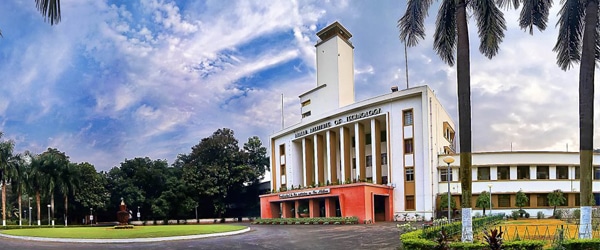
IIT Kharagpur plans to become international

IIT Kharagpur

IIT Kharagpur will now go global as it plans to bring professors and scholars from foreign universities besides offering joint PhDs with top international institutes.

Ten professors from some of the world’s leading universities would come to the Kharagpur campus each year for few months, under the Shri Gopal Rajgarhia International Programme which was launched recently.

According to Director Partha Pratim Chakrabarti, around 30 talented international scholars would be invited each year to conduct research activities at IIT. He also mentioned that they were already in talks with leading universities from the US, Europe, Australia, and Japan.

Under the joint PhD programme, students would be awarded with the doctorate by IIT-Kharagpur and an international university.

“The students will study at both the places. There will be international workshops and activities with the foreign university,” Chakrabarti said.

The international programmes will start from the January session.

IIT Kharagpur’s distinguished alumni from the 1968 batch, Gopal Rajagarhia donated Rs 10 crore for funding the initiative.

“I was always keen to give it back to IIT. Its international ratings are poor because of low international exposure. With this program, we want the IIT to make its presence felt in the international arena so that its ranking improves as per our Vision 2020,” Rajgarhia said.

At present around 200 PhDs are awarded by the IIT each year which they hope to take it to 400.

“We want around 25 per cent of PhDs to be joint PhDs. We will also be getting foreign students to study here for such joint PhDs,” director Chakrabarti said.

Besides student and faculty exchange, the IIT is also adding an international component to its courses by offering micro specialisations with a foreign collaborator.

They have already started the International Summer Winter Programme wherein students and faculties from India and abroad are participating.

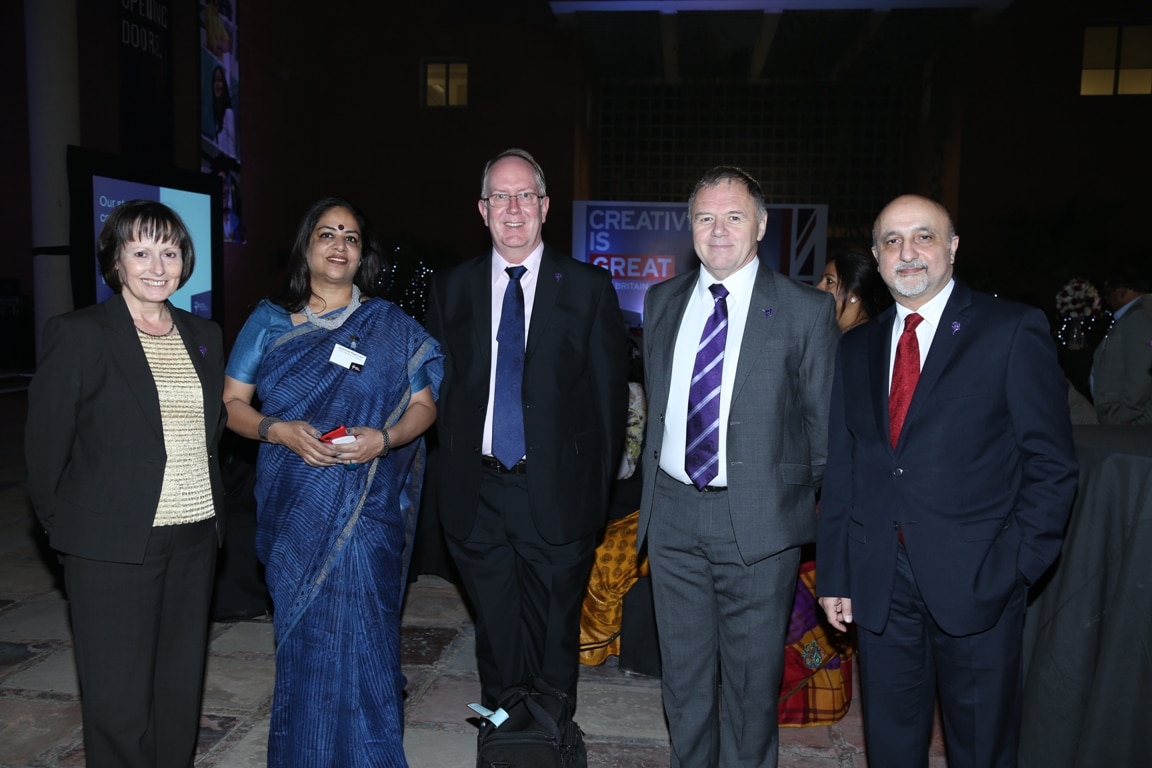
Leeds Beckett University celebrates 10 years presence in India

L_R_ Prof.Susan Price Jayashree Raghuram Andrew P Disbury Prof Paul Smith Prof Mohammad Dastbaz

Leeds Beckett University celebrated its 10th anniversary in India in the presence of Vice Chancellor, Prof. Susan Price and other senior delegates from Leeds Beckett University. Vice Chancellor and other senior delegates from the University were on their maiden visiting to India to join the celebration at British Council. Other guests included, the Director of Education for the British Council in India, Richard Everitt, and a number of Indian graduates from Leeds Beckett

The university first began its operations in India in 2004 with its base in New Delhi. Since then, the team has recruited over 2,000 students for the Yorkshire institution as a facilitator to the Indian education system.

Speaking on the occasion Vice Chancellor, Prof.Susan Price said “We recently reached a milestone with the new name for our University as we became Leeds Beckett University and have made significant progress over the last few years and that is down to the hard work and dedication of staff and students. We don’t just help to create great graduates here at Leeds Beckett, but exceptional employees, dynamic citizens, and enterprising leaders.  Over the last ten years we have enjoyed a number of fruitful academic and non-academic partnerships in India as well as sending our home students on a range of volunteering projects and we look forward to welcoming many more Indian students to Yorkshire in years to come.”

The Leeds Beckett University India Office is based in the business district area in South Delhi and provides support to students in India. India team of Leeds Beckett University also manages academic partnerships with some of India’s leading universities including Symbiosis International University and Manav Rachna University where exchange of students and academic conferences have taken place.

Speaking at the occasion, Ms. Jayashree Raghuram, Country Head, India – Leeds Beckett University, said, “I am delighted to have been part of this prestigious university’s journey in India for more than 10 years. The part I enjoy most is sharing the success stories of our alumni and students. We value these relations in India immensely.”

Ricoh India launches Ricoh IntelliClass for K12 schools

Ricoh_logo

Ricoh India Ltd., a market leader in Printing & Document solutions and IT services, has entered into the multimedia solutions for K12 School, with the launch of Ricoh IntelliClass. It is a state-of-the-art solution designed for Indian schools that offer modern multimedia classroom with world class content.

The solution was launched by Dr. Shayama Chona a renowned Educationist, Founder-President of Tamana Association and the former Principal of Delhi Public School, R. K. Puram, New Delhi.

Ricoh IntelliClass caters to the learning needs of the students and enables infrastructure that makes classrooms achieve global standards. IntelliClass is created keeping in mind different learning abilities of students of various age group. The classroom typically comes with PC, fingers touch interactive whiteboard, speakers, projectors, UPS & cabinets.

Ricoh IntelliClass content library helps teachers to create question banks, assessment, class test, class presentations, CCE worksheets and lesson plans from over 50000 chapter mapped questions. The unique lesson planner allows teachers to create their own interactive lesson plans. It will also help teachers form presentation from existing content as well as external sources and share lesson plan with other teachers, interactive virtual labs wherein students can learn through experiments.

Also present during the launch was Manoj Kumar, Executive Vice President and CEO, who stated, “Education market in India is estimated to be US$ 135 billion by 2020, of which the e-learning market alone will be US$ 7 billion. We expect huge increase in student population, 200 million in K-12 and 90 million in private schools. Ricoh IntelliClass solution is capable of providing quality education to students by helping them in better concept formation, concept elaboration, and academic achievement. We wish to make learning more interactive and interesting and take it beyond textbooks and chalkboard. With the introduction of Ricoh IntelliClass solution, we are committed to provide best in class education to the students for brighter future.”

LATEST NEWS