
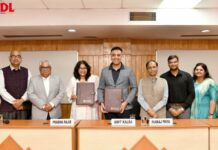
TCCS (The Call Centre School), the Tennessee based premier organization dedicated to the professional development of individuals in the call center industry has announced its advent into India in partnership with QAI, a global workforce development and consulting organization. TCCS and QAI will offer a comprehensive curriculum of certifications and training programs to cater to the needs of all personnel in the call centre industry in India. These training programs can be delivered in instructor-led mode via public seminars or private on-site programs. The gamut of offerings from TCCS cover the skill development and capability enhancement of all professionals starting from the frontline track through the supervisory up to the leadership position. Some of these trainings and certifications include the Certified BPO Customer Service Professional, Certified Transaction Monitoring and Coaching, Certified People Management Professional, Certified Workforce Planning Professional, Certified Operations Manager. Besides the BPO industry, industries like banking, finance, telecom and insurance as well as contact centers and customer centers would stand to gain significantly from these trainings and certifications in improving the capabilities and expertise of their workforce. The main distinguishing service provided by QAI is their focus on a customized learning approach. Just as individual students' needs vary, each organization's needs are unique. QAI empowers professionals with resources required to resolve complex operational and business related problems, as a result of which companies have reported cost savings, reductions in cycle time, improved productivity, increased customer satisfaction, and workforce optimization. QAI has trained over 140,000 professionals and certified over 40,000 professionals across the globe and is currently servicing over 300 clients in over 35 countries Speaking on TCCS's entry into India, Navyug Mohnot, CEO, QAI, Said, “Each individual in any role in a BPO or contact centre can make a tremendous difference in a customer's experience with an organization, ultimately resulting in customer satisfaction, retention and increased market share. We are very delighted to partner with TCCS in developing resourceful and comprehensive new programs or adapting existing courseware to fit organizational needs. We are optimistic that this partnership will be successful in inducing global best practices into the Indian industries.”
Thousands of school children in Punjab to benefit from government technology initiative
NComputing, the world's fastest growing desktop virtualization company and provider of affordable desktop computing solutions, today announced that the Government of Punjab has selected NComputing's virtual computers to deliver Computer Labs to 480 schools. This is a part of a major computer education initiative called ICT Education Project for Punjab, estimated to be valued at Rs. 7.5 Crores (US$1.6m), which will provide computer access to thousands of schoolchildren throughout the state. This further strengthens NComputing's position as the de-facto desktop computing procurement choice for education in India. The company's products are already providing desktop computing access to millions of school children through major state education projects in Andhra Pradesh, Bihar and Rajasthan. The Government of Punjab sought to provide the maximum number of computer seats in each school at an affordable purchase price, with low ongoing maintenance costs. NComputing will deliver its X550 virtual desktop product which, as well as fulfilling the need for a low cost of purchase, requires 75% less maintenance and 90% less energy consumption than traditional all-PC labs. NComputing devices only use 1 watt of electricity
Reading test for British kids to include ‘non-words’
The British government has drawn up new plans to include “made-up” words such as “koob” or “zort” in a new reading test for six-year-olds – an idea that has brought about criticism from literary experts. The government said non-words were being included to check pupils' ability to decode words using phonics. This is the reading system by which children sound out words using letter sounds. Non-words were being included to check that children were not just regurgitating memorized words, a spokesman for the department for education said, according to BBC. The proposed new test will take about 10 minutes to complete and would include about 40 items – words and non-words. Experts, however, say the approach will confuse those just beginning to read. The UK Literacy Association said the plan was “bonkers” as the purpose of reading was to understand meaning. “We think that seems a bit bonkers when the whole purpose of reading is to understand words,” said David Reedy, president of the UK Literacy Association. Reedy said the inclusion of non-words would be counter-productive since most six-year-olds expect to make sense of what they read. He said the test itself was sending out the message that all words are decodable using phonics when they are not. “There are many words with which you have to use a 'look and say' approach. This is the case with many common words such as 'the' and 'once',” he said. This was because the English language is not phonically regular like German or Finnish, he said. “Children should be using a number of sources of information to be able to work out what a word is. There is the context, the sentence itself and whether they have that word in their spoken lexicon,” Reedy said. He said it might be useful for the department for education to explain why the secretary of state's surname, Gove, did not rhyme with “love”.
Illiterate poor parents form School for their children
They can't read or write but are determined to ensure their children get proper education. A community of tribals in Rajasthan who toil hard to make just about Rs.70 a day have built a school for their children with their hard earned money. The tribals in the tiny Vasela Phali village in Rajasthan's Sirohi district, over 400 km from state capital Jaipur, came together and raised Rs.50,000 to build the primary school. Having grown up as illiterates, the around 300 villagers knew best the importance of education. All they wanted was to see their children get proper education and lead a better life than them. “It cost us Rs.50,000 to open the school. It's a huge amount of money for us. Most of us earn just about Rs.70-100 a day,” Bharon Ram, a villager, said. “We had approached the state authorities for help, but nobody came forward,” he said. The majority in the village is formed by the Garasia tribe, the third largest tribal group in Rajasthan. The villagers live near forests and are generally concentrated in Sirohi, Pali and Udaipur districts. There are no schools in the neighborhood and almost 95 percent of the population is illiterate, the villagers themselves admit. The Vasela Phali villagers named their school 'Sarasvati Vidya Mandir'. It has only one teacher as of now and is housed in a makeshift facility. But the most important thing is that it has become the home for learning for 64 children, making their parents proud. “I don't get salary every month because the villagers are very poor. But I am here for the love of it. I have enrolled 64 children aged between 5 and 14 years in the past one year,” said a beaming Bheraram Devasi, the teacher. Bheraram is the only villager who has completed college education. He said he had written many times to the state's education minister and the district collector for help but was yet to get a response. Children in the village are happy because they will now get at least primary education. The parents have bought them school uniforms and books. “My parents can't read a newspaper, so we never had one at home. But now, we get a newspaper every morning and I try to read it out to them before both leave for work,” said 12-year old Chandra Kumar. Block Education Officer Chaturbhuj Purohit admitted he had received letters from the villagers seeking financial help. “I have forwarded them to the higher authorities and am trying to ensure some help,” Purohit said. According to a child-tracking system (CTS) survey conducted by the state's education department in June and August last year, a staggering 1.2 million children in the age group of 6-14 are not attending schools in Rajasthan. “The high ratio of out-of-the-school children is due to non-availability of schools and teaching staff in the rural areas of Rajasthan,” said Rohit Singh, a child rights activist.
PM lays foundation stone for new NID campus in Assam
Prime Minister Manmohan Singh addressed the gathering at the foundation stone laying ceremony of the National Institute of Design (NID) at Jorhat Campus in Assam today. Expressing his happiness at laying the foundation stone of the institute, the Prime Minister said that this was the second institute of its kind in India after the first National Institute of Design had been set up in Ahmedabad fifty years ago. “The need for design intervention for Indian products and services was first visualized by the then Prime Minister Pandit Jawaharlal Nehru. He actively encouraged the setting up of the National Institute of Design at Ahmedabad. Starting from a small campus in 1961, the institute today is a multiple campus organization with a strong national and international profile,” he said. “It conducts graduate level diploma programs in eight design disciplines and sixteen sector specific post graduate programs in diverse domains. It has also set up state of the art infrastructural facilities like the Knowledge Management Centre, Information Technology Center, and Design Vision Center.” Manmohan Singh stated that the new NID at Jorhat is a timely and welcome initiative. “The National Institute of Design has evolved as the touchstone of good design education in India while continuing its efforts for spreading knowledge of traditional Indian design across the world. But one institute cannot serve the growing and variegated needs of our nation,” he said. The Prime Minister said that he was happy that the institute had been set up in Assam, a state with which he had a special bond. “I represent Assam in Parliament and to me coming here is like coming home,” he said. He also informed that the government had always been alive to the special needs of Assam and other north east states and a number of projects for rapid development of Assam had been initiated. He stated that he was happy to note that the comprehensive project for protecting the Rohmoria area and the Majuli Island from erosion is to be completed soon. The Prime Minister stated, “It is design that converts creative ideas into tangible products and services for society at large. It can play an important role in economic, societal and industrial development. Its importance in creating opportunity for economic development and providing jobs is to be emphasized.” He said that the aim of good design should be the improvement in the quality of life through products and services which can be accessed by people in general. “In the Indian context design should also be a tool for inclusive development. Value addition through innovation in design can play a pivotal role in enhancing the competitiveness of both manufacturing and service industries,” he said. He further added that “Specific to the North East, better industrial product design can contribute to the development of Micro Small and Medium Enterprises by enhancing product utility and by helping in translating new ideas into new products.” Stating that design had been a traditional skill in India, Manmohan Singh said, “It gives a unique Indian aesthetic value to our arts and crafts as well as our festivals and historical monuments. However, in the process of rapid industrialization, some of our traditional skills have been lost. But, with the opening up of our country to global competition, the traditional design skills are once again finding a central role in differentiating our products. Indeed this could provide a competitive advantage to our producers.” “Therefore, our design initiatives should sustain and strengthen our traditional knowledge, skills and capabilities while also being sensitive to global demands and requirements,” he inferred. He informed that the government had taken significant initiatives to enhance the design innovation and application framework cutting across all sectors and disciplines, including revamping the Designs Act and setting up Design Business Incubators. He hoped that the steps that had been taken by the government would ensure that the rights of creative people are protected and talented people are trained in innovative processes and lead to the creation of intellectual wealth. Towards the end of his speech, the Prime Minister stated that the NID at Jorhat should leverage on the traditional craftsmanship of the region and help in giving a new life to the traditional arts and crafts in this area. “At the same time the institute should come out with eco-friendly design for adoption by the people of northeast for modern industrial goods so that the modernization and preservation of the ecosystem can go hand in hand,” he said. “The promotion of the textile sector in the region as well as the initiatives under the National Bamboo Mission should also get support from this institute,” he concluded, wishing that the new institute would be of great benefit to both the region and the country.
JMI delays semester system by year
Having witnessed the chaos that had been caused by the introduction of the semester system for undergraduate science courses at the Delhi University, the introduction of the semester system has been delayed by a year at the Jamia Millia Islamia (JMI) University. The semester system at JMI had earlier been planned to be introduced commencing from the 2011-12 academic session. According to the university, the semester system has been delayed from being implemented because teachers still need time to restructure and revise the courses. Media coordinator at JMI Simi Malhotra said that the Master's, M.Phil. and Ph.D courses had been revised last year and the whole procedure had been very time-consuming. “The number of courses at the undergraduate level are a lot and we need to restructure them all properly,” she said. Authorities at the university have also said that it would be wiser to wait another year before the semester system is implemented at the varsity. JMI Vice Chancellor Najeeb Jung said that it has been a year since the semester system had been introduced for the Master's level courses at the varsity. “We concluded after a review that we still required another year to implement the semester system at the undergraduate level at the university so that the transition is smooth,” he said.
Indian students have highest transition rate to work in New Zealand
Students from India have the highest rate of transition to work in New Zealand after completing their studies, followed by their Chinese counterparts, a minister has said. While 72 percent of Indian students who come to New Zealand get job, the corresponding figure for China is 43 percent, Immigration Minister Jonathan Coleman said on Friday. Similarly, students from India also have the highest rate of transition to permanent residence (47 percent), again followed by pupils from China (23 percent). According to a research conducted by the department of labor, around one-third of international students who come to New Zealand stay on following their studies to contribute to the country's economy and workforce. “Not only does New Zealand gain from the fee-paying students, many of them stay on providing long-term benefits by contributing their skills to our workforce and economy,” Coleman said. “The research shows that New Zealand is an attractive place to study because of the quality and cost of education in an English-speaking country.” “Another plus for fee-paying foreign students is the recent introduction of interim visas which allows them to continue studying while applying for visas to further their studies. This will smooth the enrolment process for education providers.” The research also found 68 percent of former international students were in fulltime employment 18 months after gaining permanent residence. “This research report confirms what we are actually seeing in the marketplace,” said Richard Howard, a licensed immigration advisor.
Denied nursery admission, student moves court
A response from the city government and six private schools has been sought by the Delhi High Court regarding a plea for doing away with a draw of lots that was conducted for admission into nursery for economically weaker sections (EWS). According to the plea, the draw conducted for nursery admissions was in violation of the Right To Education (RTE) Act. The court has also asked the Directorate of Education (DoE) to probe the allegations made by a minor, Kanishka Panwar, who had approached the High Court through his mother Kavita and had alleged that he had been denied admission to schools as his father's annual salary was Rs.1.4 lakh. The notice to the Education Department of the Delhi government was issued by Justice Rajiv Sahai Endlaw and replies from schools have been sought by March 11 regarding the plea by Kanishka for being denied admission under the 25% quota for EWS category, which is in violation of the RTE Act. The Education Department has also been asked by the court to submit a report by March 11 by conducting an enquiry into the matter. Kanishka had said in his petition that he filed through advocate Ashok Aggarwal that the schools neither considered his father's annual income for admission nor the fact that he belonged to the OBC category and therefore, was eligible for admission through the EWS quota. The petitioner's council said that the parents had made a representation against the schools that allegedly denied admission to Kanishka. However, the government has not yet taken any action against them.
English-reading software introduced in seven schools
To improve written and spoken English and comprehension of the language among students in schools, a read-to-me software has been introduced in seven schools in the capital. The software, introduced in four government and three private schools here on Friday, enables students to master spoken as well as written English through a text-to-speech reader. “Children have lost their reading habits.
We took into account that they pick up better from sound and spoken words, so why not use technology to make the lessons interesting for them,” said V. Maithali, principal of DTEA senior secondary school in central Delhi. K. Shiva Kumar, vice president and head of operations for EnglishHelper, said, “The software is also used by the voluntary organization ‘Pratham’ to reach out to nearly 18,000 students in Maharashtra. It is a licensed product which we are trying to make more socially viable.”
“We will talk to more schools under Delhi government and will expand the project by the end of 2011,” Kumar told the sources. Sandra Swarup, principal of Arwachin Public school in east Delhi, said, “It is not just about English, children have even lost their grounding with Hindi as their mother tongue.” “All the well-known private schools can do without the software as they have trained teachers and staff. But the tier-two city schools need to be equipped with such modern-day measures of teaching,” added Swarup.