



Home Blog Page 1507

Facilitating ‘Operational Excellence’


The Indian e-Learning market today is estimated to be around US$ 122 million growing at a whopping CAGR of around 70%

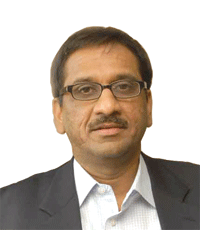
Navyug Mohnot
CEO, QAI


Please trace your journey from being an engineer to an entrepreneur.

QAI has been an interesting journey. When I returned to India after completing my PhD from USA,  there wasn’t much of an IT industry those days. There were only few companies that existed and an antenna on the top of the Texas Instruments building in Bangalore was a tourist attraction. With this as context, QAI India was set up fifteen years ago, in association with QAI USA to be an ‘enabler’ for the Indian IT industry to emerge.

India and the Indian IT has come a long way since. We started with helping companies with Quality and today our charter has increased far beyond that to helping global organisations facilitate Operational Excellence. We have been partnering the journeys of over 300 clients in 30 countries. We also have wholly owned subsidiaries in
Singapore, Malaysia, China, UK and most recently, USA.

What, according to you, are the major issues confronting the Indian IT industry today?

The economic meltdown that has brought the US economy to deep recession has also impacted the Indian industry. To face the current financial crisis, the Indian IT and BPO sector need to plan for a slower growth rate. As manpower is one of the most substantial cost factors, the biggest impact of the slowdown would be on company’s HR spends. Hiring would take back seat for most of the organisations; many would also be looking at reducing manpower.

In this hour of global meltdown it is important for the organisation to reduce cost while maintaining their competitive advantage. For this, organisations need to retain competent people. This is where training and certifying people becomes important.

What are your views on the standard of training that is provided in IT finishing schools, particularly from the employability perspective?
Current training provided by most IT Finishing Schools falls short of expectations by the corporate. Most of them are designed for teaching skills on programming languages.  Many IT schools fail to appreciate and educate the importance of process, quality, behavioral skills required for a job. Majority of the training is instructor led and the poor quality of the faculty affects the programme when you scale. It is very important to involve the industry practitioners in the programme to make it more meaningful.

How do you see the e-Learning market in India evolving? What are the key challenges or drivers?

The Indian e-Learning market today is estimated to be around US$ 122 million growing at a whopping CAGR of around 70%, while the global e-Learning market is growing at approximately 50%. The e-learning market is sitting at the cusp, waiting to explode. The timing, model and the value propositions are just right. In my opinion, the IT and the BPO sectors would consume huge market share of the e-Learning industry in the near future. The key challenge is that the e-Learning industry still faces conventional mindset which believes that e-Learning does not have as much credibility as classroom training. This challenge can be overcome by internationally recognised certifications or by a blended learning programme.

Please tell us about Six Sigma and its current application.

Six Sigma is a business strategy, which intelligently blends the wisdom of the organisation with proven statistical tools to improve both the efficiency and effectiveness of the organisation in meeting customer needs. At one level, Six Sigma is a philosophy – that all business problems need to be solved using a scientific and structured methodology. At other level, this is operationalised through a series of Six Sigma process improvement projects and through a well-developed tool set

Providing An Enabling Environment : Mrs. Anjana Prakash, Hansraj Morarji Public School, Andheri (West), Mumbai

Mrs. Anjana Prakash
Principal, Hansraj Morarji Public School, Andheri (West), Mumbai

“We do not believe in rote learning, instead we adopt such methods of teaching where a student’s involvement is more. We try to evoke interest in curriculum among the students”

What is your vision for quality education in Hansraj Morarji Public School?

Hansraj Morarji Public School is an institution which provides an enabling environment to its children to develop holistically. We believe in providing quality education to our students, for this we provide them the latest technology like computers with Internet facilities, Audio-Visual room with LCD projector to make teaching-learning more effective and interesting too.

In April this year, we also started a Junior college, which provides Science and commerce streams and has reserved seats for shoolchildren passing out of 10th standard.

Please tell us about the curriculum and learning methodology followed in the school.

We follow the Maharashtra State Board curriculum in our school. Apart from the curriculum, many other activities like Maths Club, Drama Club, Green Brigade Environment Club etc are a part of the student life at our school.  We also won the ‘Green School Awards’ in the year 1996.

We do not believe in rote learning, instead we adopt such methods of teaching where a student’s involvement is more. We try to evoke interest in curriculum among the students, due to which learning becomes easier. For this we equip our teachers with the latest technology in teaching which makes the learning process easier.

What major challenges  did you encounter while integrating ICT in education in your school?

A major hurdle which we faced is lack of knowledge among the teachers’ in this field. As such their involvement in IT usage was seen less. Teachers may find the conventional method of teaching easier than technology mediated education due to lack of expertise in this field. As the teachers may find it time consuming and more difficult to use it for expressing themselves, there may be a shortfall in communication between teachers and students.

The school management should also realise the importance of ICT in education so that relevant training programmes can be organised for teachers and adequate fund allotted for this purpose.

What are the initiatives taken up by your school for integrating ICT in school education?

ICT has been incorporated in our school sysytem for the benefit of teachers and students alike and they are using it to full capacity. We organise supervised training programmes for our staff to educate them on the proper use of internet. Teachers are encouraged to use ICT in their classroom teaching, do more research on their respective subjects through Internet and also assist students in usig it for their projects and class assignments. We have also started an inter-house competition on making projects on power points using Internet facility under the guidance of teachers.

How do you build teachers’ capacity in rendering technology mediated education?

Our teachers are encouraged to participate in various training programmes to enhance their knowledge in ICT use. We encourage them to take part in various inter-school competitions where the use of Internet becomes a must; this brings awareness among the teachers of growing importance of ICT in education. We also send them to various workshops to build awareness among them.
 
How do you see public-private partnership for enhancing proper use of technologies in school education?

I would vouch for the PPP model as private companies are better equipped to train teachers in the use of latest technologies owing to their research and advance knowledge in this field.

Partnering in Universalisation of Education : Shabnam Sinha, IL&FS ETS, India

Shabnam Sinha
IL&FS ETS

We are increasingly moving towards Public Private Partnership to impact the larger sectoral education initiative in the country. We work to supplement and enhance the quality of large educational programmes such as Sarva Shiksha Abhiyan(SSA)

Please tell with us about your company’s engagement with educational infrastructure. What are the goals and objectives?

IL&FS is one of India’s leading infrastructure development and finance companies. Our engagement in the field of education is through its subsidiary IL&FS Education and Technology Services Limited (IETS). We offer learning content and training modules for schools, colleges, vocational training institutes, governments, and the corporate sector.

How does IETS approach Public Private Partnership as an important aspect of expansion of education?

We are increasingly moving towards Public Private Partnership (PPP) to impact the larger sectoral education initiative in the country. We work to supplement and enhance the quality of large educational programmes such as Sarva Shiksha Abhiyan (SSA).

How do you support government efforts for universalisation of education?

We have been engaged in teacher training for a while, but we are now up-scaling. As part of the SSA, we have trained one lakh teachers in Jharkhand in two months. We also help the schools and classrooms in doing their MIAS and classroom management systems using technology platforms.

What are the challenges and issues that confront India’s education system right now?

There are many issues related to equity, in terms of social and gender dynamics, within the large education programmes. We in our interventions are covering girls, scheduled castes and scheduled tribes. We are working with the government of Delhi on 300 schools for enhancing the school infrastructure.

Talking about curriculum, can you give specific examples of how you go about it in schools that you are associated with?

Under PPP the schools are handed over to us in various states of dis-repair. And we are asked to give them a quality standard and a uniform and signature look. A protractor is actually drawn on the floor at the door, so when it opens it makes an angle. You can thus measure the angles that you are covering as you open the door. Thus each corner of the building becomes a learning corner.

What are the various other offerings of IETS?

Unlike most of the companies which are product oriented, we are process oriented as we work in the area of PPP. Our programmes are usually long term, from three to five years. Here I woould like to mention two critical programmes — one is the Delhi schools programme dealing with infrastructural changes. We are impacting 300 schools located in 202 buildings through this programme. So, we are doing this entire physical infrastructure upgradation for quality improvement. The other is that we provide complete holistic solution.

Talking about skill development, do you have any programmes for younger generation and college students, for enhancing employability of youth?

There is a very interesting programme which I would like to mention, i.e., Developing Life Skills package. We did this project with ILO. This Life Skills package was developed for child labourers and the unemployed youth to make them functional in a work situation. The package comprised 13 skills which were identified by us at the national level.

We are now planning to take this project to SSA schools for upscaling. The project is important as it has a strong component of entrepreneurship, negotiation skills, financial planning and budgeting involved, which is highly relevant in the current context.

Socialising, Humanising And Academising Children : V L Balasubramanian, Jawahar Navodaya Vidyalaya

V L Balasubramanian
Principal, Jawahar Navodaya Vidyalaya, Kasaragod, Kerala

Our learning methodology involves modern techniques of learning transactions through projects, group discussions, seminars, symposia, team teaching, etc

What is your vision for quality education in your school?

Quality is a process as well as a product. The ultimate aim of quality education is to help the child to re-orient his personality, whereby he turns out to be a worthy citizen capable of contributing to the world at large. We socialise, humanise and academise the child.

What model of curriculum and learning methodology is followed in the school?

The Vidyalaya follows the CBSE curriculum for both secondary and senior secondary examinations. Since most of the students admitted in class IV hail from rural areas having studied in regional language medium, the medium of instruction in classes VI and VII is mostly the regional language. However, efforts are also made to strengthen the communication ability in English language. Our learning methodology involves modern techniques of learning transactions through projects, group discussions, seminars, symposia, team teaching, etc. The ultimate aim is to make learning an enjoyable task.

What initiatives have been taken in your school for integrating ICT?

All subjects are taught through multi-media presentation, project based learning (PBL), language softwares (like Baraha, Madhuri) and interactive programmes in classes VI to XII.

The school library has a website, Vidyalaya Blogspot, specially raised in connection with UK-India educational initiative (UKIERI Programme) of which we are a partner.

ICT facilities are extensively used in co-curricular activities like quiz programmes, seminars, electronic painting competition, audio recording etc.

Training is given in advanced softwares like Adobe Audition, Photoshop, PageMaker, Flash Player, Dream Weaver, etc.

CBSE subjects like Computer Science & Informatics Practices are offered to the students in classes 11th and 12th to promote an affinity towards software development and computer engineering.

What challenges did you face while integrating ICT in your school?

Initially, the problem of inadequate number of systems was overcome with the help of MPLAD Fund and the Department supported the Vidyalaya with a VSAT connection. At present our school is equipped with sufficient number of computers, three LCD projectors and a separate functional room exclusively for multi-media, apart from the computer lab. Promotion of e-Learning is also carried out through the Vyasa educational channel.

In what ways are the teachers’ capacity built for rendering technology mediated education?

To enhance the teachers’ capacity in implementing ICTs in education effectively, comprehensive training has been provided to them along with specialised training organised by Oracle.com, Indian Institiute of Information Techbology, Intel programmes, etc. Leadership training programmes are also organised for teachers to take leadership in ICT implementation programme.

In what ways can Public Private Partnership enhancing technology in school education?

As part of partnership programme between schools in India and UK, JNV Kasaragod has been enlisted under UKIERI programme. This gives our students ansd teachers an opportunity to have international exposure and also to exchange serious research based projects in school education. Students of JNV have been presenting their projects through Oracle Think.com and the school has been awarded as the best school of the region by Oracle.

What initiatives do you plan to take up in future for effective integration of ICT in your school?

Some of the future initiatives of our school include: (1) to expand the computer facilities and e-Learning process with latest gadgets, (2) to take up a project as a pace setting activity to enhance computer awareness among parents during the next term, (3) to integrate the schools with community by training the elders in and around the Vidyalaya, and (4) to provide every student with a note book with campus wi-fi facility.

Access, Quality And Inclusive Education Mantra For Manipur : Shambhu Singh, Education Commissioner(Schools), Manipur, India

Model schools are being set up wherein the resources of the Government would be committed to deliver quality education exclusively

Shambhu Singh, Education Commissioner(Schools), Manipur

What role do you foresee for ICT in enhancing quality education?

Information and Communication Technologies have a critical role in enhancing quality of education. Though the teacher continues to be pivotal in delivering education to students, amongst the various enabling factors which ultimately ensure delivery of quality education, scope of ICT is unparalleled. For example, it facilitates better comprehension and understanding of various complex phenomena with ease. It also provides access to the unlimited source of digital information available through Internet. It can also play an important role in planning and administration, tracking the performance of individual teacher/student and prompt collection and dissemination of information.

Please mention some initiatives undertaken by the education department in enhancing the quality of education in your state.

Broadly speaking, the State government endeavours to provide access, quality and inclusive education. It is committed to ‘education for all’. While addressing the issue of access and quality, it is apparent that the two goals are divergent in nature and hence wherever the State government has adopted the policy of ‘one size fits all’, it has not been able to deliver quality effectively.

In brief, the State Education Department is making an attempt to review and re-assess the efficiency and effectiveness of its present policies and strategies and adopt such policies and strategies which will address the issue of access and quality separately. Model schools are being set up to deliver quality education exclusively.

e-Learning in various schools is also being taken up to broaden the horizon of the students. Efforts are also afoot to establish an MIS Cell in the Directorate of School Education with a dedicated website for dissemination of information to the public, with special focus on teachers and students.

Specify the challenges faced in integration of ICT in education in your state? According to you, what are the solutions to these challenges?

To harness the benefits of ICT in education it is imperative that the capacity building amongst the administrators, teachers as well as students takes place. Knowledge of computer with abundant hands-on practice is a pre-requisite. Hence, ICT in education has to be introduced in a phased manner by first giving adequate exposure and training to all concerned. Specifically the teachers should be encouraged to adopt computer enabled teaching. A unique problem associated with Manipur is the non-availability/irregular power supply which is compounded by law and order problems.

Manipur is a small but highly sensitive and complicated society. While generating content for e-Learning one has to take all sensibilities into account. The amalgamation of various tribes and the population of the Imphal valley have all different sensibilities and a balance has to be struck before virtual classes can start. As a result, we can depend on outside content providers only for pure sciences and possibly some languages.

In your opinion, should Public Private Partnerships be built for enhancing proper usage of technology in school education?

ICT per-se does not constitute the core activity of teaching-learning process and wherever feasible the supply and maintenance of its infrastructures could be outsource/privatised. There is no harm in the private sector providing the soft skills also, to the extent that it takes into account the local issues. Any public private partnership can however be made functional only when there is rule of law and contractual obligations can be enforced.

How do you envision your state school system with respect to implementation of ICT tools in the coming years?

In the present scenario of globalisation and rapid pace of changes taking place in terms of knowledge, employment opportunities etc, ICT has to become an integral part of education in the coming years. The Department envisions a school system in the future wherein the students would be empowered to access the unlimited source of WWW, shift from a memory-based to skill-based test, availability of lectures/notes on the web and also interaction between the teachers and students, parents and teachers through ICT.

Pro-Active Role Required For Facilitating Reforms In Education : Shakila Shamsu, Planning Commission, India

Among the many limitations and bottlenecks which India faces is the attitudinal factor, where there is a built in resistance to use technology
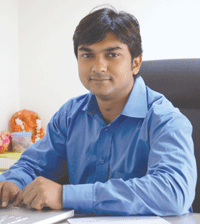


Shakila Shamsu, Joint Advisor (Education), Planning Commission

What objectives have been laid down in the 11th FiveYear Plan for catering to quality education in India?

The 11th Plan is an investment plan for Education and Health sectors. The education sector covering elementary, secondary, higher and technical education will greatly benefit from the thrust given in the current Plan period. The problems affecting quality of education – such as inadequate infrastructure, poor quality of faculty, outmoded teaching methods, outdated curriculum, lack of linkages between knowledge and skills – have been taken cognizance and appropriate corrective steps have been suggested. The Plan includes a coherent ICT based education both at the secondary and higher education.

All these can be achieved only if the States adopt a pro-active role in facilitating these reforms. States will have to protect the interests of the marginalised sections of the society through appropriate strategies as educational loans, scholarships, hostel facilities and other material assistance.

What role do you foresee for ICT in education? According to you, what are the reasons for India still lagging behind in ICT integration?

The buzzword today is ICT in education. But we need to assess the needs, usage and benefits of ICT in achieving educational objectives in a more realistic manner. Given my experience in Distance Education and Open Learning, ICT can produce optimal results only if both the receiver and sender are trained for its proper usage and attuned towards a common goal.

Among the many limitations and bottlenecks which India faces is the attitudinal factor, where there is a built in resistance to use technology. There is also a bias that greater use of technology will increase the existing digital divide. Another danger is of top down approach which results in adopting technologies unsuitable for our national or regional needs. Appropriateness of technology is crucial to the success of ICT applications.

In your opinion, how can we create an enabling environment for effective and efficient use of technologies in schools?

There is a general acceptance of the need to create technology enabled schooling environment. IT enabled learning would perhaps provide new directions in pedagogy and affect students achievement level. Technology seems to be the answer to several problems in educational settings, provided basic infrastructure such as computers and computer labs, multimedia labs, internet connectivity, power backup, etc, are ensured. In addition, human capital in the form of trained teachers competent to use ICT is also required.

What role does public private partnership play in enhancing technology usage in school education?

I strongly believe that there is great need to nurture public private partnerships for implementing ICT in school education. Majority of schools in our country are not equipped to effectively integrate ICTs in their activities. Private enterprise can do a great deal not only by supplying hardware and maintenance, but also help in developing content for teaching various subjects, especially in regional languages. Another area where private sector initiatives can contribute is teacher training by developing proper training modules.

Lastly, what would be your message for stakeholders in the education sector regarding an ICT policy on education in India?

Each one of us directly or indirectly is a stake holder in the education sector. Students, teachers, parents, educational administrators, heads of educational institutions, technology providers, all have a stake in education. The greatest stumbling block in the way of implementing an ICT policy in education is the attitudinal bias which is technology resistant. We need to correct our perspectives and ensure a blended and balanced use of technology along with the human capital to extend the frontiers of education in a global setting.

Note: Views expressed by the author in the interview are her own and in no way represent the Planning Commission’s views.

Fostering Collaboration and Learning The ‘iKen’ Way : Saurabh Saxena, Axiom Education

“The moment you keep the student, teacher, parent communities in isolation, it would limit their role in the education system. Every individual is a learner. Learning is a lifelong process and each individual can be a teacher and facilitator”

What makes India’s education sector a deserving case for implementation of ICT?

Over 26 million children join India’s primary education system each year which is even greater than the population of many countries. The challenge is to get adequate number of professionals to mentor these millions of new students.

If education remains people-centric, then we will have to find an army of professionals with skills for delivering this. Taking the sheer number into account, we need to ask, is this physically possible? And how long can we keep pace with this? This is where technology comes in as an enabler, in the form of components like computer, printer, projector, etc.

Please tell us about the idea of a collaborative platform like iken.in?

Today, we say technology has made the world a smaller place, that’s the real power of IT. It dissolves all boundaries because of Internet, telecom and other forms. Our intent was to create this platform within education to provide infrastructure to support people coming together and sharing their thoughts. A school with 1,000 students has a base of 2,000 parents, who may not physically be present in the school to contribute and hence technology can provide a platform here to support.

The moment you keep the student, teacher, parent communities in isolation, it would limit their role in the education system. Every individual is a learner. Learning is a lifelong process and each individual can be a teacher and facilitator.

Please tell us more about iken and how it fosters a collaborative approach?

We have built a complete collaborative platform portal, www.iken.in. ‘I’ means my and ‘ken’ stands for knowledge horizon. So, ‘I can’ do, this is what we wanted to imbibe. We have launched the beta version where users can share the experiences and publish their content online. Axiom’s own content is also available and we are open to collaborate with everyone, so that it becomes the biggest knowledge resource.

Collaborative learning through web seminars – students in India sit with students from other countries and solve academic problems – is a possibility at www.iken.in. You also have the best teacher training programmes available online. 

There are two sections on the website. One is for the students and the other is for professionals, we have included graduate students also as professionals. There is a segment called ‘create’ where you can draw up your own content and publish it as a learning resource. The section ‘Learn’ has all the ratified content from various recognised content providers across the world. The ‘connect’ segment provides the convergence model to connect to community of mentors, project advisors, peer groups, study groups, etc.

What is your vision for the website five years from now?

Five years from now, www.iken.in is going to be the preferred mode of education delivery across all levels. Education will be more customised, which is the need of the hour, and more individualist catering to their talents and learning curves. People will identify and work upon their strengths and weaknesses.

What are challenges that were seen in bringing this mode of education delivery in formal education system?

Benchmarking ourselves has been difficult as ours is a unique solution. So we found it difficult to improve and upgrade as we had nothing on the same lines to benchmark against. A major bottleneck is going to be the infrastructure.

Lending Collaborative And Analytical Approach to Learning : Ms Madhulika Sen, Tagore International School, Vasant Vihar, Delhi

Ms Madhulika Sen
Principal, Tagore International School, Vasant Vihar, Delhi

“Our curriculum and learning methodology are based on a collaborative, experimental and analytical approach which fosters the creative thinking process in a child”

How does Tagore International School ensure quality education to its students?

We believe in providing a holistic and progressive education which empowers every child with the skills required for the 21st century in a global context.

Please tell us about the curriculum and learning methodology followed in the school.

Our curriculum and learning methodology are based on a collaborative and analytical approach which fosters the creative thinking process in a child. For this activity based lessons and educational outings based on syllabus are planned. Our children use powerpoint presentations to reinforce their assignments, while teachers use audio visual aids such as OHP, TV, video, charts, models and slides to make teaching more effective.  To sum it up, we have facilitated the shifting of the methodology from ‘teaching’ to ‘learning’.

We are also part of the UK India Education and Research Initiative (UKIERI) programme that facilitates strategic partnerships and design and development of joint curriculum projects between schools in India and the UK. As part of the DUKE University Talent Identification Program (Duke TIP) under UKIERI, two students from our school were selected to attend a three week summer training programme this year at IIM Ahemdabad. Apart from this, online exchange programmes are also conducted with schools in Bulgaria, Romania, Japan regarding curriculum, culture studies, etc.

What is the major challenge in integrating ICT in education?

Most of the schools are engaging in a big way to provide technology enabled teaching and learning in their facility. But a major challenge is the inability of our parents to provide a computer and/or Internet facility to their child at home.

What are the initiatives taken up by your school for integrating ICT in school education?

We have three computer labs with 20 computers each exclusively for the students. There are two K-12 labs exclusively for the teachers. Our Social Science, EVS and Math labs are equipped with interactive boards. Classes 6-8 also use an online Math programme from Educosoft, which is integrated with their curriculum. Classes 1-8 use the EZ Vidya Programme which amalgamates learning of soft skills with the curriculum.

These initiatives are all integrated into the class timetable, thus ensuring that every student is familiarised with the use of technology in learning. The Language lab has a complete Audio-Video system that facilitates exposure to speech, drama and other nuances of language. Every class also visits one of the two Audio

Building Knowledge Repositories Through R&D : Prof Krithi Ramamritham, Educomp, India

Prof Krithi Ramamritham
Dean R&D, Industrial Research & Consultancy Centre (IRCC), IIT Mumbai

“IITs build the knowledge skills of students and we hope to empower a larger pool of people with these skills to take on new challenges of technology”

What role has ICT been playing at IIT Mumbai?

At our institution, ICT is used in two application areas of administrative functioning and as a research tool in R&D activities. Infact, majority of our administrative work has become paperless, which ensures its smooth functioning. We use IT in our internal management of research, finances, academics, management of grades, students registration, etc. The applications used are home-grown, comprising off-the-shelf open software, and we add some local customisation to it. 

Please elaborate on the various research projects currently on in the field of ICT at IIT Mumbai.

When you look at emerging nations like India, you see a research gap between needs and the available technology. We have tried to bridge this gap in collaboration with the industry and academia. IIT Mumbai was one of the first labs of Media Lab Asia. We started functioning as part of Media Lab Asia five years ago and continue to develop ICT based solutions for developing countries. We have had several success stories and the most exciting of them is AQUA (Almost All Questions Answered), which has been active for the past 3-4 years with the support of World Bank. Through AQUA, we answer queries of farmers in rural areas on crops, weather pattern, etc.

For those areas in India which do not have Internet connectivity, we have mobile-enabled and voicemail services on forecasts that gives real-time forecasts, including crop specific disease alerts.

We have also done extensive work in the area of ICT for education, such as teaching the children of nomadic tribes through laptops using content created locally in villages; creating content in Marathi for schools in Maharashtra thus enabling them to use  IT for education delivery. We were also behind the creation of a portal called Shiksha, which is a repository of educative content.

What are your plans for R&D efforts at the institute in the coming years?

We have a Developmental Informatics Lab where we work on technologies for development, carrying out customisations. We are developing a portal ‘Eklavya’ for mentoring engineering students and teachers to reap the benefit of IIT faculty expertise. We are waiting for government funding to take it to the next level. We are also working on an IT curriculum for primary education and have come out with a book for classes 1-5. We are in the process of implementing the integrated applications of IIT technologies at block level, called the Rahata Block Development Programme. The idea is to deploy technologies to empower people and make them self-sustaining in resources and finances and help them build entrepreneurship.

The centre has proposed establishment of new IITs under the mentoring of existing ones. Which new IIT centers are being supported by IIT Mumbai?

We are currently mentoring two new IITs at Gandhinagar, Gujarat and Indore, Madhya Pradesh. Our faculty visits these institutes and conducts lectures. In due course of time we hope to put in place a dedicated staff for teaching and administration at these places. Expanding IIT faculty is difficult so we have to make the best use of resources at hand. Hence, with the help of our distance education programme, which has the facility to transmit live lectures along with a question and answer session, we broadcast our courses live on EDUSAT.

IITs build the knowledge skills of students and we hope to empower a larger pool of people with these skills to take on new challenges of technology.

From Empowerment To Engagement : Dr Manmohan Sharma, Educo International, India

Dr Manmohan Sharma
President, Educo International

“Our mission is to ’empower the teacher to engage students’ by capturing in digital media, well known presentation and assessment techniques”

Please tell us how Educosoft was conceptualised?

Educosoft has evolved from my own experiences as a teacher for more than 40 years, enriched with inputs from educators across the world through interactions at seminars, conferences, and research symposia. Based on these, we identified three critical areas where appropriate technologies can help improve quality of instructional outcomes:

To empower the teachers to be more effective as presenters and discussion leaders in classes,

  1. To provide technology tools and question banks to teachers that can assist in periodic assessment

  2. Technology tools must be easy to use and learn and help teachers save time

How effective is the Educosoft online learning system in enhancing the performance of students?

Our mission is to ’empower the teacher to engage students’ by capturing in digital media, well known presentation and assessment techniques. Educosoft provides class notes replete with graphics and animations, tools like online grade book, online homework and frequent self assessment, communication tools (announcements, e-mailing, and chatting), survey creation and administration, and features to add content or create custom courses, tutorials, varieties of tests with solutions, etc.

Educosoft turned out to be more effective than our expectations. Its effectiveness has been measured in several ways, including national surveys in the US; published PhD dissertations; results of student performance in state examinations; and comments from principals, teachers, and students exposed to this system.

What kind of feedback have you received for your product in India?

Educosoft was officially launched in India in April 2008 after piloting its use in some select schools in National Capital Region. In the last eight months, we have organised 34 seminars attended by 1357 teachers from 456 schools. After each seminar, we conducted half day training sessions for seminar participants. Almost all teachers exposed to Educosoft have endorsed this platform as unique and comprehensive than any other initiative. There are however, some implementation hurdles related to the lack of appropriate technology infrastructure in schools and resistance to the use of internet. To counter these, we have launched a new initiative by providing schools with Local Area Network (LAN) solution to deliver content.

What pattern does Educosoft follow for its assessments?

We follow a unique pattern as all assessments including home work, section quizzes, chapter tests, or comprehensive course tests are delivered in Free Response mode. Students have to work out the solution and enter the answer on screen, instead of clicking an option in multiple choice. If the answer is correct the system will grade it correctly. All assessments are recorded automatically and saved for review later. Homework assignments have built in tutorials and all tests provide instant feedback, with step-by-step solutions. Another very powerful feature is SMS messages or e-mails to keep parents informed about their ward’s progress.

Are there any plans to cater to other subjects apart from Math?

We will have science courses by the beginning of the new academic term in April 2009. For sciences we will be having additional component of actual simulated labs, along with the theory presented in the same format as in Math courses; embedded with illustrations through dynamic graphics and animations.

LATEST NEWS