



Home Blog Page 765

Ed-tech Startup Avagmah raises fund for Technology Enhancement

Avagmah, a Bangalore-based ed-tech startup focussed on higher education, founded in 2013, announces investments by Kris Gopalakrishnan, co-founder and former CEO & MD of Infosys and Atul Nishar, founder of Hexaware and Aptech Computer Education. In the last 18 months Avagmah has secured $5 million in investments. In the same time, it has grown 8 times, and has already become operationally profitable.

Avagmah will use the latest investment on technology enhancement in acquiring new Indian university clients. It currently works with three universities that include Pondicherry University, Bharathidasan University and Los Angeles-based UCLA Extension.

Kris Gopalakrishnan, said, “The current brick and mortar higher education system is facing major challenges of excellence and access, with only 24 million students enrolled out of the potential 120 million. Universities and top tier institutions have to adopt technology to provide access to quality education to millions of working professionals and students in urban and remote India, which would then address the demand-supply gap of skilled talent. I see great potential in startups like Avagmah which can bring in positive disruption in our education system through technology.”

Avagmah provides state-of-the-art intuitive Avagmah Technology Platform (ATP) on a managed services model, assisting universities with digital marketing technology. It also provides application-based and web technology solutions for delivery of courses by universities. Avagmah offers web and mobile app platforms, helping universities manage the entire lifecycle of their students including marketing, admissions and other administration processes.

Atul Nishar, said, “Shortage of quality faculty is the single major challenge which universities are facing today. Universities will gradually resort to using technology to increase their reach and ease faculty access to students. I firmly believe that education technology players like Avagmah will play an important role in the future of education in India.”

Karthik KS, Founder and CEO of Avagmah said, “Avagmah spent the first two years in building a robust collaborative technology and demonstrating its business model at three of the university clients it had acquired. We are satisfied with the success in the initial phase, with one of the university clients reporting 200 per cent growth in student enrollment in 12 months which reached itself to a much larger audience using Avagmah’s technology and services. Avagmah is now focussed on scaling its success to grow 10x in the next 2 years.”


FlipClass raises $1 m from S Chand & Blume Venture

FlipClass, a Bangalore-based home and online tutoring startup, has raised $1 million in funding from education content and services provider S Chand and Company Pvt Ltd (S Chand) along with Blume Ventures.

Founded by Vineet Dwivedi, an IIT Kanpur graduate, FlipClass is a technology platform that connects tutors and students to provide effective home, online and mobile tutoring solutions. It also has an inbuilt assessment tool to gauge student learning and provide key inputs that help improve performance. The platform recently launched a doubt clearing mobile app FlipTutor, which uses Whatsapp like interface to provide answers in real-time.

Vineet Dwivedi, Founder and CEO, FlipClass, said, “FlipClass has an active database of 4,000 students and 10,000 tutors and has delivered over 200,000 hours of home and online tuitions. We are very excited to have S Chand invest in our platform. We will also look to integrate their content with our learning tools and provide a more enriching experience to students.”

Gaurav Jhunjhnuwala, Director, S Chand, said, “S Chand aspires to lead the knowledge ecosystem and support management teams building disruptive technologies in the educational services and content space. Investing in FlipClass is a step in this direction.”

“At Blume, we are core believers of edtech and its ongoing relevance for years to come. Even with the advent of online solutions, home tuition and tutors continues to be a huge market with innate problems of discovery and selection. This is where we believe FlipClass will play a significant role by aggregating tutors and parents onto a single platform. Equipped with unique tech tools that help parents assess their child’s progress, FlipClass has a high engagement and retention rate,” said Karthik Reddy of Blume Venture Advisors.

NIIT.tv ties up with SASTRA University to support Engineering Students

NIIT.tv, a disruptive innovation by NIIT, will now offer support to students pursuing B.Tech and M.Tech degree programmes by helping them with their curriculum and beyond, with an aim to improve employability and job readiness of engineering graduates in India. To this end NIIT.tv has entered into a significant tie-up with SASTRA University, one of the leading universities in India, situated in Thanjavur, Tamil Nadu. Sessions delivered by expert faculty members of the University will be broadcast on NIIT.tv, an internet based learning portal. Programmes on Biomedical Nanotechnology, Biosensors and Control Systems will be available in the initial stage and will soon expand to other engineering, management and law disciplines including coaching for competitive exams like GATE, etc.

Between NIIT and SASTRA University, learners go through a complete multi-modal digital platform, experience free – tutorials, videos, live synchronous classes, e-books, interactivity, discussion forums, assessment, etc, thus making the combined ecosystem the richest, widest and the deepest learning environment for students pursuing B.Tech and M.Tech programmes. The two learning destinations will enable a more seamless experience for their respective users in their pursuit to find learning material that is more suited to the skill sets required by the industry.

Commenting on this significant tie-up, Udai Singh, Chief Strategy Officer, NIIT Ltd said, “We launched NIIT.tv with an aim to make available cutting-edge skill based training to every digitally connected citizen of India, by removing the four constraints of time, space, language and money. Through this significant tie-up with SASTRA University we will now use the platform to provide relevant skill sets to aspiring engineers and make them job ready for today’s competitive corporate environment”.

Dr S Swaminathan, Dean of Sponsored Research at SASTRA University and head of this new collaborative initiative, said, “SASTRA’s decision to leverage NIIT.tv’s platform wherein to engage with a wider cross-section of learners will disrupt conventional teaching-learning mechanisms in offering quality higher education, thereby making it inclusive, affordable and accessible. This initiative is also aligned with the Government of India’s digital drive and MHRD’s National MOOC mission.”

Mission Quality Education

Ritesh Singh, CEO, Eckovation

In order to connect parents with teachers and students while also safeguarding everyone’s privacy and to make quality education accessible, Eckovation came into existence, shares Ritesh Singh, CEO of Eckovation with Elets News Network (ENN)

Why prompted you to launch the initiative?

I am from a Tier III town – Chhapra in Bihar. Although I was an average student during school, the coaching I received in Kota helped me crack IIT-JEE entrance exam. When I came to IIT, I interacted with other students on a sustained basis. I was quite shocked at the quality of education that they had access to in their cities. Lack of quality education implies denial to equal opportunity and traps economically disadvantaged people in a vicious cycle.

I always wanted to make quality education accessible even in places where only minimal infrastructure exists. That’s how Eckovation came into being.

What was the most challenging part of setting up your company?

The most challenging part was identifying critical issues and fitting solutions that could directly impact quality of education. Before we finalised the concept of the product, Akshat (co-founder of Eckovation) and I travelled across the country and researched the market for almost a year. We first explored MOOCs, but they were cumbersome and required a lot of self-discipline on the users’ part. Next, we thought of providing data analytics through an ERP system that monitors a child’s performance and equips teachers and parents with sufficient data to improve a child’s performance by finding gaps, weaknesses and strengths. But looking at the size of a normal classroom, the actual implementation seemed extremely difficult and would have required greater efforts from the teachers instead of simplifying their lives.

We also did a pilot study with 30,000 students across four cities to understand the gaps. We observed that parents are not in the loop, when it comes to classroom teaching. The turnout of parents for PTMs is a mere 15-20 per cent. This needed to be fixed. So, we decided to build a product that brings together all actors of education – parents, students, teachers and school administration. Eckovation not only helps connect parents with teachers and students while safeguarding everyone’s privacy, but it also connects students to teachers who are willing to transfer knowledge beyond their classrooms.

Who do you see as your target audience? How are you reaching out to them?

Everyone who falls in the category of an educator or a learner at any point in their lives is our target audience. Our best outreach is through network effect. However, we also engage with our audience on social media and traditional media.

What are the major benefits for institutions/individuals adopting your solutions?

Eckovation has something to offer to everyone. Since communication is the heart of education, institutions are using it for school-level and classroom communications. We recently launched “I Teach India” campaign that urges individuals to create groups and teach subjects of their choice. Since users are the best judges of quality, the algorithm allows penetration of only high quality groups, thereby ensuring quality.

How much competition do you have to face, and what is the biggest hurdle you come across?

In terms of competition, there are quite a few international players, however, none in India so far. Also, our biggest challenge is limited smartphone penetration. But, we are quite hopeful looking at the rate at which it’s growing. This has inspired us to innovate and feature the SMS integration technology on the mobile and web platform.

Where do you see your company in 5 years time?

We want to help set the standard for quality education in the next five years and be present in everyone’s smartphone as app, if they want to learn anything. We aim to reach 1 billion users by 2020.

McGraw-Hill Education’s Digital Units sales exceeds Print


McGraw-Hill Education, a learning science company, informed that in 2015 unit sales of digital platforms and programmes exceeded those of print in its US Higher Education Group, for the first time. In the previous year, the company also expanded the number of adaptive offerings for US higher education to over 1,400, up from 40 in 2012. Increasingly, educators are turning to adaptive programmes, which have been shown to improve engagement, student retention, test scores and pass rates. The company saw double-digit growth in activations across its key digital offerings in 2015. The key digital platforms and programmes that reported strong year-over-year growth are Connect, LearnSmart, SmartBook and ALEKS.

David Levin, President and CEO, McGraw-Hill Education, said, “Our transition to providing digital products that offer better outcomes at meaningfully lower prices is going really well. In fact, as students returned to college in early 2016, they activated 1.2 million subscriptions to our Connect platform during January and February, a double-digit increase over the previous year.”

“We are also delighted that for nearly all the courses for which students purchase Connect, they can also order a loose-leaf print version of the textbook for as little as $25 and we continue to encourage those who want print alongside digital to use this very inexpensive option,” he added.

MHRD constitutes Committee on ‘Yoga Education in Universities’

A Committee on ‘Yoga Education in Universities’ has been constructed by Ministry of Human Resource Development (MHRD), informed Shripad Yesso Naik, Minister of State for AYUSH (Independent Charge) and Health & Family Welfare.

The Committee has been constituted with the following terms of reference:

  • To identify the courses and programmes in Yogic Arts and Science and the levels at which these can be offered;
  • To spell out the scope of programmes offered at Certificate, Diploma, Degree, Post Graduate Degree/Post Graduate Diploma and research levels, and to develop broad details of the curriculum in the core and elective courses thereof;
  • To prescribe the syllabus for conducting National Eligibility Test (NET) in Yogic Arts and Science;
  • To determine the eligibility qualifications for students for joining Yoga education programmes at different levels;
  • To prescribe the qualifications of faculty of Yoga in Colleges and Universities and also to examine whether the existing qualifications for recruitment of the faculty in the Colleges and Universities as presently approved by the UGC, will need amendments;
  • To identify universities, where Departments of Yoga also exist and to consider whether they can be upgraded to be developed as Departments of Yogic Arts and Science.
  • To suggest the names of national level Yoga centers whose expertise can be networked with universities where Departments of Yogic Arts and Science will be established;
  • To determine the modalities of further training of persons who may be recruited with their present background in the field of yoga.

81% Test Owners in India believes CBT is more Reliable

Divyalok Sharma, Director - Client Development, Pearson VUE

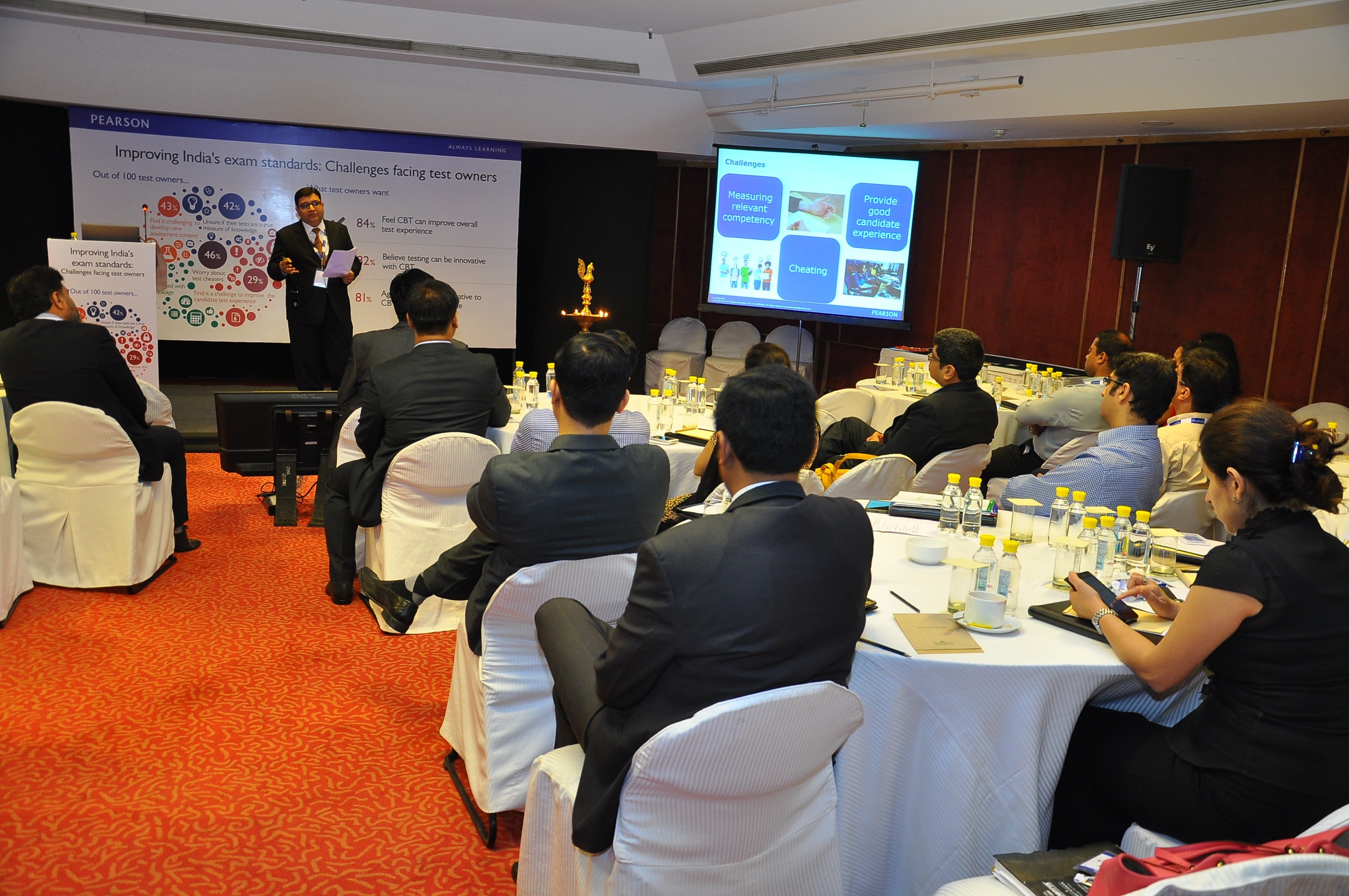
A potential trend of test owners are moving from pen-and-paper to computer-based testing (CBT) delivery in India, reveals a recently published report. Of the 47 per cent, who currently use pen-and-paper, 33 per cent said they are likely to move to CBT in the near future. The vast majority of all test owners, i.e. 81 per cent stated that there is no alternative to CBT as it is more reliable.

The study, conducted by Pearson VUE in partnership with IMRB, surveyed senior managers from 100 exam-owning companies and institutions in the medical, legal, finance, IT and higher education sectors. About 43 per cent reported challenges in developing new assessment content, and 38 per cent expressed difficulty in maintaining the relevancy of their assessment. The survey reveals the challenges of knowing whether an exam accurately measures relevant competency, with 38 per cent test owners finding the restrictions of the exam format itself a challenge – which may in part have an impact on the ability to fulfil the test purpose.

The report, “Improving India’s Exam Standards: Challenges Facing Test Owners”, also found that about 46 per cent are concerned that candidates are cheating in exams, and a third are concerned with candidate impersonation. There is also concern about test paper leakage (39 percent), which is a problem associated with pen-and-paper rather than CBT.

Divyalok Sharma, director of client development at computer-based testing company Pearson VUE, said, “Assessment content, or in other words the test questions, is the lifeblood of an exam. Focusing on that content is key to the success of an exam programme, along with finding ways to make exams more relevant not only in terms of legislation and up-to-date processes, but also making sure it is relevant to the professional role that person will eventually hold. It is equally important for test owners in India to review their current test development practices and standards and follow international best practices in testing.

“There are a number of inter-related factors and processes that can cause an exam to succeed or fail, including understanding of test objectives, robust test design, appropriate test format, good quality test questions and the statistical analysis of questions. These factors also contribute to the ultimate goal of creating a valid, fair and reliable test,” he added.

Imarticus raises Investment to expand eLearning Business

Imarticus Learning, a platform offering certified industry-endorsed courses, has raised a round of funding from a bunch of investors. These include: Amit Nanavati, Investor and Entrepreneur;  Tashwinder Singh, Director, KKR; Anil Gudibande, 1 Crowd Founder/Ex MD RBS; Taranjit Jaswal, Director, Barclays; and, Amit Khanna, Ex-KPMG Partner. The newly raised capital will be used to expand the eLearning business in India as well as in the Asian Markets.

Nikhil Barshikar, Founder and MD, Imarticus Learning, said, “The company has been aggressively expanding its product portfolio in Finance and Analytics for its B2C segment while building out a comprehensive B2B portfolio, which includes Staffing, Agile Hiring and Corporate Training. It has developed over 20 programmes available through offline and online delivery channels. The B2B portfolio has corporate training, train and hire mandates and management development.”

With an estimated $100 billion market size and a growth rate of over 18 per cent, the education sector in India alone is poised to witness major growth in the years. Asia is the second largest market with revenues from e-Learning products in Asia projected to reach $12.1 billion in 2018, up from $7.9 billion in 2013. The goal will be to set up a state of the art technology infrastructure to help scale the retail platform domestically and internationally, focusing initially on the UAE, Hong Kong and Indonesia markets.

Uttarakhand to Promote Girl Education

A special scheme would be launched to promote girls education belonging to backward classes and the minority community in Uttarakhand, said Chief Minister Harish Rawat. The state government would take all the necessary steps to provide more funds under the Maulana Azad Foundation and Hunar Scheme.

The Chief Minister said, “The concerned officials had been directed to draft a scheme to make sure that girls belonging to minority community continue with their education.”

“Various plans are in the pipeline to overcome shortage of teachers in government schools. The government is committed to providing quality education to students enrolled in government schools,” he added.

“Skill development education with spiritual and academic education should be imparted in minority educational institutes of the state,” he further added.

Need to Increase Funds for Higher Education

The universities and centres of higher educations should not be starved of funds for infrastructure and creating avenues for research and development activities for students, said Prof HM Maheshwaraiah, Vice-Chancellor, Central University of Karnataka.

Prof Maheshwaraiah said that the New Education Policy should address all the issues concerning higher education and make access to higher education easy with more number of colleges and universities. He was speaking at the inauguration of a two-day state-level seminar on “Higher Education: Opportunities and Challenges” organised jointly by Hyderabad Karnataka Government College Professors Federation and Gulbarga University.

“In India, there were 38,500 colleges and 700 universities, including private universities. This was grossly inadequate when compared to the population of youngsters seeking higher education in the country. The disparities in the allocation of funds by UGC among Central Universities and the conventional universities should end,” he said.

“At present, 80 per cent of UGC grants was given to 39 Central Universities, while 20 per cent of grants is shared among 700 universities. This disparity should end,” he added.

He stressed that the State government should increase allocation for education in the budget to provide more funds to universities to improve infrastructure and fill all vacancies. Most of the grants given by the State government go to the payment of wages of teaching and non-teaching staff and very little amount was available for meeting the demand for infrastructure.

Prof Maheshwaraiah said that the universities should diversify academic activities and move towards providing vocational courses at the undergraduate and postgraduate levels to professionals and introducing massive online programmes to offer courses online to professionals and those who cannot attend classes in universities.

LATEST NEWS