Home Blog Page 773

HC empowers Govt to Regulate Fee Hike in Private Schools

Court OrderIn a landmark verdict, the Delhi high court put an end to what it called “profiteering and commercialisation of education” and empowered the state government to regulate fee hike by private schools.

The court ruled that fee hike by private unaided schools, who got DDA land at concessional rates, requires prior sanction from the Delhi Government’s education department. The order is expected to curb arbitrary fee hike

A bench of Chief Justice G Rohini and Justice Jayant Nath held, “It is clear that schools cannot indulge in profiteering and commercialisation of school education…Quantum of fees to be charged by unaided schools is subject to regulation by DoE under Delhi Schools Education Act and it is competent to interfere if hike in fee by a particular school is found to be excessive and perceived as indulging in profiteering.”

The court further ordered DoE to ensure compliance. It also directed DDA to take action against those private schools which violate the embargo on fee hike in the letter of allotment of land.

We can’t afford to produce professionals who fail to meet skill levels, President

President - Shiv Nadar“Access to learning opportunities and the pursuit of excellence must both receive equal attention,” says the President Pranab Mukherjee, while inaugurating the Shiv Nadar University on January 18, 2016 at Dadri, Gautam Buddha Nagar (Uttar Pradesh). He also laid the foundation stone for its faculty residential campus.

The President said that private institutions account for about 60 per cent of the students enrolled in higher education. “Though proliferation has led to greater access, its negative fallout on standards is alarming. If the declining quality of education particularly in the area of higher learning is not reversed quickly, we will land ourselves in a scenario of having a large number of people with degrees but not enough manpower with proficiency. We cannot afford to produce workers and professionals who fail to meet the skill levels required by a growing economic system,” he adds.

He expressed happiness that in 2015, two Indian institutions for the first time have been ranked within the top two hundred Universities in international rankings. He was confident that many more will join in the coming years.

JCU to conduct Scholarship Tests in Mumbai, New Delhi and Chennai

JCUJames Cook University (JCU), Singapore is conducting the assessment tests in Mumbai, New Delhi and Chennai in the month of January/February 2016. The scholarships will be covering up to 50 per cent of the course fee for the Master’s Degree and Bachelor’s Degree programmes. The University has been organising scholarship tests across India since the past six years, to support the educational journey of promising students.

The JCU scholarships are given to meritorious students based on the two-hour long test conducted by the university and assess the students on their English Language Skills and Aptitude. The assessment test will be essentially based on four topics, namely, Antonyms, Sentence completion, Mathematics based questions and General Knowledge Questions.

Candidates, who are planning to pursue their studies (either Bachelors or Masters) and wish to apply for the scholarships must do it before appearing for the test. Meanwhile, they must have a score of 60 per cent or above marks in their higher secondary examinations or Bachelor’s degree.

Established in 2003, the university offers a slew of scholarships. For the Indian students, the scholarships are worth S$16050 (approx INR 8 lakhs) for Masters’ Degree in the field of business, IT and tourism and S$23832 (approx INR 11 lakhs) for Bachelor’s’ Degree in subjects like business, IT and psychology.

Education in the Present Era

Kalpana Nath, Principal, The Chintels School

Kalpana Nath, Principal, The Chintels School shares with Elets News Network (ENN) about the challenges in school education, qualities of a best school, parents involvement in child education, role of technology in education, Chintels’qunique proposition and more

Challenges in School Education
Today, the main challenges regarding education are the various competitions students have to face to be successful in life, in order:

  • To keep at par with national and international level of education and technology;
  • To get admission in the colleges of their choice.

Qualities of a Best School
The qualities that make a best school are:

  • Excellent infrastructure such as spacious, wellventilated classrooms; cleanhygienic washrooms; activity rooms with latest gadgets; science and computer labs with latest technology, etc. Big sports field, swimming pool, gymnasium,
    library, audio-visual rooms and auditorium are also essential for a good school;
  • Highly qualified faculty, who are dedicated and always eager to update their knowledge; knowing the latest technology to help in teaching. And above all imparting values of life to the students;
  • Should be headed by a well-experienced principal, who should be openminded to bring in the required changes in the school;
  • Management should hire well-trained and hardworking office-staff and Grade IV employees for official work, maintenance and cleanliness of the school;
  • Ambience should be environmental friendly;
  • Students should be guided and encouraged to participate in competitions and extracurricular activities so that later in life they can face any challenges that can come in their way.

The Chintels: Imparting High Moral Values
The Chintels School is different from others, due to the following qualities:

  • A team of dedicated, sincere, hard-working teachers guides, motivates, educates the students to do their best;
  • The students excel in their academics  performing excellently in the ICSE/ISC Board results and proving themselves in the city and state level;
  • In various interschool competitions, students of junior and senior classes have won top positions at the city and state level, bringing glory to the school;
  • The Chintelians have high moral values and are well-disciplined.

Parents Involvement in Education
I agree that positive parent involvement has a significant impact on student education. When parents take keen and positive interest in their child’s education, the students are motivated to do well in academics and competitions.

Role of Technology in Education
In this rapidly changing world, education too cannot escape the impact of technology. The presence of Internet itself has revolutionised the process through which we access and disseminate information. It has created a global platform for the students. The process of assessment has become efficient. Students can now take online tests. The interaction between students and teachers has improved. The most important factor is that there is an instant access to information and e-books.

Keeping with the Changing Demands
The teachers at The Chintels Schools use both traditional and modern methods of imparting knowledge to the students. Through seminars and workshops, the teachers update their teaching methods and keep abreast with the changing demands.

Professional Achievements
I feel proud that my students have performed brilliantly in academics and co-curricular activities and competitions, bringing laurels to the school.

This, I feel, is my achievement too which could not have been possible without the hard work of the teachers. One can never stop learning because life never stops teaching.

eduDESTINATION Progressive Index

progressive_indexSmart Education is an integral part of the entire precept of Smart Habitations. As a part of digitalLEARNING School Perception Survey, the chosen eduDESTINATIONS were subjected to a social poll. Some of the eduDESTINATIONS performed overwhelmingly well in this social poll, while others kept guessing about the intent of the same and couldn’t open up their tally. The extent of participation in the aforesaid social poll has somewhat a co-relation to the overall progressiveness of the concerned eduDESTINATION.

Based on the Social Perception Survey, following is the Progressiveness Index of eduDESTINATIONs of the country.

eduDESTINATION STATE ZONE PROGRESSIVENESS INDEX
Chandigarh UT North 1
Hyderabad Telangana South 2
Jaipur Rajasthan West 3
Ludhiana Punjab North 4
North Mumbai Maharashtra West 5
Noida Uttar Pradesh North 6
West Delhi Delhi North 7
South Delhi Delhi North 8
Bengaluru Karnataka South 9
Central Delhi Delhi North 10
South Mumbai Maharashtra West 11
Kanpur Uttar Pradesh North 12
Vadodara Gujarat West 13
Indore Madhya Pradesh Central 14
West Mumbai Maharashtra West 15
Gurgaon Haryana North 16
Allahabad Uttar Pradesh North 17
Kochi Kerala South 18
East Delhi Delhi North 19
Chennai Tamil Nadu South 20
Guwahati Assam East 21
Lucknow Uttar Pradesh North 22
North Delhi Delhi North 23
Cuttack Odisha East 24
Dhanbad Jharkhand Central 25
Ajmer Rajasthan West 25
Ahmedabad Gujarat West 26
Vijayawada Andhra Pradesh South 27
Gwalior Madhya Pradesh Central 28
Muzaffarpur Bihar Central 29
East Mumbai Maharashtra West 29
Bhubaneswar Odisha East 30
Alwar Rajasthan West 30
Bokaro Jharkhand Central 31

Why Do Educational Institutions Need Mobile Apps?

Gaurav Mundra Co-Founder & CEO, myly
Gaurav Mundra
Co-Founder & CEO, myly

Gaurav Mundra, Co-Founder & CEO and Madhup Bansal, Co-founder & COO, myly share with Elets News Network (ENN) about the need of mobile apps in educational institutions, myly’s unique proposition, benefits for educators, students & parents and more

What is the need for mobile apps in educational institutions?

Although education leads to technology improvement, but the implementation of technology for improvement of education delivery has been in a sorry state till now. Most of the educational institutes are still using age-old methods, even in this digital age.

Educational institutions need to adopt mobile app solutions not just to look smart but to actually act smart. Mobile apps lead to better, cheaper and faster communication and transaction enablement. Mobile apps enable customised and personalised learning, content delivery, assessment and feedback, improving quality of learning, etc.

Which type of educational institutes can use a mobile app?

Any and all types of institutes can and must use mobile apps – schools, colleges, universities, tuition classes, coaching centres and hobby classes. There is no restriction of minimum number of students to adopt an app.

What are the key features that educational institutions must look for in a mobile app?

There is no limit to features you can have in a mobile app. To begin with, any app must have:

  • Bi-directional messaging between educators and students/parents;
  • Ability to share homework, circulars and exam schedules;
  • Attendance notification of student’s absence;
  • Ability to create events’ and holidays’ calendar;
  • Gallery for sharing images and videos;
  • Fees payment via multiple online channels.
Madhup Bansal Co-founder & COO, myly
Madhup Bansal
Co-founder & COO, myly

With several players in institute-home communication space, what is unique about myly?

First, myly is completely FREE for educational institutions, students and parents. We guarantee our customers that the current offering will remain free for life. We will introduce various optional value-added services that customers may use at a small fee.

Second, myly is useful for all types of educational institutions: schools, colleges, universities, tuition classes, coaching centres and hobby classes.

Third, myly is transaction-enabled. It is designed to allow payments via net banking, credit/debit card and mobile wallets.

Fourth, myly is extremely easy to setup and use. Our typical turn-around from sign-up to go live, including training, is only two days.

Please share the vision and mission behind myly?

myly was born out of the common frustration of co-founders Gaurav Mundra and Madhup Bansal, about not getting timely information from their kids’ schools. The conventional means of communication like diary and circulars are grossly inefficient in this digital age. Even SMS and email leave too much to be desired. This is why Gaurav and Madhup left their fulltime engagements and started myly.

Their vision is to have myly in hands of every educator, student and parent across schools, colleges, universities, tuition classes, coaching centres and hobby classes.

myly’s mission is to connect, engage and facilitate learning over a seamless mobile platform.

How is myly benefiting educators, students and parents?

For educators and institutions:

  • Saves communication cost and staff time by up to 90 per cent;
  • Improved brand image and higher brand visibility;
  • Share messages, documents, images and videos;
  • Complete audit trail on what was communicated, and when;
  • Comprehensive data repository is created on a secure cloud;
  • Accessible anytime, from anywhere;
  • Saves paper, helps the environment.

For students and parents, myly app allows to:

  • Get all communication even when they are absent;
  • Access all information in one single repository;
  • Access images and videos shared by institute;
  • Apply for leave from the app;
  • Make fees payments via net banking, credit/debit card and mobile wallets;
  • Get advance information about events and register for them.

Overall, it increases the participation of all stakeholders in the student’s learning improving outcomes.

Enriching Students with Aesthetic Values

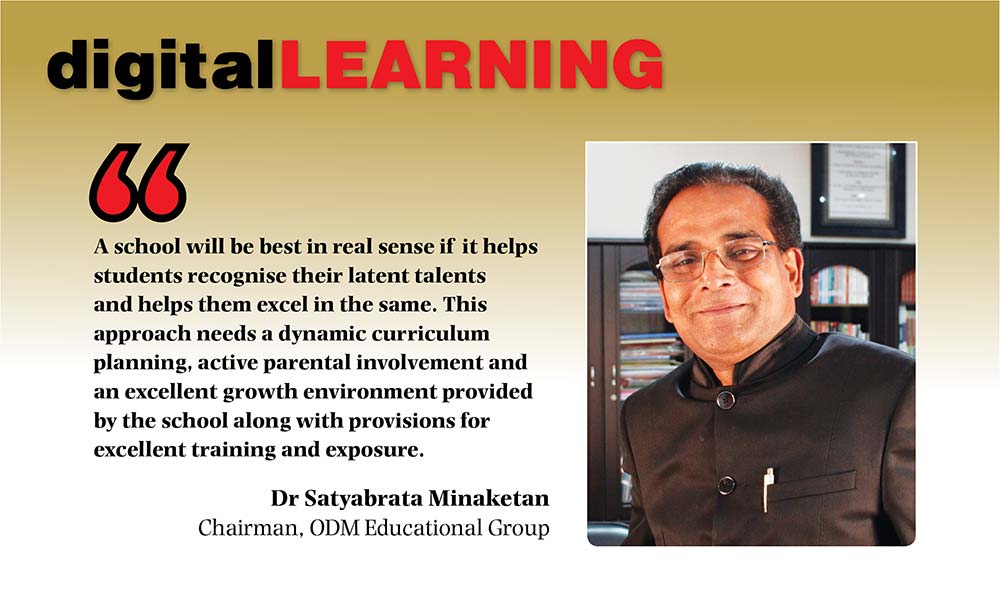
Dr Satyabrata Minaketan, Chairman, ODM Educational Group shares with Elets News Network (ENN) about the challenges in school education, qualities of a best school, parents involvement in child education, role of technology in education, ODM’s unique proposition and more

What do you see as the main challenges for school education today?

Today, the biggest challenge in the domain of school education is the dearth of quality teaching methodologies and curriculum. The school education in our country has actually gone through very few changes to catch up with the dynamics of the changing economy. I believe that school education should lay the foundation among the students to nurture future leaders. For this, schools today have to go through radical changes in terms of their teaching pedagogy and curriculum planning.

According to you, what are the qualities that defines a best school?

A best school is the one that truly prepares all its students for the future. An ideal school brings out the best out of every child. A child might be good at academics, sports, dance or music. A school will be best in real sense if it helps students recognise their latent talents and helps them excel in the same. This approach needs a dynamic curriculum planning, active parental involvement and an excellent growth environment provided by the school along with provisions for excellent training and exposure.

What makes your school sets apart from others?

Since the foundation of school, my team and I have relentlessly been focussing on providing a unique pattern of education – on enriching students with aesthetic values and overall grooming through modern global teaching pedagogy. We believe in nurturing students by imparting rich spiritual values (not specific to any religion) as well as ensuring a techbased education system with modern and advanced teaching aids used by leading schools across globe.

Positive parents involvement has a significant impact on student education. Do you agree? If yes, how?

It has been noticed that parents’ culture and lifestyle impacts the grooming of a child to a great extent. The way we behave at home, lead a lifestyle – our child learns from us and starts to act accordingly. We, at ODM, have clearly understood this aspect. Whatever we teach a child in school not only in academics but also in other aspects, if that training is supplemented at home, then that doesn’t lead to a complete development in a child. Hence, we think positive parents’ involvement has a significant impact on students. We have seen that parents who are concerned about their child’s development and cooperate with school by supplementing on the coaching provided to the students have witnessed their child acing domains with flying colours.

Use of technology has become an integral component of education. In your opinion, how technology is transforming the school education landscape?

It is undoubtedly true that school education is transforming with the aid of technology. The advent of smart classes, tab-based learning and other teaching aids have not only taken the education to next level among students but also have improved teachers’ efficiency exponentially. The smart classes have made learning fun and the visual and audio aids made understanding and memorising of facts easier for students.

We are one of the few schools in eastern zone to introduce tab-based learning for senior secondary students this academic session. Through tabs, they can go through recorded e-classes of some of the best teachers in the state which help them understand the concepts at any time of the day or year. The new ERP software for schools have made the process of maintaining records, student profiling and examination conduction a lot easier and the efficiency of the staffs in school increases exponentially.

Integrating Technology to the Curriculum

Rita Kaul, Director, The Millennium School, is a special educator and psychologist with 23 years of experience. She shares with Elets News Network (ENN) about the challenges in education, qualities of a best school, role of parents in school, unique proposition of The Millennium School and more

What do you see as the main challenges for school education today?

Today, the greatest challenge is to balance the information and knowledge we provide in school, with the harmony in life. Gone are the days when teachers would force the children to mug up and vomit out during examination. Thus, the first and foremost challenge is to train the teachers in a way that they can think of various strategies to engage the students in class. There is need to change the methodology of assessment and let the students enquire and discover the facts.

According to you, what are the qualities that defines a best school?

Being the head of a school, I interact with young parents of a nursery child as well as with a parent who is seeking admission of a child in grade XI. Their expectations vary from one stage to another. To sum up, basically a parent looks at the quality of academics i.e., the kind of curriculum adopted, physical school environment that is quality infrastructure and the psychological environment that is the attitude of all the stakeholders inside the school. A best school will certainly practice cultural values, have democratic approach, and engage qualified and passionate teachers who are well-versed in integrating technology to the curriculum. The environment in a quality school is student-centric. Parents as partners and freedom to students for research will also add on to the quality of school.

What makes your school sets apart from others?

The Millennium Schools across the country are based on developmental milestones and not on the chronological age of the students. Our curriculum, called The Millennium Learning System, is based on Piaget’s longitudinal and cross-sectional study of children across the world. The Millennium Learning System (MLS) is an age appropriate learning system that caters to the psychological, emotional and cognitive needs of the learner. It has different levels, based on developmental milestones and age appropriate pedagogy.

Integrating technology into the classroom is definitely a great way to reach diversity in learning styles

Every tangible for MLS has been developed at the R&D Division, with a focused outcome in mind. This outcome is clearly understood through our vision for every child who enters the system. Age appropriate, psychologically mapped and pedagogically apt tangibles are used at every level of the MLS. Some of these are the books, the assessment system and the lesson plans.

Positive parents involvement has a significant impact on student education. Do you agree? If yes, how?

To have positive and educated parents as partners is like having a mirror in front of us. Parents are our ambassadors. If they speak respectfully of our schools and are involved in certain decisionmaking stages, they have an ownership like a family member has in a family. The student feels confident when school and parents work together. When these parents believe in the system, they talk about it and give the schools an honest feedback and thus create opportunities for the schools to correct the course when they are perceived in a negative manner.

How technology is transforming the school education landscape?

Technology has become an intrinsic part of education and an important tool for teachers. Integrating technology into the classroom is definitely a great way to reach diversity in learning styles. It gives students the chance to interact with classmates more, by encouraging collaboration.

With technology, the teacher becomes the encourager, adviser and coach. Students can have access to digital textbooks that are constantly updated and often more vivid, helpful, and creative. Technological tools, like Fliplearn, help to communicate and enhance knowledge, and play a vital role in bringing the stakeholders closer and sharing of information. Technology also facilitated learning for the differently abled.

‘Making Higher Education Available 24×7’

Bharat Lal Meena, Additional Chief Secretary, Dept. of Education (Higher Education), Govt of Karnataka

Bharat Lal Meena has initiated ICT projects in Karnataka Power Transmission Corporation Ltd (KPTCL) – a Government of Karnataka undertaking, during his previous assignment as Managing Director, and set a trend for other States to emulate in power sector. Now as the Additional Chief Secretary, Department of Education (Higher Education), Government of Karnataka, he is on a new mission, making ICT an efficient tool for learning, governance and academic activities. He shares with T Radhakrishna of Elets News Network (ENN) about the Department’s mandate, initiatives, action plans, challenges in implementing ICT and more

Describe the Department’s mandate and its objectives. Who are your key stakeholders?

The mandate is to make quality education affordable and accessible to all sections of students. The department deals with higher education i.e., college, universities and technical education. Its objectives are: Development of undergraduate and postgraduate education; Increasing access to higher education; Development of infrastructure in Government colleges; and, Maintaining high standards of education in colleges. The key stakeholders are students, faculty, administration, parents and people in general.

What systems and processes have you used to ensure the effective running of the Department’s functions? In which functions, do you use ICT and how?

The history of implementation of ICT in universities/colleges was poor till mid-2015. Basic computing was available in each office or institution, but office automation did not exist. The day-to-day functions of higher education were not connected in realtime IT environment. However, the potential for using ICT in the higher education is enormous. ICT is very useful tool for learning, governance and academic activities.

Could you tell us about how you have maximised the use of current facilities at Department? What were the challenges you faced in managing them?

In the absence of systems and processes, monitoring is a challenge. Data sharing is another. There was low priority for collating and updating data. Cyber security and information overload are some other concerns. Going forward, the Department is seeing a massive ICT implementation to bring in digitisation in higher education. While office automation is one aspect of it, there are a host of student centric initiatives. After I had joined the department about 10 months ago (in February 2015), I studied the situation and focused on how and where to use ICT in higher education to bring in productivity, accountability and transparency in the day-to-day functions. As part of this, I travelled to all the universities and held meetings with officers concerned and later called for presentations on best practices in higher education from all. Data sharing must be linked with critical areas like approval, renewal, grants, etc. Finally, we came out with a roadmap for ICT initiatives after elaborate discussions with internal stakeholders.

Explain your 100-point ICT plan for Department improvement.

The department has prepared a roadmap for ICT initiatives to facilitate ease of administration and academic reach for students in universities and colleges. The programme aims to provide end-to-end digital solution from admission to completion of education, covering all functions of the department and its stakeholders. The 100-point table is nothing but an action plan for each requirement of the department’s functions. Of them, 15 ICT initiatives and solutions are related to administration; 22 exclusively for universities; six exclusively for colleges; 15 for colleges and polytechnics; 12 for universities and colleges; and 30 for universities, colleges and polytechnics. The action plan has mapped the entire functions of key stakeholders – students, faculty and administration, and feedback mechanism to parents (of students).

Under administration, we are deploying modules such as Online Admission for Students; Education Management Information System with Dashboard; HRM System; e-Administration System; e-Library Networking and Synergy, Accreditation Monitoring, etc. For Smart Student Support System, we shall implement modules such as Online Scholarship Management System; e-Attendance; Online Class Monitoring and Matrix; e-feedback system by students about teacher, etc. Under academic initiatives, conversion of classrooms into Smart Classes, Tele-education, Campus Wifi, Online Affiliation System, Teachers Biometric Attendance, Setting up of well-equipped studios in each University, Question Banks (10 years old) are taken up.

What is the status on ICT initiatives? Give details about its timelines.

We have tested ICT initiatives on a pilot basis with the support of National Informatics Centre (NIC) and adopted most of the initiatives in a holistic manner. All the initiatives are interconnected. Software is freely available to all institutions. The Department has set March 15, 2016 as deadline for achieving 50 per cent implementation of ICT initiatives and June 1, 2016 for completing 100 per cent implementation.

On November 6, 2015, the department launched ‘Jnana Sangama’ (convergence of knowledge), an ICTenabled programme in the presence of TB Jayachandra, Minister of Law, Parliamentary Affairs and Higher Education and Vice Chancellors of Universities. It is aimed at digitisation of higher education institutions in the State. This ICT initiative is the ‘Smart Karnataka Education Yardstick’ (Smart-KEY), designed for digitising most of the teaching materials in public and private domain throughout the State.

The Department has set March 15, 2016 as deadline for achieving 50 per cent implementation of ICT initiatives and June 1, 2016 for completing 100 per cent implementation

Through Jnana Sangama, the higher education system in Karnataka – 50 Universities, 2992 undergraduate and postgraduate colleges, 305 polytechnic colleges, and 207 engineering colleges – will get a major boost.

Highlight student-centric initiatives.

Major thrust will be given to make the processes of entire pre and post-exam and admission, online. The department will introduce online application and admission process for undergraduate and postgraduate courses. Digital attendance registration, interuniversity information highway and online affiliation process are on the anvil. While some of these are partially implemented this year, the department is looking at full-scale implementation from the next academic year. The department will make the entire admission process online, including the application process. The students do not have to go from college to college to buy application forms. They can apply once online and seats will be allotted based on merit, like Common Entrance Test (CET) admissions. The Department has tried this out in 2015 for polytechnic courses and in some government degree colleges. This will be implemented across all government-aided and unaided institutions for undergraduate and postgraduate courses.

Not every student can secure admission in top colleges. However, on this account alone, students should not miss out on quality education. This is the principle with which e-content sharing is being implemented. To begin with, 22 top colleges have been selected to record their lectures and share teaching aids with other institutions. The content shared by colleges is available on a central server that can be accessed by other colleges and students. The department has signed MoUs with private universities for sharing e-content, including video classes. Today, we have 2 TB size of videos of e-content.

Do you have any suggestions to Ministry of Human Resource Development (MHRD)?

There is a need for synergy of data exchange of different portals such as AISHE, UGC, AICTE, NAAC, NBA, DISE, MCA, etc. ICT initiatives in higher education need to be encouraged. Scalable and robust ERPtype ICT solutions could be developed and made available to all states by MHRD, based on Karnataka model. Quarterly national level workshops in different regions be held for sharing best practices and case studies be undertaken and sponsored. Financial support be extended for reforms-linked activities and annual awards and incentives to innovative initiatives in states should be taken up.

EduTech Redefining Learning Landscape

8-14-EIn this fast-paced world, technology is impacting every sphere, and education is no exception. There have been major developments in the sphere of education technology and technological trends are reshaping the teaching and learning. Besides, some technologies have emerged in the recent times that will impact education over the course of the next few years. Aamir H Kaki of Elets News Network (ENN) shares insights on how technology is transforming the learning experience, emerging technological trends and innovative solutions in education, potential challenges of technology and much more

Educational institutions are now taking the burden to advance the culture of innovation, foster environments that accelerate learning and creativity and to create the conditions for innovations to happen. Technologies are becoming affirmatively accepted by the education sector to add value to learning experiences.

According to education experts, major developments in education technology and technological trends will help shape teaching and learning in the near future. A little bit of futuregazing suggests that emerging technologies that will impact education over the course of the next five years would be: cloud computing, mobile learning, elearning, learning analytics, MOOCs, virtual and remote laboratories, and tablet computing, etc.

Transforming Traditional Learning

In this ever-changing dynamics of technological transformations, nothing seems constant. The one guaranteed constant in educational technology is change, as also elsewhere, and the pace of that change is definitely accelerating. Technology trends in both higher education and K-12 classrooms continue to evolve and transform traditional learning environments.

The advent of technology over the decade has and would continue to play a key role in changing the face of education in India. As Ujjwal Singh, Vice President, Product – K12, Pearson India, puts it, “Education providers in the country are beginning to understand the significance of measurable progress in a student’s life as opposed to learning that is confined to the four walls of a classroom. Technology is one of the most important tools in learning that will help Indian education progressively reach its peak. However, growing availability of technologies and educational apps require teachers to be trained to make use of such technology integration.”

“Technology enables the dissemination of information beyond geographical barriers and gives students access to the same learning opportunities. This also makes technology one of the greatest equalisers, as it promotes inclusivity by providing education to all whenever and wherever. It is one of the key factors in extending learning beyond classroom hours,” he adds.

On the integration and adoption of technology in learning, Nirav Khambhati, CEO – Tata ClassEdge states, “Today, more and more schools seem to be adopting experiential learning as opposed to just textbook-centric teaching. By using a blend of traditional teaching methods, exploratory activities, projects and interactive technology, schools can bring in more engagement in classrooms. Some students do use laptops and tablets at home. But we are not sure if they use them creatively for educational purposes. What we need is a structured approach on how to integrate technology in the teaching-learning process.”

Distance and online learning using technology not only impart quality education to all despite the varying geographies, but also enable students to work at a pace and in a subject area that facilitates comfortable learning environment. In the Indian context, this model is extremely important as it is a great way of transforming the education space, since it puts students at the center of learning

The technology is surely redefining the future of education. Today’s society shows the ever-growing computer-centric lifestyle, which includes the rapid influx of computers in the modern classroom. As Rishi Khemka, Founder and CEO, MindBox, says, “The Information and Communications Technologies (ICT) in education provide opportunities to students to mainly build their capacity on ICT skills and make them learn through computer-aided learning process.”

He further says, “MOOC is gaining a firm foothold in education around the world. More than two-thirds of respondents from academia say that their institutions offer online courses. Computing, Communications and Storage anywhere facility, and the ability to create interface with digital technology, data and the web anywhere, anytime on any device is the key to ACCESS to ALL.”

With the change in scenario in education, classrooms – be it in a school or college – are slowly transitioning to a more modern approach that uses technology to deliver education in a more impactful and effective manner. Manikandan R, Director – Mobility, Education & Healthcare, HP, points out, “The introduction of technology in the education system has not only aided the students but also the faculty, and as a result overall efficiency of the system has improved. With the introduction of technology, students have started taking more interest in the curriculum.”

UJJWAL SINGH

Technology enables the dissemination of information beyond geographical barriers and provides students access to the same learning opportunities. This also makes technology one of the greatest equalisers as it promotes inclusivity by providing education to all whenever wherever and. It is one of the key factors in extending learning beyond the classroom hours

UJJWAL SINGH
Vice President
Product – K12, Pearson India

“Use of technology in education is one of those methods that has helped improve the quality of education in India. The face of education is somehow shifted partly from books to ebooks. From books and study material to the method of teaching — everything is tending to go virtual with the help of latest technologies. Technology is not only changing the face of education, but also altering the way the education is provided, making it faster and easier to grab,” adds Manikandan.

Innovative Technological Trends

Creative and innovative technological educational solutions are becoming increasingly significant for the development of the 21st century knowledge society. They contribute to economic prosperity as well as to social and individual well-being and are essential factors for a more competitive and dynamic economy. Technology in education is seen as central in fostering creative and innovative skills.

The use of blended learning models in schools has been on the rise, especially in the recent past. Ujjwal Singh points out, “Blended learning models that combine technology with classroom instructions help teachers experiment with a variety of educational models. This technology allows students to network effectively, enables personalised learning and is an excellent platform to display their ability to innovate and collaborate.”

He states, “Distance and online learning using technology not only imparts quality education to all despite the varying geographical background, but also enable students to work at a pace and in a subject area that suits them in a comfortable learning environment. In the Indian context, this model is extremely important as it is a great way of transforming the education space, since it puts students at the center of learning.”

With technology pervading every sphere and field, education is no longer lagging in accepting the transformational change. As Nirav Khambhati, CEO – Tata ClassEdge puts it, “With technology moving into all aspects of our lives and children becoming more tech-savvy, the education system isn’t far behind in integrating technology in teaching-learning practices. Schools are realising that digitisation of teaching methods gives an experiential edge to the students. ICT in schools in India started with digital classrooms that comprise digital boards, projectors and multimedia animations.”

“Tata ClassEdge was one among the first to introduce cloud technology and usage analytics in this space. Soon, we are going to witness more innovations in the personalisation of learning, through adaptive logic and intelligent tutoring. But this is just the beginning. What the future holds for technology in education is far more than what we can all imagine at this point in time,” he adds.With technology pervading every sphere and field, education is no longer lagging in accepting the transformational change. As Nirav Khambhati, CEO – Tata ClassEdge puts it, “With technology moving into all aspects of our lives and children becoming more tech-savvy, the education system isn’t far behind in integrating technology in teaching-learning practices. Schools are realising that digitisation of teaching methods gives an experiential edge to the students. ICT in schools in India started with digital classrooms that comprise digital boards, projectors and multimedia animations.”

Advancements in technology is bringing societal changes and impacting education, growth and development of India. Rishi Khemka says, “We are entering a time of momentous societal shifts brought in by advancements in technology. These changes will impact the education, growth and development of our country. Inventions previously seen only in science fiction, such as artificial intelligence, connected devices and 3D printing, will enable us to connect and invent in ways we never have before. Modern tools of creativity like design lab (3D printer), creativity lab (STEAM), smart devices and digital cameras, online resources, like social media, blogs, virtual classrooms, video conference and podcasts, and latest infrastructure like ICT lab, wirefree internet, intranet, smart boards, interactive projectors collectively, all such advances will lead to profound changes in the way courses are taught and learned.”

Digitisation of the education industry will be the most disruptive trend the sector has witnessed after the invention of paper. Manikandan further says, “At HP, we believe that every student should have access to a high quality education, at any time and from anywhere, and the access should be combined with true learning, meaningful learning, social and economic outcomes result – for students, for schools and for communities.

Innovative Solutions – The Road to Future

Innovative solutions in the learning space is transforming the education sector and creating a road for the future. Organisations are bringing out solutions that are not only easing the learning, but also changing the overall experience of imparting and acquiring education.

NIRAV KHAMBHATIBy using blend of traditional teaching methods, exploratory activities, projects and interactive technology, schools can bring in more engagement in classrooms. Some students do use laptops and tablets at home, but we are not sure if they use them creatively for educational purposes. What we need is a structured approach on how to integrate technology
NIRAV KHAMBHATI
CEO, Tata ClassEdge

Ujjwal Singh states, “We, at Pearson, have always had a learner-centric approach. In line with this, we introduced MyPedia, an innovative integrated learning solution that focuses on improving conceptual understanding of students. It is based on 5i learning process and intends to actively engage students in the learning process, help develop their critical thinking skills, stronger understanding of concepts and create meaningful learning experiences.”

He elaborates, “MyPedia allows students to learn in a more comprehensive manner, and reason abstractly and quantitatively by integrating learning across subjects. Its unique features help students understand different learning layers, where each layer comprises the skills and concepts that a student needs to learn in a particular grade. This really helps students to break away from compartmentalisation of subjects. It combines the best in curriculum and content, digital and technology, assessment framework and training.”

8-14-DOrganisations in learning space are introducing solutions to inspire learners as well as teachers. Nirav Khambhati informs about initiatives at Tata ClassEdge, “This year, we are introducing Tata ClassEdge Cosmos, an ecosystem of solutions developed over the last five years based on our core philosophy — INSPIRED SCHOOLING. We have Tata ClassEdge LX, our flagship classroom solution based on our proprietary multiple learning experiences framework to engage varied learners. We have introduced ‘Thinking About Values’, the values and life skills curriculum for students to start questioning what is right and wrong from an early age. Then we have PlanEdge for automated academic planning, and standardised assessment management through TestEdge. Our new app for parents, ClassEdge School Connect, enables easy communication, simplified transactions and enhanced parent involvement in the child’s education. ClassEdge After School is a tablet/ web based solution, which personalises learning at home. The ecosystem aims to create a complete solution for Indian schooling, enabling inspired teaching and learning.

Almost 40 percent of the skilled workforce is not employable as the acquired education and training are of substandard quality. With 93 percent of work available in the informal sector, a good number of even well-educated youth in India are either unemployed, underemployed, seeking employment, between jobs, or coping with insecure work arrangements

RISHI KHEMKAMOOC is gaining a firm foothold in education around the world. More than two-thirds of respondents from academia say that their institutions offer online courses. Computing, Communications and Storage everywhere – the ability to interface with digital technology, data and the web anywhere, anytime on any device is the key for ACCESS to ALL
RISHI KHEMKA
Founder & CEO, Mindbox

He further adds, “Tata ClassEdge Cosmos provides end-to-end support for academic needs and simplified and convenient school administration to schools. It enables teachers to create engaged and effective classrooms and saves their time spent on administrative and repetitive tasks. The student has an access to diverse experiences leading to enhanced understanding of concepts, personalised learning, while allowing for the development of a discerning mind through critical thinking. For the parent, Tata ClassEdge Cosmos allows for greater involvement in student’s education and increased connect with schools.”

Education technology is empowering the students and making them ready for the future. Informing about Mind- Box’s initiatives, Rishi Khemka, says, “As educators, we empower students to ideate, explore, lead, think and collaborate. MindBox is an initiative that aims to empower students with 21st century skills. We develop creativity and life skills of students by an output method of expression using Visual Communication as Language, Design Thinking and STEAM as a subject. The delivery happens using ‘technology as a tool’ inside the school’s campus through project/design-based learning methodology for Class I-XII students. MindBox provides kits, industry expert sessions, worksheet and software, along with qualified faculty to conduct these sessions and a four-way assessment system for schools and students.”

Opportunities blossom when everyone is empowered to control their own educational experience. The educational experience is much richer when the content is personalised to the needs of the student. Manikandan R says, “HP believes in the value of the Hybrid Learning model, combining the best of digital printing with electronic content, to optimise learning outcomes. Print continues to deliver intrinsic educational value that facilitates true learning with deep engagement, and high levels of comprehension and retention. Along with electronic channels for mobile consumption and student feedback and analytics, we can get the most out of technology, and being given the opportunity to do so not only makes things easier, it also makes them greater. At HP, we don’t just hand out gadgets; we provide the support and training necessary to turn a device into an instrument of change.”

Making Students Industry-ready

Though technological advancements are taking place, we live in a country wherein education is perceived as the primary means of climbing the social and economic ladder. Our education system is still largely centered on knowledge as a finished product and learning as memorising things that are enshrined in the textbooks. The present-day workplace, on the other hand, is evolving at a very fast pace. Our teaching methods still focus on testing knowledge at the completion of every level as opposed to teaching skills that are vital to deal with a volatile working environment.

Ujjwal Singh says, “Apart from the basic aptitude to perform a specific job, workers are expected to have technical skills, communication skills, soft skills and a basic understanding of IT for the current high-paced workplace. If educational institutions take the effort to impart these skills to students over and above their domain knowledge, we will be able to produce employable talented workforce to meet the growing needs of the industry.”

He suggests a few ways in which technological interventions can help make youth industry-ready for future:

  • Incorporating digital capabilities meaningfully into the learning process gives students new opportunities to learn and attain skills required for the present-day work environment. Technology also grants immediate access to vast amounts of quality information and developing valuable research skills. Integrating technology in teaching and learning throughout the process, focusing on problems unique to our educational context, is imperative to plugging the existent talent gap.
  • Technology allows for personalised learning, a way of teaching that caters to students’ individual needs. Keeping in mind, the different paces and levels of ability helps channel the students towards the right choice of employment based on their interests. This in turn will enrich their experience in a future workforce.
  • Another effective approach to tackle the problem of lacking job-readiness among Indian students is an effective partnership between the industry and academia. Technology provides the platform for teachers and industry experts to collaborate and share their ideas and resources online.
  • Providing training in high-demand job skills to those who have limited exposure levels in Tier II and III cities will help create far more job-ready employees.

India is coping with the skills gap and a significant number of even well-educated youth in the country are unemployed. Manikandan observes, “Youth unemployment is a major challenge in India. Young job seekers constitute 49 per cent of the total unemployed in India. And, even as literacy and educational levels are increasing, an estimated 89 per cent of young people lack any kind of vocational training and among the rest, about half have received it through hereditary practices. According to NASSCOM, almost 40 per cent of the skilled workforce is not employable because the acquired education and training are of substandard quality. With 93 per cent of the available work provided by the informal sector, a significant number of even well-educated youth in India are either unemployed, underemployed, seeking employment or between jobs, or coping with insecure work arrangements.”

MANIKANDAN RDigital technologies are everywhere and they are impacting what, where, how and why students learn and who they learn from. Many schools are using digital technologies like the internet, laptops and tablets to quickly, easily and cost-effectively connect students with the huge range of digital services and resources
MANIKANDAN R
Director – Mobility, Education & Healthcare
HP

He suggests, “It is critical for the educational institutions to impart 21st century skills, such as innovation, collaboration and critical thinking, to Indian students to make them more employable.”

Potential Challenges

Even though the technology has changed the way students learn, there are some security issues which are being addressed by new pieces of education technology tools. Ujjwal Singh submits, “Technology makes the teaching-learning process very easy and interesting, but there are potential security risks involved. Emerging ICT applications must have security policies and mechanisms that support authentication, authorisation, confidentiality and accountability. Online learning providers and practitioners must consider security as top priority. Children must be made aware of the nature of threats that exist online and given clear guidelines about the parameters in which they can operate online.”

He suggests few ways to ensure children’s security online, which are:

  • Children should be given restricted access to technology;
  • Software should be designed in a way that allows joint access with parental or teacher supervision;
  • Parental guidance and supervision is another way to ensure children are secure while using technological tools; and
  • It is also important to check the rate of dependency among children on technology. There should be clear communication that it is a means to an end, not the end in itself.

Though technology has lots of benefits and offering support to ease the learning process, it has some challenges, too. Says Manikandan, “Digital technologies are everywhere and they are impacting what, where, how and why students learn, and who they learn from. Many schools are using digital technologies like the internet, laptops and tablets to quickly, easily and cost-effectively connect students with the huge range of digital services and resources. However, the many benefits of learning with digital technologies are accompanied by some challenges and potential risks for students as well as schools. These ‘digital challenges’ are real and present a dilemma to schools seeking to use digital technology to enhance student learning.”

To overcome these challenges, he suggests, “There are technical solutions available like Mobile Device Management, commonly called MDM. If deployed, MDMs can provide good amount of safety to the extent of enforcing security policies and/or making the device work in kiosk mode. Such technical solutions have a role, but must be balanced with strategies that promote:

  • Development of skills and knowledge for safe and responsible use of digital technology;
  • Opportunities for students to be involved in decisions about the management of digital technology at the school;
  • Development of a pro-social culture of digital technology use; and
  • Cooperation of the whole community in preventing and responding to incidents. The ultimate goal is to ensure the online safety of all students. We cannot sidestep our obligation to make technology a tool our kids can use safely and responsibly.


LATEST NEWS