To ease the admission process while assuring placement to their wards to a right school, Rajan Arora, CEO, SchoolAdmissions.in talks to Elets News Network (ENN) about his new platform, SchoolAdmissions.in, that helps streamline the admission procedures of schools and also help parents choose an institution without missing their office.
Can you brief us on the reason behind starting SchoolAdmissions.in.
One of the major challenges I as a parent faced during the admission of my own son few years back has brought my life to a complete standstill and confusion for months. There is no central resource to help parents across the country facing the same problems. To aid parents to choose from choices under one platform led us to start SchoolAdmissions.in
What is the market size of the services offered in India at present?
Around 40 million kids take new admissions in schools every year, out of which 38 per cent enter private schools and this figure is increasing every year. They are our target group.
What are the major benefits for organisations adopting your solutions?
We can see increase in admission inquiries, applications and admissions by spreading awareness about schools, pedagogy and reach out to a larger target audience (parents) who are members of SchoolAdmissions.in and are looking for a right school for their children.
Our solution is a one-stop solution for parents for school research, admission information, applications and results. Instead of spending months doing everything themselves, they can simply use SchoolAdmissions. in to manage the entire admissions process of their child without leaving their home or taking off from work for weeks.
We have joined hands with Corporates to provide our services to their employees. The organisations can ensure that their staff is not stressed or absent during the admission season thus leading to no work loss for the organisation. The entire admissions process will be managed by SchoolAdmissions.in for both, entry level nursery admissions or senior class admissions for employees moving to a new city.
What is the vision of your company for next two years?
Our vision is to reach out to every nook and corner of India and help millions of parents make the right informed decision related to their child’s school education and admission, whether it is for nursery class or K-12 admissions.
What are the various methods to increase the visibility of your organisation?
We are focusing on strategic partnerships, social media and presence at relevant events.
Around 40 million kids take new admissions in schools every year
How you can differentiate your services from competitors?
We provide complete school admissions support from verified research to results including personalised admissions management and counselling for parents as compared to our competitors who are more focused on generating unverified content to increase page views. Our objective is to find the right school for a child and make the school admissions process as smooth as possible.
What are the ways of engaging the customers with you? Can you share a case study?
We had recently launched nursery admissions helpline and have completed nursery admissions management service for parents in Delhi-NCR. An interesting case study is of a parent who had just got transferred back to India and wanted us to manage the nursery admissions process for his daughter as well as mid-session admission for his elder son in 4th standard. Our team completely assisted him even though he and his family were still in Canada by taking over the complete admission process for his both kids. We constantly engaged with schools in Gurgaon for 3 months and helped him secure admission for both the kids in the same school.
Getting it right: We provide complete school admissions support from verified research to results including personalised admissions management and counselling for parents as compared to our competitors who are more focused on generating unverified content to increase page views
What are the major stakeholders and sectors you are focusing on?
Major stakeholders are playschools, schools, parents, corporates and the government. Our focus sector is education especially the K-12 Segment.
What are the various initiatives taken by your organisation to emerge as a market leader?
We believe in constant innovation, right partnerships, use of technology and maximum focus on customer satisfaction as the key to market leadership. We are taking various initiatives in this regard and would soon be making some announcements related to new product launches.
Aiming to cater to the internship and placement requirements of colleges and universities nationwide, Internkafe.com provides window of opportunity for students who come from small states. Amit Sohal, Founder, Internkafe.com shares with Elets News Network (ENN), how his company is connecting with colleges and universities situated in remote areas to help the students get the right job
Give us the brief of the various reasons behind starting Internkafe.
While doing MBA from Central University of Himachal Pradesh, we realised that for students like us, who come from a humble background and do not move out of their home towns for higher education, getting industry exposure is very difficult. The main reason behind starting InternKafe was to provide a window of opportunity for students who come from such parts of the nation where industrial exposure is comparatively low, but have the caliber if not more, equal to those who study in metro cities. The bottom line is to bring the industry closer to those who have the employability skills.
What are the various difficulties and hurdles encountered in doing business on ground level?
We try to connect with the colleges and universities situated in remote areas of the nation, therefore, we face a huge challenge of connectivity and how to spread awareness. Although we try to overcome these challenges through offline promotions and awareness workshops, still such difficulties remain and our team works hard to overcome these. There are times when students do not join the internship after being selected. I think that in the service sector, the biggest challenge is to predict human behaviour.
What is the market size of the services offered by you in India at present?
We aim at catering the internship and placement requirements of colleges and universities nationwide. In a short period of time we have managed to make our presence felt in many states and cities like, Himachal Pradesh, Ranchi, Jaipur, Bhubaneswar, Hyderabad, Punjab and Chennai. Our main focus will always be students in Tier I and Tier II cities who are comparatively less privileged in terms of exposure than their counterparts in metro cities.
What are the major benefi ts for organisations and individuals adopting your solutions?
As our tagline reads – “your perfect internship assistant”, for students adopting our solutions we aim at brining to them internship and placement offers from the best of organisations in their respective field. On the other hand, for the companies as our client, we focus on bringing to them the best of employable talent from different corners of the nation.
What is the vision of your company for next two years?
Well, it can be said that our team is pretty ambitious for a rookie, but it’s the enthusiasm of our team that keeps us going. In the next two years, we intend to connect with at least 60 per cent of students of the country covering Tier I, Tier II and Tier III cities. Our special focus will always be the students belonging to remote and interior areas so that they are sensitised to the corporate industry during their study period itself.
What are the various methods you are using to increase the visibility of your organisation?
Ours is a young company formed just a year ago, with a vision “to be the best information junction for aspirants and one stop total marketing solution for educational Institutes and connecting the students to corporate world.” Our team members consist of young dedicated people from varied background who work remotely and are connected virtually. In order to spread awareness about our services, we are consistently active on social media. We also resort to offline advertisement through print media and education fairs.
We are wired to be more receptive to things that are simple and easy. Our everyday life is fraught with instances where we respond more naturally to simplicity in everything. Our innate nature is to cut through the complexity and simplify things.
At the same time, we are surrounded by great yet simple technology products that run on complex technology. Does it sound confusing? If you pause and think, it makes perfect sense. Although these products that we love so much are based on complex technology, they are designed in such a way that technology remains in the background while we use them to achieve our goals.
Speaking of technology in education, we have some popular technology products and platforms that promise to deliver manifold benefits to educators. Some platforms or products like Learning Management Systems (LMS) have been there for a while and there are a few new ones that are changing the face of online education as we know it today.
Learning Management Systems have a plethora of users across the world. Moodle is one such LMS which is popular among educators, colleges, and universities. While Moodle has evolved over the years and found many takers, it poses some serious challenges to user organisations and educators who want to quickly build their online presence with minimal effort and without any complexity. Some innovative educational solutions, such as WizIQ Online Academy are addressing these needs and helping organisations build a unique brand identity and deliver a holistic learning experience to their learners.
Here are some reasons why an innovative solution, such as WizIQ Online Academy can offer great value to users by overcoming challenges posed by a traditional LMS like Moodle.
Time to Market – In the fast-changing online education space, educators are experimenting with educational approaches and technology to find the right way of engaging learners. In this competitive space, the idea is to be online with the right solution as quickly as possible. Time to market or speed matters. You don’t want to be saddled with a solution like Moodle that takes a considerable amount of time to be installed and optimised according to specific teaching needs. You need a server or web hosting services provided by a third-party vendor to host and install Moodle, which is followed by a series of customisations.
WizIQ Online Academy, on the other hand, enables to create your own online academy with a unique sub-domain of choice within minutes and get started with your teaching activities. You don’t need an IT team or experts to set it up for you. It’s pretty much a Do-it-yourself approach to quickly having a strong online presence with minimum effort.
Ease of use – Moodle is far from an intuitive and easy-to-use solution. To fully utilise its potential, you need to either spend a lot of time understanding its in-built features or get trained on the system before you can sail smoothly. The user interface is not intuitive and re- quires customisations before if it can be user-friendly.
WizIQ Online Academy has ease-of-use as one of its biggest strengths. Right from setting up your Online Academy to conducting teaching or learning activities, everything can be done quickly with least possible effort and without any assistance. The simple and intuitive design ensures that even an uninitiated or first-time user can become an expert user within a short time. Using WizIQ Online Academy is a no-brainer.
Affordable – There’s more to it than meets the eye. While Moodle is an opensource LMS which is available for free,you need to make a sizeable investment before you can bring it to a level that is acceptable to you and your learners. The additional costs of hosting, integration with third-party applications, and customisations leave you with a “Free LMS” which is costlier than a paid, plug-and-play solution that gets you up and running within no time.
With WizIQ Online Academy, the total cost of ownership (TCO) of your online academy is limited to your subscription plan. Online Academy offers flexible plans and pricing which allow both big and small user organisations to create their online academies without worrying about investing in expensive IT infrastructure and engaging an IT team to maintain it.
Mobile – As more and more content is being consumed on mobile devices every day, mobile learning cannot be ignored any longer. The ease of use and accessibility are some of the reasons why it’s popular among learners. Educators need the right platform to get their content on mobile devices.
Moodle has a mobile app, but there’s very little that you can do with it. There is no builtin functionality to access content. You are directed to Moodle’s website when you attempt to access content and there are no real-time notifications about important events. The user experience is broken with the Moodle app.
WizIQ App allows learners to access content, attend live classes, and get real-time notifications, among others things.
If you have any queries, write to ajayv@wiziq.com.
Dr Ravi Gupta, Editor-in-Chief, digitalLEARNING magazine and Founder Publisher and CEO, Elets Technomedia Pvt Ltd
The Digital India initiative flagged off by Prime Minister Narendra Modi recently aims to make citizens digitally literate and transform India into digitally empowered economy. A secure digital nation is capable of advancing economic prosperity. But a keen eye on educating the citizens on cyber security is the need of the hour.
Digital India is a transformative programme, which will increase the adoption of ICT and will empower citizens through equitable access to ICT infrastructure. The programme will bring huge opportunities for the education sector, where ICT penetration is already playing a vital role. With Bring Your Own Device (BYOD) technology gaining momentum in the education world, it is obvious to make users aware of the threats prone to technology. Our nation’s growing dependence on cyberspace is evident today. From smartphones to online banking, from e-governance to m-governance, electronic attendance record, social networking, all talks about the progressive India. The need for a secure and safe environment has never been important.
While the biggest push for the Digital India initiative is towards inclusive growth in all sectors, but what is required is to strategies plans to tackle the threats associated with the cyber crimes. Industry estimates that number of cybercrimes in India is around 1,49,254 and is likely to cross 3,00,000 in 2015 growing at compounded annual growth rate (CAGR) of 107 percent.
Raising the concerns on the growing epidemic of cyber crime in the educational world, we have highlighted the experts, educationists and psychologists opinions on the growing need of training and counselling students on cybercrimes.
In the midst of all, there is another disturbing truth negatively influencing India as an educational hub. Where the Prime Minister envisioned ‘Digital India’ as an ambitious umbrella programme to transform India into a digitally empowered knowledge society, the real truth lies in the negative influence of the technology in hand. In the past one year, about a dozen major question paper leaks have been reported affecting lakhs of students across India. This has compelled the academicians to opine that cheating in India has long gone beyond personal ethics and become institutionalised, enhanced by the use of technology.
Amidst the entire negative picture, the issue has put forth a breather on how technology is being used for a very positive development that involves fee management through the online mode and how anti-virus and network security plays a crucial role in safeguarding the educational institutions interest.
The issue highlights the burning issues of technology advancement and how it can be controlled through implementing the right solutions and drive plans to shape up the digital future.
India, where half of its population is below 30 years of age, are poised with the potential to become the next generation leaders, workers, thinkers etc. To embark the beginning of new India, Prime Minister Narendra Modi who in June 2014 had pledged to make country a Skill India is now seems to take shape after one year of rigorous planning and hard work.
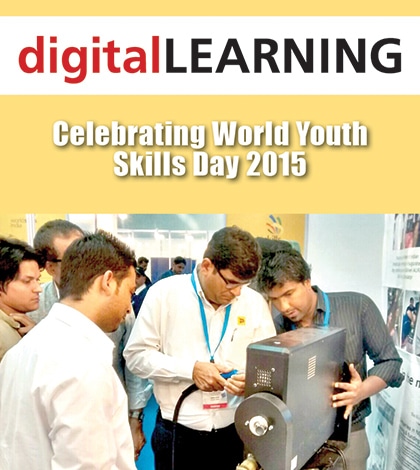
Recognising the country’s young demographic dividend, Prime Minister has stressed on producing skilled manpower and pushing ahead the Skill India mission, the government is launching number of initiatives aimed at developing skills and promoting youth in every field. The Prime Minister will unveil new National Policy for Skill Development Mission and Entrepreneurship 2015 on 15 July to mark the occasion of World Youth Skills Day. He will also roll out all-India flagship scheme, Pradhan Mantri Kaushal Vikas Yojana (PMKVY).
The government has set the target to skill 40.2 crore people by 2022 under the National Policy for Skill Development. The other initiatives to be launched are the model skill loan scheme, skill card for persons certified under Pradhan Mantri Kaushal Vikas Yojana.
Below are the opinions of what the stakeholders feel about the Skill India Mission and the initiatives that they are taking to skill youth of India-
Rajiv Pratap Rudy, Minister of State Ministry for Skill Development and Entrepreneurship (Independent Charge) & Parliamentary Affairs said, “Skills and knowledge are the driving forces of economic growth and social development for any country. We are in cognizance of the huge demographic dividend that our country stands to reap, at this point in time.”
Captain Sandeep Malhotra, Director, Alliance Educare and Research Private Limited says, “At the outset, we all acknowledge that institutions follow very fine academic practices for imparting regular curriculum. However, the country’s employment data shows that 82 per cent students face employment crisis due to the gap between their acquired knowledge and the industry needs. As we know, India is a nation with 65 per cent population below 35 years. It poses a tough challenge of skill training of 500 million people by 2022. However, if achieved, it offers a great opportunity of being a large pool of skilled workforce available to us and, to the world.”
Dilip Chenoy, Managing Director and CEO of the National Skill Development Corporation (NSDC), “NSDC is partnering with the state governments to introduce training partners and set up labs and get people skill trained. Two very recent examples are in Haryana and Himachal Pradesh where school children who passed out of 12th and not wanting to continue higher education have got jobs upto Rs. 50,000 a month based on their skill certificate. In many cases where they have not even passed 12th but passed their skill certificate, they have got jobs in the market, say for example in the retail sector, where they are earning an average of `12,000- `13,000 per month.”
Madan Mohan Mittal,Technical Education Minister, Government of Punjab, “Education, creation and adaptation of information, knowledge, skills and values are a key lever of sustainable development. The vision of “Skill India”, “Skill youth” will give equitable opportunities to all to access effective and relevant learning throughout life delivered through multiple formal, non-formal and informal settings. Skill education is important to individuals’ development as it is to the development of the nation and to the world at large.
In India Skill Development is very significant as the Hon’ble Prime Minister of India, Narendra Modi is the brand Ambassador for carrying this Skill Development in the whole country and he is taking keen interest. More so, inspite of his busy schedule, the Prime Minister has kindly consented to launch National Skill Development Mission and for promotion of Pradhan Mantri Kaushal Vikas Yojana which is being celebrated as World Youth Skills Day on July 15 at New Delhi.”
India, where half of its population is below 30 years of age, are poised with the potential to become the next generation leaders, workers, thinkers etc. To embark the beginning of new India, Prime Minister Narendra Modi who in June 2014 had pledged to make country a Skill India is now seems to take shape after one year of rigorous planning and hard work.
Recognising the country’s young demographic dividend, Prime Minister has stressed on producing skilled manpower and pushing ahead the Skill India mission, the government is launching number of initiatives aimed at developing skills and promoting youth in every field. The Prime Minister will unveil new National Policy for Skill Development Mission and Entrepreneurship 2015 on 15 July to mark the occasion of World Youth Skills Day. He will also roll out all-India flagship scheme, Pradhan Mantri Kaushal Vikas Yojana (PMKVY).
The government has set the target to skill 40.2 crore people by 2022 under the National Policy for Skill Development. The other initiatives to be launched are the model skill loan scheme, skill card for persons certified under Pradhan Mantri Kaushal Vikas Yojana.
Below are the opinions of what the stakeholders feel about the Skill India Mission and the initiatives that they are taking to skill youth of India-
Rajiv Pratap Rudy, Minister of State Ministry for Skill Development and Entrepreneurship (Independent Charge) & Parliamentary Affairs said, “Skills and knowledge are the driving forces of economic growth and social development for any country. We are in cognizance of the huge demographic dividend that our country stands to reap, at this point in time.”
Captain Sandeep Malhotra, Director, Alliance Educare and Research Private Limited says, “At the outset, we all acknowledge that institutions follow very fine academic practices for imparting regular curriculum. However, the country’s employment data shows that 82 per cent students face employment crisis due to the gap between their acquired knowledge and the industry needs. As we know, India is a nation with 65 per cent population below 35 years. It poses a tough challenge of skill training of 500 million people by 2022. However, if achieved, it offers a great opportunity of being a large pool of skilled workforce available to us and, to the world.”
Dilip Chenoy, Managing Director and CEO of the National Skill Development Corporation (NSDC), “NSDC is partnering with the state governments to introduce training partners and set up labs and get people skill trained. Two very recent examples are in Haryana and Himachal Pradesh where school children who passed out of 12th and not wanting to continue higher education have got jobs upto Rs. 50,000 a month based on their skill certificate. In many cases where they have not even passed 12th but passed their skill certificate, they have got jobs in the market, say for example in the retail sector, where they are earning an average of `12,000- `13,000 per month.”
Madan Mohan Mittal,Technical Education Minister, Government of Punjab, “Education, creation and adaptation of information, knowledge, skills and values are a key lever of sustainable development. The vision of “Skill India”, “Skill youth” will give equitable opportunities to all to access effective and relevant learning throughout life delivered through multiple formal, non-formal and informal settings. Skill education is important to individuals’ development as it is to the development of the nation and to the world at large.
In India Skill Development is very significant as the Hon’ble Prime Minister of India, Narendra Modi is the brand Ambassador for carrying this Skill Development in the whole country and he is taking keen interest. More so, inspite of his busy schedule, the Prime Minister has kindly consented to launch National Skill Development Mission and for promotion of Pradhan Mantri Kaushal Vikas Yojana which is being celebrated as World Youth Skills Day on July 15 at New Delhi.”
The advent of new age technology has brought a pleothra of innovations in learning. Gone are the days when teachers and professors imparted knowledge to us with a chalk and a blackboard, it is the age of social learning. Some members of the educational sector share their views with Elets News Netwrok (ENN) on the swift learning through social media
he new era of technology has replaced these blackboard and chalk with a click of the mouse! Even though the digital learning is being experimented upon,what is fast gaining momentum is the social media networking platforms of Face-book, Twitter, Youtube, that are acting as research textbooks for the tech-savvy students.The concept of learning through the New Media and the conceptulisation of incorporating social media sites as partof learning in the students’ curriculum, for e.g., the Facebook is often seen as a suitable research engine for various groups, forums for engaging students in fruitful debates. But how far can we utilise this tool, as every explosion of information can be either utilised or exploited by the cyber criminals. To optimally use these platforms and thrive digital learning through social media,experts and gatekeepers of the sector are still hoping for best.
As per the McAfee’s Tweens, Teens & Technology Report 2014, a thorough survey across Indian online teenagers aged 8-12years old and 13-17 years old, comprising respondents from Mumbai, Delhi, Chennai, Bangalore, Hyderabad, Ahmedabad and Pune, there is a dangerous trend. Some 70 per cent of online youth in India spend more than five hours on the internet in a normal week. The Internet access is still predominantly desktop based (41 per cent), however, 36 per cent use laptops and 27 percent use smart phones among the Indian youth, these statistics only alarms the guardians and teachers to initiate necessary steps.
Zafar Rais, MindShift Interactive
Necessary dosage of socialising
“Social learning enables a broader and new age approach to absorbing information. Through social media you’re able to educate yourself through new forms and with flexibility, while being able to share your reviews and opinions to benefit others. Social media acts as asocial facilitator to exchange informa-tion and expertise. I believe, social media has made it faster to absorb information and provides for a continuous learning environment,” says Zafar Rais, CEO,MindShift Interactive Pvt. Ltd.
India’s youth are constantly connect-ed, feels the McAfee’s report. Ined, feels the McAfee’s report. Interms of social networking terms of social networking platforms, Facebook is byplatforms, Facebook is byfar the most popular site used (93 per cent),followed by YouTube(87 per cent) and WhatsApp (79 percent). About 10-12years-old social ac-count users report higher count users report higher daily access to Snapchat,daily access to Snap chat, Pinterest, Tinder, Tumblr, and Pinterest, Tinder, Tumblr, and Vine than their teen counterparts, eventhough the minimum age to register to these social networking sites is 13 years.An eye opening trend is that half (52 percent) of India’s youth even access their social media accounts while at school;57 per cent being 8-12 years old v/s 47per cent 13-17 years-old.
Siddarth Bharwani, Director of Jetking, shares, “Social media has enabled us to communicate in ways that may have seemed unorthodox a decade ago.Today Wikipedia and YouTube are the most preferred resources for students who turn to the internet for information online. Jetking taps Facebook and Twitter for posting updates regarding upcoming events, opportunities for our students and highlighting their achievements. And we upload lectures by our faculty on YouTube for students to refer to again in case they miss something in class. We realise today’s students are the internet generation and social media definitely helps us in connecting with them. The key is moderation and them. The key is moderation and reaching out to them in a manner reaching out to them in a manner they are comfortable with.”
children, youth and even adults engag Sumit Vohra, Founder, Education for All and Social Activistopines that the concept of the social media is booming in this social media is booming in this fast paced age of technology with fast paced age of technology with children, youth and even adults engaging and leaning onto the digital world for minute references.
“Children engaging themselves in social media is rampant. One of its causative factors being peer pressure the numerous in the cyber Zafar Rais Mind Shift Interactive the numerous in the cyberative factors being peer pressure but anything done under but anything done under supervised attention will supervised attention will reap no harm and will reap no harm and will ensure protection from ensure protection from the otherwise cyber the otherwise cyber threats that are looming in the cyberspace.threats that are looming in the cyberspace.The digital world has The digital world has access to voice ones access to voice one sopinions and thoughts to opinions and thoughts to world. The future of world. The future of digital learning Idigital learning I believe is the IB believe is the IB curriculum, which is widely accepted which is widely accepted abroad, where abroad, where students are students are required to do required to do more of research more of research work for their subjects.” Vohra added.work for their subjects.” Vohra added.
Youth often share what would be considered private information publicly,both intentionally and unintentionally.The report shows that despite majority (80 per cent) of Indian youth being aware that their online activity can affect their identity, out of 90 per cent who have done or posted something risky online, 70 per cent have posted their contact details like email, phone, home address.
“The acceptance however of children engaging on social media platforms is still lacking as they are bombarded with negative perceptions of this space.The learning however is that children are not guided properly into the world of the internet and therefore there is a gap between the needs of a parent and a child in the online world. With the internet community beginning to accept that children have different needs when it comes to social media, there ischange in content that is more responsible and beneficial to the child. Taking this first step in creating responsible content for kids in the online world not only enhances access to digital learning, but also ensures quality content for the child,” informs Monish Ghatalia, founder, worldoo.com.
Stark Reality of the VIRTUAL SPACE
Two-thirds (66 per cent) of youth in India say they feel more accepted on social media than they do in real life. 72 per cent feel important or popular when they receive a lot of “likes” on the photos posted of themself on social media.
Keeping up to the social pressure, 64 per cent even admit to have tried reinventing themselves online by trying to appear older or creating a fake profi le. Moreover, 46 per cent say they would put themselves in danger to see more engagement/ activity on their posts (e.g., more likes, comments, shares or retweets).
While cyber-bullying continues to represent a serious problem for youth, the 2014 survey found 57 per cent of youth would not know what to do if they were harassed or bullied online.
Youth share a variety of fears regarding risks they face online, including: fear their privacy will be compromised (26 per cent) and fear of being hacked (23 per cent). Notably, these fears are greater than the fear of being cyber-bullied (18 per cent) or unpopular (12 per cent).
According to a study by Go-Globe, social networking accounts for 28 per cent of all media time spent online
“The way we engage on the internet has changed over the past few years. It is no longer just a highway of information,but has also become a source of entertainment, engagement with friends as well as a platform of work. When we are engaging with so many different things online, our children are also catching up with the content Ghatalia says.
According to a study by Go-Globe, so-cial networking accounts for 28 percent of all media time spent online. How can we then deny that social media has no benefits at all? Yes, for every activity that we send our child to, we ensure that they derive some learning experience from it.In the same way, when social media con-tent is directed towards children, it ensures that the amount of engagement is high and conversational in nature that can help the child come back to learn something more, adds Ghatalia.
However, a disturbing fact reveals that the youth are becoming moretrusting of the virtual world to familia-rise themselves with unknown people,in spite of being aware that it is risky.Some 63 per cent of youth do not turnoff their location or GPS services across apps, leaving their locations visible to strangers, and only 46 per cent enable their privacy settings on their social net-working profiles to protect their content.
Virtual Mindspace: Has social media paved in way for a plethora of virtual tools that kids may or may not comprehend with
For the better or worse?
Ghatalia speaks in favour of how social media has changed digital learning for the better.
“The rules of engagement with the online world have completely online world have completelychanged in today’s day and changed in today’s day and age. The internet has been accepted by both parents and teachers alike who have identified the crucial role that it plays in expanding the horizons of a child’s learning.”
Kids want to imitatewhat their parents and their what their parents and their peers do, so if there is a large number of comments on a particular topic,peers do, so if there is a large number of comments on a particular topic,they will also feel encouraged to join the discussion and share their opinion.This cross exchange of ideas may not bepossible in a classroom set up if a childis shy, but in the online world, a child would be able to express their ideas more freely that leads to learning, he adds.
RK Sharma, Director, Ahlcon PublicSchool, however feels, “The world of social media is very good for digital learn-ing, if used constructively, the platformwill be beneficial in holistic learning,apart from academics and can also garner behavioural aspect of the youth as well. Starting from the primary to the higher education it depends on the teacher on how they the teacher on how they impart the necessary and the correct knowledge impart the necessary and the correct knowledge on the students on the students that will progress that will progress the learning in the learning in them.”
Kalpesh Banker, Founder and Managing Partner,EduShine Advisory Group
Optimum research tool
Apart from interaction,Apart from interaction,these networking sites have these networking sites have gained popularity because of its social method of attaining necessary research,while engaging people and so on.
Kalpesh Banker, Founder and Man-aging Partner, EduShine Advisory Group, feels, “Digital is certainly a ma-jor part in learning in terms of socialmedia, it is the future as independent fo-rums provide a platform for the students to interact likewise.”
“A curated social network can be created, gap in personal and learning oriented is the drawback in terms of adoption for the university or higher education sector, their administration is apprehensive in the adoption process.Students use Kora, Youtube for learning generally and social media. My probability is higher and my learning is higher than my classmate. My classmate will contribute equally then social media can contribute optimally. Groups of research like the Gate research and academia are gaining popularity among the students because it is the new generation learning and is considered as the mandatory thing for research among the students.One cannot stop the coming generation in utilising the social media as it has penetrated the current generations ’mindset,” he says.
But, keeping tab on the numerous sites is also essential. “They need guidance for sure, for social media networks like Facebook, cyber crime is prevalent with cases of hacking and all. These predominant issues should be made aware for the students as they lure you into the web world easily,” Says Banker.
As per the McAfee’s report, despite significant efforts to discourage cyber bullying, and its negative effects, two-thirds (66 per cent) of youth in India have had some experience with cyber bullying.
Nitin Putcha, CEO, ITM Group of Institutions
Sea of change
Even though the con-Even though the concept is gaining momentum, it still has scope of change while adapting to the nuances of new-age learning.
Institutions, says, “Both Nitin Putcha,CEO, ITM Group of Institutions, says, “Both social media and digital social media and digital learning are in a state of volatile change.Nitin Putcha CEO, ITM Group of Institutions
The explosion of social networking findsa parallel in the spread of Massive Open Online Course (MOOCs). Digital learning today is essentially an online socialactivity, with learners joining communi-ties and studying together, unhampered by distance or time. As social media changes, from broad-based networksand unfiltered social sharing to per-haps the resurgence of verticalhaps the resurgence of vertical networks and micro-local networks and micro-local networks, so will digital learning- MOOCs areoverhyped and under-whelming as a learning technology, and stand to make way for emerging social emerging social learning plat-forms, which learning plat-forms, whichforms, which may combinemay combinemay combine mobile technology,mobile technology,mobile technology,peer-to-peer learning,peer-to-peer learning,virtual presence and focused learner communities. So, social media and virtual presence and focused learner communities. So, social media and Nitin Putcha CEO, ITM Group of Institutions digital learning are inter-twined, and someday may be a digital learning are inter-twined, and someday may be a single platform.”single platform.”
Rahul Puri, Head-Academics, Whistling Woods International
Opines Rahul Puri, Head-Academics, Whistling Woods International, “Social media has Whistling Woods International, “Social media has become part of life and become part of life and therefore it has not therefore it has not only found its way only found its way into curriculum and into curriculum and syllabi but also into syllabi but also into learning.”learning.”
Students can get instantaneous feed-back on ideas and gain instantaneous feed-back on ideas and gain access to wider reaching access to wider reaching markets across the world. This markets across the world. This allows a wide range of learning opportunities that teachers can develop which are practical and have real world results,says Puri.
“It’s here to stay and we use it extensively in our teaching and practical’s at Whistling Woods and will continue to develop these techniques,” he added.
India, where half of its population is below 30 years of age, are poised with the potential to become the next generation leaders, workers, thinkers etc. To embark the beginning of new India, Prime Minister Narendra Modi who in June 2014 had pledged to make country a Skill India is now seems to take shape after one year of rigorous planning and hard work.
Recognising the country’s young demographic dividend, Prime Minister has stressed on producing skilled manpower and pushing ahead the Skill India mission, the government is launching number of initiatives aimed at developing skills and promoting youth in every field. The Prime Minister will unveil new National Policy for Skill Development Mission and Entrepreneurship 2015 on 15 July to mark the occasion of World Youth Skills Day. He will also roll out all-India flagship scheme, Pradhan Mantri Kaushal Vikas Yojana (PMKVY).
The government has set the target to skill 40.2 crore people by 2022 under the National Policy for Skill Development. The other initiatives to be launched are the model skill loan scheme, skill card for persons certified under Pradhan Mantri Kaushal Vikas Yojana.
Below are the opinions of what the stakeholders feel about the Skill India Mission and the initiatives that they are taking to skill youth of India-
Rajiv Pratap Rudy, Minister of State Ministry for Skill Development and Entrepreneurship (Independent Charge) & Parliamentary Affairs said, “Skills and knowledge are the driving forces of economic growth and social development for any country. We are in cognizance of the huge demographic dividend that our country stands to reap, at this point in time.”
Captain Sandeep Malhotra, Director, Alliance Educare and Research Private Limited says, “At the outset, we all acknowledge that institutions follow very fine academic practices for imparting regular curriculum. However, the country’s employment data shows that 82 per cent students face employment crisis due to the gap between their acquired knowledge and the industry needs. As we know, India is a nation with 65 per cent population below 35 years. It poses a tough challenge of skill training of 500 million people by 2022. However, if achieved, it offers a great opportunity of being a large pool of skilled workforce available to us and, to the world.”
Dilip Chenoy, Managing Director and CEO of the National Skill Development Corporation (NSDC), “NSDC is partnering with the state governments to introduce training partners and set up labs and get people skill trained. Two very recent examples are in Haryana and Himachal Pradesh where school children who passed out of 12th and not wanting to continue higher education have got jobs upto Rs. 50,000 a month based on their skill certificate. In many cases where they have not even passed 12th but passed their skill certificate, they have got jobs in the market, say for example in the retail sector, where they are earning an average of `12,000- `13,000 per month.”
Madan Mohan Mittal,Technical Education Minister, Government of Punjab, “Education, creation and adaptation of information, knowledge, skills and values are a key lever of sustainable development. The vision of “Skill India”, “Skill youth” will give equitable opportunities to all to access effective and relevant learning throughout life delivered through multiple formal, non-formal and informal settings. Skill education is important to individuals’ development as it is to the development of the nation and to the world at large.
In India Skill Development is very significant as the Hon’ble Prime Minister of India, Narendra Modi is the brand Ambassador for carrying this Skill Development in the whole country and he is taking keen interest. More so, inspite of his busy schedule, the Prime Minister has kindly consented to launch National Skill Development Mission and for promotion of Pradhan Mantri Kaushal Vikas Yojana which is being celebrated as World Youth Skills Day on July 15 at New Delhi.”
India, where half of its population is below 30 years of age, are poised with the potential to become the next generation leaders, workers, thinkers etc. To embark the beginning of new India, Prime Minister Narendra Modi who in June 2014 had pledged to make country a Skill India is now seems to take shape after one year of rigorous planning and hard work.
Recognising the country’s young demographic dividend, Prime Minister has stressed on producing skilled manpower and pushing ahead the Skill India mission, the government is launching number of initiatives aimed at developing skills and promoting youth in every field. The Prime Minister will unveil new National Policy for Skill Development Mission and Entrepreneurship 2015 on 15 July to mark the occasion of World Youth Skills Day. He will also roll out all-India flagship scheme, Pradhan Mantri Kaushal Vikas Yojana (PMKVY).
The government has set the target to skill 40.2 crore people by 2022 under the National Policy for Skill Development. The other initiatives to be launched are the model skill loan scheme, skill card for persons certified under Pradhan Mantri Kaushal Vikas Yojana.
Below are the opinions of what the stakeholders feel about the Skill India Mission and the initiatives that they are taking to skill youth of India-
Rajiv Pratap Rudy, Minister of State Ministry for Skill Development and Entrepreneurship (Independent Charge) & Parliamentary Affairs said, “Skills and knowledge are the driving forces of economic growth and social development for any country. We are in cognizance of the huge demographic dividend that our country stands to reap, at this point in time.”
Captain Sandeep Malhotra, Director, Alliance Educare and Research Private Limited says, “At the outset, we all acknowledge that institutions follow very fine academic practices for imparting regular curriculum. However, the country’s employment data shows that 82 per cent students face employment crisis due to the gap between their acquired knowledge and the industry needs. As we know, India is a nation with 65 per cent population below 35 years. It poses a tough challenge of skill training of 500 million people by 2022. However, if achieved, it offers a great opportunity of being a large pool of skilled workforce available to us and, to the world.”
Dilip Chenoy, Managing Director and CEO of the National Skill Development Corporation (NSDC), “NSDC is partnering with the state governments to introduce training partners and set up labs and get people skill trained. Two very recent examples are in Haryana and Himachal Pradesh where school children who passed out of 12th and not wanting to continue higher education have got jobs upto Rs. 50,000 a month based on their skill certificate. In many cases where they have not even passed 12th but passed their skill certificate, they have got jobs in the market, say for example in the retail sector, where they are earning an average of `12,000- `13,000 per month.”
Madan Mohan Mittal,Technical Education Minister, Government of Punjab, “Education, creation and adaptation of information, knowledge, skills and values are a key lever of sustainable development. The vision of “Skill India”, “Skill youth” will give equitable opportunities to all to access effective and relevant learning throughout life delivered through multiple formal, non-formal and informal settings. Skill education is important to individuals’ development as it is to the development of the nation and to the world at large.
In India Skill Development is very significant as the Hon’ble Prime Minister of India, Narendra Modi is the brand Ambassador for carrying this Skill Development in the whole country and he is taking keen interest. More so, inspite of his busy schedule, the Prime Minister has kindly consented to launch National Skill Development Mission and for promotion of Pradhan Mantri Kaushal Vikas Yojana which is being celebrated as World Youth Skills Day on July 15 at New Delhi.”
Traditionally parents and students have used the banking channels or ‘Over the Counter’ methods to remit school fees and college fees. In this digital age, where around Rs 3 lakh crore annual transaction happens in the education sector, it is imperative that educational institutes elevate online platforms for fee management. Nidhi Sharma of Elets News Network (ENN) talks to industry experts to find out the scope of profits for the target market as well as service providers
India is one of the world’s largest education markets.Around `3 lakh crore annual transactions happen in the education sector. Ironically, unlike sectors like retail, travel, entertainment and food, the level of automation and e-commerce penetration is abysmally low in this sector. It’s astonishing that even the most renowned universities, colleges and schools in India are still collecting their fee in physical mode wherein the payers have to face issues like geographical constraints to travel to institutes, have to stand in long queues and encounter slow and manual accounting. Thousands of schools, colleges, universities and coaching classes across the country have similar arrangements for fee mobilisation. Millions of payers have to face hassle in the current scenario.
Experts opine that today the fee management market in the education sector requires an umbrella solution in terms of online payments. However, in order to integrate payment gateways, educational institutes have to incur a cost in upgrading their websites and technical upgradation.
According to Ankur Sharma, owner of White Sepal Services, which runs feepal, the online platform for payment of fees for educational institutions, says, “The other hurdles is trust deficit, inertia and status quo in the educational institutes.Many educational institutes appreciate the value addition and technological improvement that Feepal brings, but are reluctant to adopt it because of trust deficit and the conventional approach of the decision makers, but now with about 100 educational institutes in our kitty the trust deficit factor is gradually getting diluted.”
In India, there are about 1.4 million schools, and 50 thousand institutes out of these offer higher education. In terms of volume the size of Indian education market is about3 lakh crore per year. The requirement for fee management service providers is to tap this market with focus on the education sector. With pr-schools, schools, colleges, universities and coaching classes, the target audience is enormous in terms of numbers.
Furthermore, 21st century India is bestowed with favourable demographic dividend. As per census 2011 the population below 25 years of age in India is about 55 crore. With literacy rate of 74 per cent, there are around 35 to 40 crore students in various educational institutes across the country. About 13 crore of these are in urban areas where internet penetration is high. This target market includes students in preschools, schools, colleges and coaching classes.
Traditionally parents and students have used the banking channels or ‘Over the Counter’ methods to remit school fees and college fees. While these channels serve the purpose of collecting school fees and college fees, it does put an enormous amount of burden on the administrative personnel of the institution for reconciliation of payments.On the other hand the long queues at Bank Teller Counters, which inevitably operate only on “working” days of the week, thereby forcing working parents to seek a leave of absenteeism to ensure fees are remitted.
Over the years new age banking channels like “Net Banking” have eased this by providing a facility for transferring funds electronically. Though this has eased the burden on the parents’ side, the administrative side continues to put-up with long hours of reconciliation efforts. This entire school fees collection or college fees collection can be a pleasant experience.
With today’s technological advances when people transact millions over stock exchanges, it should be possible for a school fees or a college fees to be collected through an online fees mode that provides the following:
The opportunity lies in the growing size of the education sector – it was worth `3.83 trillion in the financial year 2013, according to rating agency CARE Ltd., Atom Technologies Ltd and Fee counter Online Services Pvt. Ltd are two other examples of service providers in this area.
The trend is more prominent in Tier 1 cities with the National Capital Region leading the pack, followed by cities such as Mumbai and Bangalore.
Gaurav Zutshi, CEO, Money On Mobile, says, “It took 30 years for banks to move to being a digital economy. While it is not an uncontested space, security is paramount when it comes to digital platform for making payments. Therefore,providing bank grade security becomes indispensable.”
“There are competing solutions and both time and money cost can be avoided by having digital platform. I don’t think there is any huge pain which the students or parents are facing presently, so elevating to the digital platform for fee payment will take its own adoption cycle. We are in the early cycle of giving these digital payment option to parents. It has to be done in a collaborative approach with service provider and schools”, Zutshi added.
Kumar Karpe, CEO, TechProcess Payment Services
Growing online fee payment
More than half of the country’s 1.2 billion population falls in the target market for education and hence it widens the scope of growth for the online fee payments industry, says Kumar Karpe, CEO,Tech Process Payment Services
Kindly throw light on the Indian education sector as far as fee payment through the usage of technology is concerned?
India is an important educational center in the global education industry. Using credit cards to pay education fees has picked up in India. The repayment to the card issuers can bed one in lump sum or through equated monthly installments(EMIs). The trend is new and the facility is available at many(but not all) pre-schools, higher secondary schools, colleges,universities and ancillary education service providers such as coaching institutes.
What are the stumbling blocks hampering the growth in this arena?
The major challenge in adopting technology and digitising payments solutions in the education space is the lack of awareness and readiness towards a change. Moreover, technical complexity makes digital implementation in education difficult. Scarcity of relevant technology due to the lack of infrastructure in the suburban and rural areas also poseshindrance towards implementation. Government policies on education need to improve along with the upcoming technologies and advancements in the education space.
How large is the Indian market size as far as fee payment through online portals is concerned?
India’s online education market size is expected to touch US$ 40 billion by 2017. India has almost around 439 million students. Education sector is a wide with exponential growth patterns. This expansion is creating a major need of technological advancements in terms of digitalisation. More than half of the country’s 1.2 billion population falls in the target market for education and hence it widens the scope of growth for the online fees payments industry.
Speaking on the market size and outlook, he said that it is definitely a big market.“There are around 5000 million students and even if each is giving around `1000 – `2000 fees per month,one can easily do the maths to see that the market is very promising. A lot of transaction is happening in cash, but if school gives incentive to pay fees by a digital mode, there will be a change.It will be a win-win situation for both where parents will also save a lot of hassles through the online mode and get regular reminders and updates, and will have access to entire transaction history and the educational institutes will be getting the funds in time to manage their enormous infrastructure.”
Sridhar Pandurangiah, Chief Technology Officer, Sastra Technologies,which provides fee collection solutions on the cloud, says: “We have come along way in electronic fee collections since 2010. We have seen social institutions move their Fee and Subscriptios to the cloud. People expect convenience and choice of payment methods when choosing a payment aggregator. However, The education sector currently is at a very nascent stage when it comes to electronic fee collection. We are likely to see traction in this space when Banks offer payment gateway facilities to them by announcing tieups with payment aggregators . This is because the current banking infrastructure like IMPS, NEFT is designed for Bank to Bank transfers and the education sector needs a choice of payment modes irrespective of the ircurrent Banking relationship. This is offered by the Payment aggregators like ATOM, CC Avenue, citrus, EBS, Pay U, PayU Money, PayTM etc.”
Furthermore, in terms of technology and products, fee management companies are looking to move beyond the core fee aggregation and have a vision to sell other education related products and services on there portal such as summer camps for students, school uniforms,online courses, online test series among others.
Online fee payment market is huge
Vikrant Khorana, Senior Vice President, PayUmoney
More institutes moving to online fee collection and parents opting to admit their kids in the institutes providing the facility, informs Vikrant Khorana,Senior Vice President, PayUmoney
Kindly throw light on the Indian education sector as far as fee payment through the usage of technology is concerned?
Indian education sector has seen a tremendous change in last one decade. The most noticeable out of them is the conventional way through which fee has been paid till now. The introduction of online fee payment has helped the parents immensely as most parents are working these days and physical depositing fee becomes a point of concern for them. This has already lead to more institutes moving to online fee collection and parents opting to admit their kids in the institutes providing the facility. PayUmoney has helped the education sector immensely, especially in Punjab and Andhra Pradesh. We have empowered over 6000 educational institutes across India till date.
What are the stumbling blocks hampering the growth in this arena?
Lack of education towards online payments is one block. A majority of Indian consumers are still not aware of the benefits of the online payments. Online payments are still confined majorly to metropolitan cities, regional to an extentand almost non-existent in the rural areas.
How large is the Indian market size as far as fee payment through online portals is concerned?
The market for online fee payment in India is huge. The number of education institutes which have shifted to this payment module in recent times is large.Almost all private education institutes are opting for it and a major chunk or government institutes have also started following the trend. As an estimate there are over 18 lakh educational institutes including government and private in India which is a huge number itself.
What is the future of fee payment through online payments in the country?
With initiatives such as digital India by government of India, the online payment industry has just seen the tip of the iceberg. The impact is going to be at such a level that online payments will become a necessity for any sector, be it education or any other. It has already started playing a major role in the success of any business, with even the Small and Medium Enterprises (SMEs) opting for online payments apart from big merchants. PayUmoney alone empowers over 1 lakh SMEs who have integrated us to grow their business.