Home Blog Page 865

Students using e-learning to de-stress examination pressure


Preparing for Board Exams

As board exams are hardly a month away, students are making their best efforts at studies by seeking assistance from various CBSE consulting websites and downloading apps on smart phones to cover entire exhaustive syllabus along with employing traditional writing and learning techniques. The trend is been reported in TOI. As high school students are about to appear for their final exams in mid February, this last moment is very necessary for them to stay stress-free to cover major portions and plan deadline for finishing up the courses in time. Students now prefer to be consulted from uploaded videos on learning and teaching websites instead of turning pages at eleventh hour.

Downloading of applications in their phone, just in a click, to get answer to their queries has become a craze for students of CBSE and ICSE board. Students are also doing group studies which have become a fun as well as learning at same time, while, referring to digital slides in seeking answers to the questions.

Psychologist and MBBS Doctor Amba Sethi suggested that parents should not take and emit stress to their wards as marks are not the be all and end all road to life. “Parents should encourage students to study and work hard in their preferable hours. Besides, every parent, regardless of the performance of their child, should provide a congenial environment for studies. This approach is a good factor is taming stress and encourages them to focus,” said Sethi.

Embibe improves Students’ performance

To help students achieve good grades in exams, Embibe, a platform which uses data analytics and technology helps in improving student performance across all ability levels.

Embibe.comHaving proven this already across two of the toughest exams in the country, JEE and AIPMT/AIIMS, embibe is now looking to add to its scope by launching foundation and content for classes VIII, IX and X. Using embibe’s technology, schools across the board will not only be able to understand exactly what is holding each and every student back individually, but also improve the average performance of the class as a whole.

Embibe’s sole objective is to help every student achieve his potential in these exams. It focuses on marks improvement for students across all ability levels using technology and data analysis. Last year, test-takers on Embibe improved by 10,047 predicted ranks on an average after taking just 4 tests on the system. These include high rank holders like Chitraang Murdia (AIR 1) and Govind Lahoti (AIR 3) as well as students like Oamkaar (whose score increased from 70 to 105 by understanding gaps in exam strategy & time management) who significantly improved their main score using Embibe. It is the only exam prep platform which focuses not just on academic weaknesses, but also improving critical exam taking skills like speed, accuracy, time management, stamina and attempt planning.

Most online exam prep websites today are focussing on creating a massive online question bank with unlimited tests and practice. Embibe’s smart system however, has been developed to enable students to improve by consuming limited high quality content and focussing on exam strategy. Embibe’s content is developed by experienced faculty from some of India’s best institutes. Embibe is also the official testing and analytics partner for Abhayanand’s Super 30 amongst many other private institutes operating across the country.

Backed by the investors of Snapdeal and InMobi, Embibe is the only education-technology company that has raised Rs. 30 crore in a short span of 2 years and is testimony to its efficacy in solving the problem at hand. Embibe recently grabbed eye-balls after it was invited at the prestigious Web Summit in Dublin in November of the top 150 highest potential start-ups in the world. It was in fact, the only education technology company representing India for its role in harnessing technology and data sciences to enhance the scope of personalised education leading to marks improvement for students across all ability levels.

With JEE Main 2015 just around the corner, here are 5 bonus exam tips from Embibe experts:

– Be very aware of time spent on questions you don’t attempt, students can tend to waste 5-50% of total test time!

– Know your overtime attempts – right or wrong, to improve overall speed.

– Wasted attempts or careless mistakes need to be carefully controlled by identifying their causes. (+5 marks/mistake)

– Pinpointing exact concepts that are weak through all tests taken will help you manage revision efficiently &decrease stress.

– Assisted practice with video solutions is the fastest way to improve weak chapters.

You can visit embibe: www.embibe.com

Flipkart signs partnership with TCYonline to offer examination preparation tools

Flipkart
Flipkart

In a recent major business gesture, online marketplace Flipkart has signed a contract with online education pioneer TCYonline providing a wider array of test preparation tools. Under the partnership, the students across India can now have an instant online reach to an entire set of educational offerings, online. TCYonline is known to be one of the largest and well known testing platforms in the country with tests from over 50,000 teachers in more than 90 exam categories to assist the students in their examinations.

However, this type of business gesture is not unique to Flipkart’s way of exploring new opportunities in-demand e-learning space, the thought as being shared by Gaurav Gupta, Director-Retail, Flipkart. He further said, “In recent years, the e-learning space in India has seen a huge surge in demand. With this exclusive partnership, we are introducing a range of new age test preparation tools for students and learners in India. Products from TCYonline will add more depth and a new dimension to our rapidly expanding e-learning category.”

Government plans to digitally literate one crore people in next five years

Ravi Shankar, Minister, IT and Communication
R S Sharma, Secretary, IT

Central government is devising a slew of initiatives, primarily, weaved around digital literacy and electronic delivery of services to inculcate efficiency in governance within the ambit of PM Narendra Modi’s mega Digital India plan.

RS Sharma, secretary at the Department of Electronics and IT (DeitY) during a Digital India Summit while referring to the need of digital signature said, “Online on-demand digital signature is being developed, which has a very transformational architecture. The day is not far when every Indian will have a digital identity and a mobile connection linked to it.” He further added that the department is modifying software and systems to accommodate to developing technological scenario, where, digital certificates can be stored and shared online to bring an ease of work and eliminate paperwork.

In attaining Digital India campaign, Digital literacy too is one of the biggest challenges and to overcome this deficiency, the government has come out with an idea to make at least one family member, digitally, literate. According to National Institute of Electronics and Information Technology (NIELIT) Managing Director Ashwini Kumar Sharma, the government has plan to make 1 crore people digitally literate in five years while aiming to train 10 lakh individuals by the end of this year. The government has already begin a 20-hour basic learning course and another such programme for the ESDM (Electronic System Design Manufacturing) sector with a goal to train 4.5-lakh youth in five years is under way.

During the summit, telecom and IT minister Ravi Shankar Prasad spoke about the various measures taken by the government in offering business friendly environment for industries to utilise opportunities created by Digital India initiative. Prasad further said that Digital India rests on three pillars involving architecture and utility, delivery of government services and digital empowerment of people, and with the mega initiative that aims to bridge the digital divide. However, he emphasised on the need of local language for content delivery.

Tablets Right Pill for Education? :: February 2015

Editorial

Changing face of Indian Education

Leaders’ Speak

Youth Theatre: Developmental Drama for Young Adults

Special Feature

MOOCs: Finding the right solution

Tapping into a tablet-savvy future

Entering an era of Tablet-Based learning

Interview

Tablets as panacea for schools

Technology not a shortcut to education

Industry Speak

Learning net for Everyone

e-Learning Future of K-12

Guest Column

Value-based education self reliant

Nanotechnology Makes a Good Career

Special Feature

Let Digital, Traditional Go Together’

Disruptive MOOCs

Exclusive Interviews

Transitioning from Blackboard to Tabs

Shifting dynamics of education

Case Study

The School of Tomorrow

Advertorial

Embibe improves Students’ performance

The green road ahead


The School of Tomorrow

One of the fastest growing schools in India, with 80 schools and more than 80,000 students. The school houses award- winning faculties and strives to provide the highest level of education to students in India today. The use of technology in teaching is emphasized greatly in all its schools and it has won accolades in being the ‘Best Technology enabled’ schools in all of India.

To further grow its footprint in ‘digital education’, they partnered with KITABOO®, which has over 14 years of experience in creating interactive eBooks for publishers, institutions and corporates.

school-of-tomorrowNeed – A Digital Textbook Platform
They wanted to create a self-branded, end-to-end eBook ecosystem for their students in India. The answer to this was a ‘Digital textbook Platform’ which would allow their students across the classrooms in India to learn using Enriched, Interactive eBooks and collaborate with their teachers who would be equipped to help them with better student analytics. The eBooks needed to be feature rich, equipped with a next generation eReader, which can support the enhanced eBooks on multiple formats and platforms. All the above should be done keeping the content highly secure and encrypted

The Solution – Digital Textbook Platform
KITABOO®’s digital textbook platform to consist of a courseware repository, which can be distributed to all their classrooms across the country. The Students and Teachers will now be able to read and collaborate over the school branded Reader App, powered by KITABOO®

Enriched, Interactive eBooks
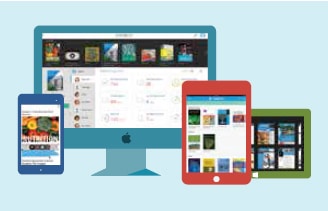
Converting textbooks to rich interactive digital textbook for iPad, Android and PC/Mac, KITABOO® will add contextual enrichments and make the subject mater come alive for students, which will help in retention and comprehension. The books will be enriched with high-resolution images, adding audio and video notes by teachers/authors on specific portions, which would help in a distraction-free learning experience for the student. KITABOO® Widgets will allow addition of quizzes, flashcards, and drag-drop activities into the textbook itself.

Student Analytics
With KITABOO®’s strong analytical engine embedded behind the reader, it will have the capability to analyze and record the student movement on the book, page-bypage. The teacher will now know how much the student has read, how much time has been spent on each page and what activities have been performed on the page.

Content Security and Digital Rights Management
KITABOO® utilizes both content encryption as well as license key validation mechanisms to validate an authentic user. The eBook content is encrypted / password protected with secure keys. The DRM encrypts audios, videos and images using AES 128-bit algorithm with CBC mode with PKCS5 padding. When an end user requests for an eBook, KITABOO® validates the license for that book. The package can only be decrypted by KITABOO® cloud reader or native reader apps.

Finally, the Digital Textbook Platform would enable better engagement among students, owing to more compelling content such as audios, videos and assessments. Teachers on the other hand would be able to better gauge a student’s performance and engagement with better usage analytics.

KITABOO® Cloud, a GOLD winner of the prestigious Brandon Hall Award for Advance in Mobile Learning, has processed and converted over 10 million input pages, it is an end-to-end eBook solution, that provides a great way to digitize books, make them interactive and distribute and deliver efficiently to your readers. And best of all, almost no major upfront investments are needed.

For more information on how to digitally energize your content, whether you are an institution, a corporation or a publisher, you can contact KITABOO@hurix.com or visit www.KITABOO.com

Shifting dynamics of education

The changing face of Indian education system is surely a positive step in the teaching methods today. The digital era is gaining momentum in imparting education to the new age generation. However, Dr K P Singh, Chairman, NIMT believes that only digital education is not enough to shape the future of Indians. A proper curriculum must be designed in such a way that both learning styles are accommodated

Shifting-dynamicsHow important do you think is a tablet for the curriculum in your institution?
The digitization of the classroom globally has resulted in a changed education pattern. Students have better accessibility towards study material. The tablet makes complex procedure very easy to understand for students, which was earlier difficult to understand by hard copy study material. It has revolutionized the e-learning programs or distance education programs, hence giving a better interactive learning for the students. Therefore we cannot deny the importance of tablets in education.

Is a tablet the only way for the colleges and the universities to help their students understand the concepts better?
Is a tablet the only way for the colleges and the universities to help their students understand the concepts better definitely not. For overall concept clearing of the student and with demand of the topic the teacher must adopt the best learning tool. The tools need not be only digital to be called as best learning tool. An appropriate example to quote here is paramedical students learning bones anatomy etc. The best way to teach them is through real skeleton in front of them, which is a classical way of teaching.

The e-content must be strictly regulated. A host of security concerns, including data protection and compliance with the Children’s Internet Protection Act (CIPA) should be followed

What can a tablet, e-book and e-content not do?
Those concepts/subjects or topics which can understood best by using concrete information such as facts, procedures, practical experience, visual analysis etc cannot be understood by digital method. Therefore the curriculum must be designed in such a way that both learning styles are accommodated. The classroom is filled with facts, which are organized with theories, providing a rich environment to feed children’s natural preferences.

In fact NIMT has already incorporated e-learning into its curriculum. NIMT has a team that has deployed an instance of openEDX. Students are able to access recorded lectures, interactive animations, questionnaires etc on edx. nimt.ac.in

NIMT has also started NIMT X which is basically a platform for both open and UGC approved online courses from over 50 Universities across the globe including the likes of King’s College, London, Trinity College London, Yonsei University, University of Warwick and partners such as The British Council, The Royal Shakespearean Company amongst others.

How do you evaluate, assess a tablet before selecting it for the curriculum in your institution?
Apart from technical specifications that should meet the criteria of the curriculum, other factors include warranty and after sales support for students. In case of tablets for school students, the specs are not very intensive and selected keeping in mind the kind of content that will be made for the curriculum. However for UG and PG students, the specs generally include the standards available in the market. The tablets are selected keeping in mind the multi-purpose utility of these tablets – which are used not only for learning but also for surfing, entertainment, games etc.

Introduction of digital tools into the classrooms has brought the narratives alive. The traditional tools of teaching are slowly losing their relevance. Do you see any inherent contradiction between the two?
Today academic field have witnessed the dramatic growth and influence of Internet, wireless technology. The educators hold the vision of revolutionizing future of teaching and learning systems. However, one must not forget that the main aim of educator is to use the best learning tool and depending on the topic, digital learning tools are not always the best. Therefore it is the responsibility of an educator to strike a good balance between traditional and modern learning tools.

Although the private institutions are far ahead of the public institutions, the new government appears committed to bridging the digital deficit. How do you think should the government move?
Government is taking strong steps in minimizing the gap of modern technology in academics. Government must keep in mind the economic and social inequality according to categories of persons in a given population. Keeping in mind the difference in socioeconomic levels of parents, government must release free of cost technology based learning tools for better growth of students. This will help in filling the gap due to technological advancement in private and public academics.

The main aim of educator is to use the best learning tool and depending on the topic, digital learning tools are not always the best. Therefore it is the responsibility of an educator to strike a good balance between traditional and modern learning tools

The digital roads to smart education have their own shares of potholes. Infrastructure continues to be the main bottleneck. How do you think can it be overcome?
e-Learning has become increasingly significant learning tool in education. Since many schools have lack of infrastructure to support wireless devices, students to bring their own devices cannot give access to immediate technology integration in the classroom. The access advantage— anytime, anywhere, any device—gives a significant benefit in learning.

Must the e-content be regulated? There are equally good reasons for both in favour or against. What is your take?
The e-content must be strictly regulated. A host of security concerns, including data protection and compliance with the Children’s Internet Protection Act (CIPA) should be followed. Protective wireless infrastructure, providing a segmented student network which separates teachers and administrators must be followed, to avoid data security conflicts and protecting student information. Built-in authentication procedures must be implemented which should monitor internet. Also, a web filter should provide internet access controls.

Do you think that e-learning runs the risk of over exposure and doing more harm than good in the end?
“If we teach today as we taught yesterday, we rob our children of tomorrow.” – John Dewey. Therefore we need to follow the best technology to educate student. But at the same time we cannot deny that over exposure to e-learning tools have risks to student’s health. There are several statistics which explains the same. The best way to regulate the exposure time is to make students aware of the risks involved in over exposure to technology. The institution and the educator must also share the responsibility in regulating the exposure time for the same.

The massive open online courses (MOOCS) have brought closer the dream of digital equality in our country. However, the shallow internet density in our country is making a crisis out of an opportunity. How do you think can the Government come to seize upon the opportunity?
Although the private institutions are far ahead of the public institutions, the government appears committed to bridging the digital deficit. However, many classrooms still struggle to integrate technology tools into daily learning. Therefore the government has the vision for how the future of teaching and learning systems should be revolutionized

Transitioning from Blackboard to Tabs

TransitioningThe e-learning has gained popularity in recent years where private schools have adopted its usage and public and government schools are in a mode to sync with the new age teaching technology. Carrying the trend of e-content to classroom is still at a nascent stage in India but Kalyani Rangarajan, Dean, VIT Business School, VIT University, believes that tablet is a powerful tool in a technologically advanced world today

How important do you think is a tablet for the curriculum in your institution?
As important as the ‘Fountain Pen’ was before it was demolished by the ‘Ball pen’! Tablet is a powerful tool in the technologically advanced world to impart learning to the students. Just as we have shifted from desktop to laptop we need to shift to tabs. Soon it would be all encompassing mobiles and sooner than later we might have google glasses and other wearables.

Is a tablet the only way for the colleges and the universities to help their students understand the concepts better?
If the question is, ‘can the tablet replace the teacher?’, the answer ‘might’ be ‘No!’ But it might even be better to have the tablet as a teacher, which can be non-judgmental, and definitely better than moody and sometimes inappropriate Teachers. Other methodologies in use such as role play, simulations, games etc. might be adapted to a tablet mode, in the days to come! Then, one might, justifiably say that there is no substitute for a tab.

What can a tablet, e-book and e-content not do?
At present, physical contact with other human beings might still be a problem, provided it is a necessary component of learning. But if only information sharing is important, then one can easily do with a tablet, which can provide enough and more content, correct and relevant.

How do you evaluate, assess a tablet before selecting it for the curriculum in your institution?
Availability, price, quality, and ease of use would largely decide the particular brand or specs that are required for a specific group.

Soon MOOCs would alienate the teacher from the taught and Prof. Gautam Kaul has clearly stated that no student should try to contact the instructor directly by mail or phone as it is impossible for him to devote time to any of the thousands who register for a MOOC

Kalyani Rangarajan
Kalyani Rangarajan
Dean, VIT Business School, VIT University

Introduction of digital tools into the classrooms has brought the narratives alive. The traditional tools of teaching are slowly losing their relevance. Do you see any inherent contradiction between the two?
The ancient gurukul, where the teacher had personal contact with few students, he would condescend to teach, has given way to large class rooms and impersonal teaching through blackboards, whiteboards and smartboards. However, as long the objectives of the teaching – learning process are achieved, one cannot complain about the lack of personal touch, which was the very essence of teaching in days of yore.

Although the private institutions are far ahead of the public institutions, the new government appears committed to bridging the digital deficit. How do you think should the government move?
There is indeed a welcome change in the approach of the government to improve the quality of education in the public institutions. This would pose a greater challenge to the private institutions as they need to be ahead of the public institutions if they have to attract good quality students at the higher fees that they charge. If government does it this year, private should have already done it a couple of years earlier.

The digital roads to smart education have their own shares of potholes. Infrastructure continues to be the main bottleneck. How do you think can it be overcome?
When the going gets tough, the tough gets going. Nothing great is achieved without its share of pains and obstacles. Both the management and the faculty of these institutions need to strive hard to enable the smooth transition from the blackboard to the tablet mode of teaching – learning process. Power availability, internet connectivity, students’ techno-phobia, evaluation methodology, and the objectives of the learning process need to be addressed to break the bottlenecks. Having a large cap might help.

Do you think that e-learning runs the risk of over exposure and doing more harm than good in the end?
A knife can be used both to kill a person and also to save him from death, depending on who is wielding it. Similarly one has to have a trade-off between no information and overload of information. Guess, the amount of water drunk depends on how thirsty is the person.

The massive open online courses (MOOCS) have brought closer the dream of digital equality in our country. However, the shallow internet density in our country is making a crisis out of an opportunity. How do you think can the Government come to seize upon the opportunity?
The easier option would be to put a ban on all MOOC courses, so that the limited band width is used only for emails. It is like throwing the baby with the bathwater. Having made millions of rupees, it would be more appropriate for the government to ensure that the 3G and 4G bandwidths are implemented and the last mile issues in internet connectivity are resolved at the earliest. Having caught up with the mobile revolution, we should not lose out on the wide band video communication

Disruptive MOOCs

MOOCsMassive Open Online Courses, or MOOCs, present a unique opportunity to address all the challenges. In 2011, the academic world experienced a revolution in content distribution and teaching methodology when MOOCs emerged as the next big thing in distance education

Continuing economic uncertainty, intense competition and enormous political, technological, environmental, and businessrelated challenges, as well as the knowledge revolution have given rise to disruptive innovations. The only way to thrive in these unusual times is to adapt collectively to the ever-changing demands of the industry and economy. For countries to keep pace with the changing times and stay competitive globally, it becomes imperative to engage the masses by making them employable and employed. Thus, skills are the only seemingly global currency in this century.

The capacity of nations today is linked to how rapidly and effectively they can skill their people. The 20th century was marked with the setting up of brick-and-mortar universities and colleges for this purpose.

However, it is clearly evident that these institutions alone will not be sufficient to address the vast need-gaps and ever changing requirements of the 21st century. Massive Open Online Courses, or MOOCs, present a unique opportunity to address all these challenges. In 2011, the academic world experienced a revolution in content distribution and teaching methodology when MOOCs emerged as the next big thing in distance education. Although the concept of online education has been around since the advent of the Internet, MOOCs attracted a larger audience due to their interactive content, global access, and, most importantly, free quality education.

In a world where Ivy League education is considered the panacea for an ailing global economy, MOOCs made it possible to receive such an education in the comfort of your home.

Some Facts about MOOCs
• The term MOOCs was coined by Dave Cormier of the University of Prince Edward Island, Canada and Senior Research Fellow Bryan Alexander of the National Institute for Technology in Liberal Education, US

• New York Times dubbed 2012 as the year of MOOCs, while Time magazine dubbed MOOCs Ivy League for the masses

• In 2008, George Siemens of Athabasca University and Stephen Downes of the National Research Council offered the first cMOOC – Connectivism and Connective Knowledge (CCK08) with an enrolment of ~2200 students

• In 2011, Stanford University offered the first xMOOC – Introduction to Artificial Intelligence – taught by Sebastian Thrun and Peter Norvig which registered an enrolment of ~160,000 students.

MOOCs can be categorized as connectivist MOOCs, or cMOOCs, or xMOOCs, where cMOOCs can be defined as a network of individuals sharing knowledge on a common topic. The prime objective of cMOOCs is to facilitate communication between users and thus tends to be dynamic in nature. Using digital media, enrolled participants interact with their peers to clarify doubts, complete assignments, and share knowledge.

xMOOCs, on the other hand, tend to be the extensions of certain courses or concepts. Generally offered by universities as an introduction to a particular course or topic, xMOOCs familiarize its users with the fundamentals by using lecture videos and course content.

In a world where Ivy League education is considered the panacea for an ailing global economy, MOOCs made it possible to receive such an education in the comfort of your home

Evolution of MOOCs
In 2002, following the concept of Open Educational Resources (OERs), MIT launched its Open Course Ware (OCW) project which was followed by similar projects at other elite American Universities. With over 125 million visitors and online materials corresponding to over 2,150 courses, the OCW project can be considered hugely successful and a pioneer for MOOCs. Salman Khan, an MIT and Harvard alumnus, launched Khan Academy in 2006 which featured Internet-hosted videos on various subjects like mathematics, history, healthcare, medicine, finance, and biology and garnered more than 440 million views.

These concepts are widely regarded as the precursor for the MOOCs movement. Since 2012, several educational organizations started offering online courses on a plethora of topics. Several other universities also started offering their content online in order to reach a wider audience. Despite the ever increasing number of players in the MOOCs space, three are considered the most important actors, viz. Coursera, Udacity, and edX.

Current Business Model
Most MOOCs players are currently following a freemium model wherein content is used to drive traffic while a premium is charged for additional services (or add-ons) which become the main source of revenue. These additional services can be directed towards end users via offering certification, one-onone mentoring, career counseling and placements, or towards partners by charging licensing and hosting fees.

Several other revenue options, such as accreditation, are currently being explored by MOOCs providers. The universities like Georgia Institute of Technology have teamed up with Udacity and AT&T to offer an accredited Online Master of Science in Computer Education (OMS CS) at minimal cost (around $7000). Even players like Coursera and edX are exploring accreditation with the recommendations of the American Council on Education’s College Credit Recommendation Service (ACE CREDIT), which are taken into consideration by over 2,000 universities and colleges for transfer of credits.

$200 billion will be required to meet the additional intake demand across education segments. Therefore, the traditional model of education may seem ineffective in meeting the future requirements of the country

Quality education in India is highly restrictive in nature and only a few who have adequate resources and are willing to put in enormous efforts get access to it. In the current scenario, if the student is not among the top 1-2% of the country, the entry to elite institutions within India is difficult. This situation is changing, with the increase in number of private universities and colleges. At the same time, the employability of some of the students graduating from these private colleges is in question as their curriculum design and delivery may not have been benchmarked against the best.

At the same time, at the current growth rates in the education sector, there will be an enormous need for funds and land to set up such institutions, a requirement that will be largely prohibitive in nature. It is estimated that $200 billion will be required to meet the additional intake demand across education segments. Therefore, the traditional model of education may seem ineffective in meeting the future requirements of the country.

We believe that in order to address the unique challenges that India faces, the learning intervention needs to be characterized by the following key constituents, namely:

•Scale
•Efficacy (in terms of every learner being engaged and learning)
• Affordable
• Accessible
• Accredited (implying quality of delivery in terms of quality of teachers/ faculty)
• Acknowledged by the Industry; and
• Linked with Assessment

Across the world, public and private bodies are experimenting with newer learning models to capture this market. We have made an attempt to evaluate these models for India. MOOCs, which have been touted as the game-changer in this domain, quite efficiently address many challenges of the current system. However, its impact on the efficacy in terms of student engagement and learning is still questionable. This gets reflected in the low completion rates in most MOOCs offerings.

It is therefore questionable whether MOOCs will be able to reroute India’s leviathan education system. There are challenges as well with MOOCs, including the absence of an experiential learning framework and imparting employment as one of the key outcomes.

We believe that the Minerva project, begun in the West, could well be the next most significant model, even within the Indian landscape. Minerva provides higher education to the world’s brightest and most motivated students, completely online. Each class is capped at 20 students and these students travel across the world to gain experiential learning. Most importantly the application-to-intake ratio is among the highest in the world. Similarly, Udacity and Georgia Institute of Technology offer a complete online MS Program in Computer Science. Concepts like these are often categorized as Small Private Online Courses or SPOCs.

MOOCs: Outlining the Model for India
We believe that MOOCs will evolve from their current state to Valueadded MOOCs, or vMOOCs, with large number of smaller groups or sapiential circles. In the vMOOCs business model, MOOCs will continue to occupy the core position; however, they will be supplemented by value-added services which will make the internationally benchmarked content relevant and more meaningful within the Indian context. These value-added services may include:

• Placement Support
• Aptitude Profiling
• Recognition of prior learning
• Career Counseling
• Localization and Customization of the Content
• Providing additional reading/reference material on the subject to students
• Providing customizable assessment reports to students indicating gap areas for reinforcements
• Accredited
• Online Proctoring
• One-on-One Mentoring

The various stages of education highlighted above lend themselves differently to a MOOCs solution. Some education needs like K-12 cannot be fulfilled with MOOCs while, for others like test preparation, an immediate solution seems possible.

MOOCs could also provide solutions in terms of decreasing the costs of some of these education components and play a major role in promoting equity and access. A detailed assessment and possible MOOCs interventions for each of the above stages of education have been highlighted in the following sections.

Key Challenges
While the test preparation model has stabilized and been fairly well accepted at a macro level, it faces some challenges
which are enumerated as under:
• Students need to travel to faraway locations to attend these classes, which are conducted in large batches in the physical
class-room type set-up
• Technology usage is minimal and restricted to online exams
• The high cost of preparing for exams like CAT, GMAT, etc. proves prohibitive for some students who, as a result, are forced to
restrict themselves to self-study. The absence of expert guidance/course material may prove counterproductive to their
chances of getting through
• The delivery costs are high due to the need for a physical class-room setup and minimal use of technology
• The service provider and students are overly dependent on a few good tutors
• The recognition of prior learning is often limited and the model works on the “One size fits all” approach
• In most test preparation models, large batch sizes result in a lack of personalization and individual attention to students
Some of the key challenges presently observed within the Indian Higher Education framework include minimal interuniversity
knowledge transfer; the consequent failure of medium- to lower-ranked universities in terms of benchmarking
their curriculum against top-ranked institutions; lower access to quality education due to enhancing selectivity among the
top institutions; culture of continuing education has not yet set in among the working population of India; lack of faculty
exchange and academia-industry partnerships; limited access to good quality higher education with only those who
have resources and high intellectual quotient likely to get through the highly competitive entrance systems; steep disproportion
between number of seats available and number of aspirants; and, massive investments, from both government and
private players, as well as time is needed to fill the prevalent demand-supply gap.
The MOOCs model would encourage collaboration between universities at different levels resulting in improvement in
content quality, lecture delivery, and resource utilization.
The Indian higher education market is currently estimated at $11 billion, but is growing at a CAGR of 20%. The current
state of higher education with the Gross Enrolment Ratio, or GER, at only 20%, is characterized by high exclusivity and low
inter-university coordination, thereby isolating the masses from access to quality education and functioning of universities
in silos.


‘Let Digital, Traditional Go Together’

Dr Sraban Mukherjee
Dr Sraban Mukherjee
Director, KIET

Despite education going digital fast at K-12 level, there’s a section that still favours the traditional mode of teaching. Nonetheless, heads at various universities still believe that live interactive sessions between students and teachers play a crucial role in polishing the pupil’s mind

The ICT integration supports number of policies in education but there is still variation in implementation of these policies. The access to ICT is still limited in Indian education plethora. Dr Ajit Kumar N. Shukla, Director and Dean, School of Engineering, RK University believes, “Tablets for the curriculum is not much important but it could be linked to some courses as doable in practice. Our institution has more than hundred of that and using it for the same.”

The changing dynamics in education sector and shifting expectations for the learning environment require universities to examine teaching and learning practices. The forces of change in higher education system seem to be need of the hour. Believing the thought of using tablets as a medium of study Dr M K Abdul Khader, Vice Chancellor, Kannur University, Kerala says, “With the widespread use of e-resources, irrespective of faculty/ topic of study, by teachers, students, research scholars tablets would be of great significance. Tablets are less expensive in its cost and maintenance which has replaced Laptops with lightening speed. It could be easily handled by everyone in class rooms and during presentation.”

Tablet being one of the portable knowledge base, students can retrieve information as and when needed from internet. It acts as a connecting medium with fellow students as well as the professors. So once the problem popped, it can be shared with all and can get an immediate feedback or solution.

The total number of schools in India is estimated to be 1.3 million out of which 20% of schools are privately run and only 10% of these schools have adopted multimedia. The market size for digitized school  products is predicted to grow to $2 billion by 2020. The market for ICT is promising if government schools are considered too.

But is it the only way for the colleges and universities to help their students understand the concept better? Of course not, opined by Dr Dharmender Saini, Principal, Bhartiya Vidyapeeth’s College of Engineering. He asserts, “Tablet is not the only means to make students better understand the concept, Interaction with teacher/expert is must.”

Promoting his thoughts, Shukla adds, “There are many other ways it could be done and it is done extensively by using interaction mode in the class through various activities which gives better experience.” Coming fr om a different school of thought, Dr Sraban Mukherjee, Director, Krishna Institute of Engineering & Technology shares, “Brains were nurtured and they did wonders even in the era of no electricity and modern basic amenities of living. So tablets are not mandatory, however, they do provide an ease of learning, understanding, connecting, discussing and communicating.”

“No, besides other sources it is one of the important source,” says Jaswinder Kaur, Publicist, Desh Bhagat Group.

An important aspect of M-learning, the technology is convenient which is accessible virtually from anywhere. But M-learning brings portability by replacing books and traditional methods of teaching with small devices filled with learning contents? “Definitely a tablet cannot replace the professor of the institution. It can serve the purpose of a physical book. As we know that different streams (medical, engineering etc.) of studies not only need textual reading but also pictorial understanding of the system. So in these cases we need a copy and pen to memorize and understand them,” shares Mukherjee.

E-book, e-content etc. are mostly passive in nature. They cannot provide learning experience that students get from interactive methods like class room teaching, group discussions, interactive video lectures etc. Tablets cannot propagate values which are lacking in the modern world. Knowledge disseminated from teachers would have lasting impression in the minds of the learner. Tablets provide knowledge indiscriminately. There are no barriers between good or bad. Conventional form of teaching builds unbreakable bond between teacher and the taught.

Universities are addressing this shifting landscape but still there seems to be little adoption. Online courses are growing in number and some universities are making it available free to everyone. To evaluate, assess a tablet before selecting for curricula the universities emphasize on its key features like portability,

free OS (Android) to get the desired apps with an ease, WiFi support, 3G/4G support, capable of storing teaching learning material, processing speed, memory, support for external devices, power consumption, weight, durability, warranty and after sales support.

Use of technology to simulate everything has allowed students anywhere in the world to interact with professors and one another in real time rather than requiring physical presence. The introduction of digital tools in the classrooms has brought the narratives alive. They play a major role in the classroom teaching but the effectiveness of such tools depends on how they are incorporated into the learning process. Traditional teaching tools are to be modified so as to use along with digital tools. Though conventional teaching has its own relevance yet the optimum situation could be created by effecting a judicial balance between the two.

“This is the era of digitization. So when we talk about our learning curriculum, the ease to get information is the key. Every curiosity needs to be addressed quickly as well as correctly and our digital world supports it with abundance of information on internet, and a tablet to harness it. However we cannot deny the importance of white chalk and black board based traditional form of education.The primary educaeducation system should always be traditional because writing alphabets is an art too which can be imbibed and enhanced in the budding mind only by a pencil in hand and not a key under the finger tip,” says Mukherjee.

The digital education is gaining momentum in education sector as the new Modi-led government has taken steps to bridge the digital divide and had launched new Digital India Campaign. Fortunately the institutions still believethat government should ensure that the in-house practices of public institutions should be improved and government should ensure quality in teaching learning methodologies. Lack of fund is a barrier to the public institution. Specific initiatives should be taken by the government to strengthen the internet and other digital resources in public funded institutions.

“It is wrong to say that always private institution are far ahead public institution. Yes it is correct new government is committed to bridging the digital deficit and it is required also mostly using the mobile set or through android one. More so for financial transaction in this regard through Pradhan Mantri Jan-Dhan Yojna appears to be a turning point,” informs Shukla.

The digital road to smart education has its own share of potholes and infrastructure continues to be the botand also ensure proper functioning of facilities so that students get services on time. The below formula can work to bridge this gap:

  • First strengthen the basic educational amenities in the depriving institutions
  • Educate the professors and the teachers about the positives of the digitisations
  • Support students for getting the modern educational aid (laptops, palmtopsetc).
Dr Ajit Kumar N ShuklaDirector & Dean, SOE, RK University
Dr Ajit Kumar N Shukla
Director &
Dean, SOE, RK University

The advancement of e-learning might have been good for the education institutes but it also comes with risk. Elearning do run the risk of overexposure doing harm than good. “Based on the temperament of the learner if he is exposed to the sensitive topics indefinitely than this might result in harming the society then actually benefitting it,” believes Mukherjee.

However, digital technology has the potential to change the phase of education in India and with the new model built around massive open online courses (MOOCS), it has brought closer the dream of digital equality in the country. But this dream can only take the shape into reality only if the infrastructure is placed judiciously. The shallow internet density is making a crisis out of an opportunity. Government should take steps to provide 3G/4G internet services not only in cities but in other rural places as well. Government can come to seize this opportunity by providing the dedicated lease line of internet facility as an outreach program to all the university, colleges and school throughout the state.

LATEST NEWS