



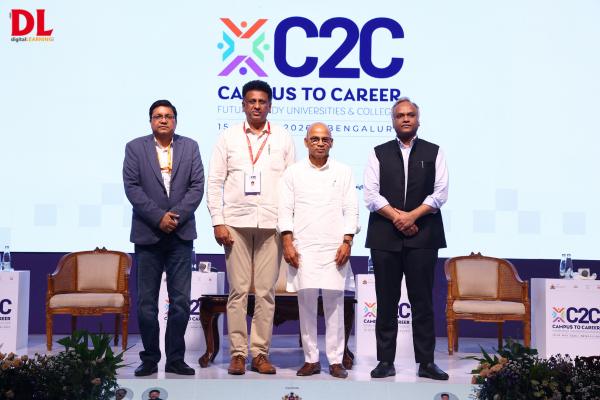
The Two-day Campus to Career (C2C) Summit 2026: Future Ready Universities & Colleges concluded successfully today at The Lalit Ashok, Bengaluru. Jointly organised by the Higher Education Department, Government of Karnataka, and Elets Technomedia Pvt. Ltd., the summit brought together ministers, policymakers, IAS officers, university leaders, industry experts, technology innovators, startups, and skilling organisations to deliberate on the future of higher education, employability, AI integration, innovation, and workforce readiness.
Day 1 Highlights: Karnataka Presents Its Vision for Future-Ready Higher Education
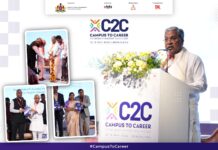
The Inaugural ceremony commenced with a prayer and the rendition of the Naada Geethe, Karnataka’s state anthem, setting an inspiring tone for the summit proceedings. This was followed by the ceremonial lamp lighting in the presence of distinguished dignitaries, including Smt. Khushboo G. Chowdhary, Secretary, Department of Higher Education, Government of Karnataka; Sri Siddaramaiah, Hon’ble Chief Minister, Government of Karnataka; Dr. M. C. Sudhakar, Hon’ble Minister for Higher Education, Government of Karnataka; Dr. Sharanaprakash Patil, Hon’ble Minister for Medical Education and Skill Development, Government of Karnataka; Sri Priyank Kharge, Hon’ble Minister, Department of Electronics, IT, Biotechnology and Science & Technology, Government of Karnataka; along with Smt. Shalini Rajneesh, Dr E.V. Ramana Reddy, IAS, Shri Mohammad Mohsin, Smt. Kanta Naik, Shri S. Bharat, IAS, and Dr Ravi Gupta, alongside senior government officials, university leaders, and industry representatives.
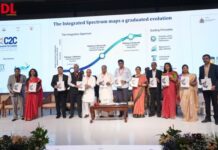
A major highlight of the inaugural session was the launch of the Vision Framework on Karnataka’s Higher Education Journey, along with the unveiling of the special issue “Karnataka Futuristic Vision for Higher Education” and the special magazine “Skilling Pathways in Higher Education” by the Higher Education Department, Government of Karnataka.
Delivering the Welcome Address, Smt. Khushboo G. Chowdhary highlighted Karnataka’s focus on research excellence, educational quality, and employability-driven reforms.
Addressing the summit, Dr M.C. Sudhakar, Hon’ble Minister for Higher Education, Government of Karnataka, said, “Karnataka is undertaking a major transformation in higher education by shifting from static, theory-driven learning to a dynamic, industry-aligned and skill-oriented ecosystem.” He also highlighted the state’s collaborations with organisations including the British Council, Microsoft, Wadhwani Foundation, Siemens, Schneider Electric, and Tata Electronics, alongside the establishment of multiple Centres of Excellence and global academic partnerships.
Sharing Karnataka’s broader vision for future-ready education, Sri Siddaramaiah, Hon’ble Chief Minister, Government of Karnataka, stated, “The focus is now on ensuring that students are equipped with the skills, confidence, and capabilities needed to lead in the future economy, while enabling a stronger transition from campus to career.”
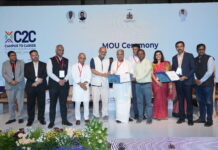
The inaugural ceremony also witnessed the signing of several strategic MoUs. Key collaborations included partnerships with the British Council, Head Held High Foundation (HHHF), 1M1B Foundation, SS Sigma Infotech Pvt. Ltd., Timbuckdo Innovations Pvt. Ltd., and the National Stock Exchange of India Limited.
Key Sessions and Discussions on Day 1
The first day of the summit featured several high-impact sessions and panel discussions including “The Government of Karnataka’s Vision for Outcome-Based Higher Education,” “From Silos to Synergy: Reimagining Higher Education for Industry-Ready Talent,” “From Education to Employment: Institutionalising Skilling in Formal Education,” “Developing the AI-Ready Workforce,” “AI-Enabled Universities: Transforming How Karnataka Learns, Teaches and Leads,” and “Future-Ready Doctors: Bridging Medical Education with AI, Clinical Skills & Real-World Healthcare Needs.”
The summit also witnessed leadership addresses and industry presentations by organisations including HP Inc., Adobe, VMock, and Roombr Technologies, alongside participation from academic leaders, policymakers, and international experts discussing innovation, employability, digital transformation, and future workforce readiness.
Continuing Into Day 2 with a Deeper Focus on Innovation & Industry Integration
Building upon the strong momentum from Day 1, the second day of the summit focused on Centres of Excellence, semiconductor talent pipelines, startup ecosystems, BFSI workforce development, AI integration, employability, and Karnataka’s Vision 2030 for future-ready education and innovation.
Delivering the Opening Address on Day 2, Smt. Khushboo Goel Chowdhary, Secretary, Higher Education Department, Government of Karnataka, stated, “Karnataka’s landmark summit has laid a strong foundation for transforming higher education through unprecedented collaboration between government, academia, industry, and global leaders. The shared vision is clear: Karnataka must lead not only in education access, but in innovation, employability, relevance, and future readiness.”
Major Sessions and Discussions from Day 2
One of the major highlights of Day 2 was the session “The CoE Blueprint: Accelerating Innovation from Campus to Corporate Innovation at Scale,” chaired by Dr Manjula. N, IAS, Secretary to Government, Department of Electronics, Information Technology, Biotechnology, and Science & Technology, Government of Karnataka. Highlighting Karnataka’s growing innovation ecosystem, she stated, “Karnataka, recognised among the world’s leading innovation ecosystems, is leveraging its network of 200+ engineering colleges, 1,000+ technical institutes, nearly 65 universities and over one lakh graduates annually to build a stronger future-ready workforce aligned to emerging industry needs. Campus-to-Career initiatives are becoming critical in strengthening the bridge between academia, industry and innovation ecosystems. Over the last decade, Karnataka has invested more than ₹500 crore in Centres of Excellence across domains such as AI, cybersecurity, robotics, biotechnology and semiconductors. These initiatives have supported over 750 startups with a combined valuation exceeding ₹4,000 crore, enabled nearly 250 patents, skilled more than 10,000 young professionals and facilitated over 100 industry-academia collaborations. The larger objective is to ensure that innovation, skilling and high-quality opportunities are not concentrated in one city alone. Through Centres of Excellence and initiatives beyond Bengaluru, Karnataka is building a more distributed and inclusive talent ecosystem that can support the next generation of digital, deep-tech and research-led growth.”
The session featured distinguished speakers, including Dr Debabrata Das, Director, IIIT-Bangalore; Shri Raghu Dharmaraju, CEO, ARTPARK; Shri Ashok Kamath, Director, ASCEL Technology Forum, CoE-AI; Shri Ranjit Mishra, Centre Head, CoE-CySecK; and Mr Dilip Shankar, Associate Vice President, Bangalore Bioinnovation Centre.
Another key session, “Talent Pipeline for Building Karnataka’s Semiconductor and Advanced Manufacturing,” brought together Sivakumar P.R., Pradip Thaker, Prof. Mayank Shrivastava, and Sanjeev Keskar, who discussed semiconductor ecosystem development, specialised workforce creation, and future manufacturing opportunities in Karnataka.
The summit also hosted “Strengthening India’s Financial Talent Pipeline,” a focused discussion on how the BFSI sector can help shape business education to meet evolving industry and regulatory demands. Moderated by Ramesh Kaza, EVP, President & Country Head, LPL Financial GCC, the session featured Payal Aggarwal from HCL Technologies, Ritu Rakhra from Broadridge India, Rajesh Balaraju from LPL Financial GCC, Dr N. Nagamani Nagaraja from Global Academy of Technology, and Priya Madhavan from Nasscom.
A dedicated session titled “Campus to Company: Celebrating Student-Led Startups & Innovation” highlighted the growing importance of entrepreneurship, incubation, mentorship, and innovation-driven learning ecosystems in shaping future-ready campuses. Moderated by Bharath Chandra BK, AVP, Karnataka Digital Economy Mission, the session featured Anuj Mehta, Vice President, Campus Fund; Rajeev Warrier, EVP, Wadhwani Foundation; Ritu Sharma, Director, TiE Bangalore; and Johnson Tellis, CEO, Shine Foundation.
A special address was also delivered by Prof. Y.M. Jayaraj, Pro-Chancellor of BLDE University, who emphasised the importance of innovation-driven education, research collaboration, and skill-based learning in building future-ready universities and enhancing student employability.
The session, “Mastering the Human Element / Building General Professional Skills,” featured Arundhuti Gupta, P N Nayak, Prof. Suresh Bhagavatula, and Aditya Vellore, focusing on communication, adaptability, leadership, and workplace readiness skills essential for future careers.
A special address was also delivered by Sanjeev Kumar Gupta, CEO, Karnataka Digital Economy Mission, who stated, “India’s next growth phase will depend on how effectively we align education with employability and emerging industry demand. Karnataka is already building that pipeline through large-scale skilling, industry-academia partnerships and regional talent programmes, with initiatives under NIPUNA Karnataka alone creating a beneficiary pipeline of over 17,000 learners. Our focus is not just on placements, but on building talent with stronger problem-solving ability, critical thinking and adaptability across emerging technologies and innovation-led sectors. As AI and digital technologies reshape classrooms and workplaces, it is equally important that learning remains meaningful, inclusive and student-centric.”
He further added, “What is equally important is ensuring that these opportunities are distributed beyond Bengaluru. Through initiatives such as LEAP Labs across Hubballi, Mysuru, Kalaburagi and Hoskote, cluster-level skilling programmes, and industry-academia ecosystems like IIT Dharwad’s dhaRti incubator and KLE-CTIE, Karnataka is building a stronger regional innovation and talent network. The state has also supported 11 Technology Business Incubators with over ₹110 crore in backing, while partnerships with global technology and semiconductor companies are helping students gain direct exposure to emerging industries and advanced manufacturing ecosystems.”
Concluding his address, he stated, “As Karnataka works towards enabling 20 lakh jobs across sectors, initiatives like Campus to Career will play a critical role in connecting students, academia, startups, industry and government to create a future-ready workforce and stronger innovation-led career pathways across the state.”
High-Level Ministerial Panel on Karnataka Vision 2030
One of the major highlights of Day 2 was the High-Level Ministerial Panel Discussion on “Karnataka’s Vision 2030: Integrating Education, Innovation & Industry for a Future-Ready State.” The session brought together Dr. M. C. Sudhakar, Hon’ble Minister for Higher Education, Government of Karnataka; Dr. Sharanaprakash Patil, Hon’ble Minister for Medical Education & Skill Development, Government of Karnataka; and Sri Priyank Kharge, Hon’ble Minister for IT, BT & Science and Technology, Government of Karnataka, who shared the state’s roadmap for building a future-ready, innovation-driven ecosystem.
Addressing the importance of practical learning and employability, Dr. Sharanaprakash Rudrappa Patil stated, “The balance between classroom learning and hands-on experience must be redefined to make graduates truly employable and aligned with real world skill requirements.” He emphasised the need for stronger industry exposure, practical learning environments, and skill-focused education to ensure students are prepared to meet evolving workforce demands.
Highlighting Karnataka’s growing talent ecosystem, Dr. M.C. Sudhakar said, “Bengaluru became a GCC hub because talent from across states and tier 2 and tier 3 cities converged there, but talent is never confined to one city, and expanding GCCs across regions can unlock similar growth everywhere.” He underlined the importance of decentralising growth opportunities, strengthening regional innovation ecosystems, and creating industry opportunities beyond metropolitan centres.
Speaking on integrated governance and future growth, Sri Priyank M. Kharge remarked, “If we want to stay relevant in global markets, drive continuous change, and move up the value chain, departments of IT, skills, higher education, and industry must work together in sync.” He stressed the importance of collaboration between government departments, academia, industry, and skill development ecosystems to strengthen innovation, workforce readiness, and Karnataka’s global competitiveness.
The session concluded with a shared vision of positioning Karnataka as a leading hub for innovation, employability, advanced technologies, and future-ready talent.
Important Roundtable Discussions
The summit also hosted several high-level roundtable discussions including “CSR & Emerging Technologies,” “Industry Perspectives on Centres of Excellence (CoEs): Building Collaborative Innovation & Talent Ecosystem,” and “Global MedTech Talent Pipeline: Preparing Karnataka’s Workforce for International Healthcare & Medical Technology Markets.” The discussions brought together government leaders, industry experts, healthcare professionals, CSR representatives, and academic stakeholders to deliberate on innovation ecosystems, skilling, emerging technologies, healthcare talent development, and stronger industry-academia collaboration.
Special Highlight: Student-Led Innovation and Startup Ecosystem
One of the key highlights of Day 2 was the dedicated focus on student-led innovation and entrepreneurship through the special session “Campus to Company: Celebrating Student-Led Startups & Innovation.” The session brought together startup ecosystem leaders, investors, incubators, innovation experts, and student entrepreneurs to discuss how universities can become launchpads for entrepreneurship, innovation, and future-ready ventures. As part of the session, students also presented their startup ideas and innovations, showcasing emerging entrepreneurial talent and innovative problem-solving approaches from campuses across Karnataka.
Summit Concludes with Strong Commitment Towards Future-Ready Education
The Campus to Career Summit 2026 concluded on a strong and optimistic note, with leaders collectively reaffirming their commitment towards building an AI-enabled, innovation-driven, employability-focused, and globally competitive higher education ecosystem for Karnataka. The summit successfully established a collaborative roadmap while reinforcing Karnataka’s position as a leading destination for future-ready education and talent development in India.
For more information, visit: Campus to Career Summit 2026