


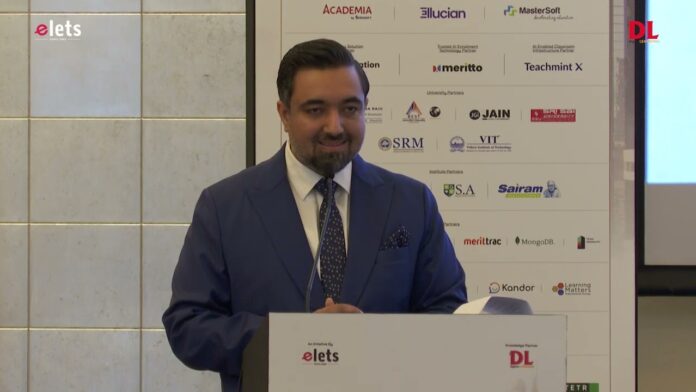
In today’s globally interconnected world, the realm of education is evolving at an unprecedented pace. The UAE stands out as a beacon of innovation in creating an education ecosystem that balances excellence with consistency. The insights shared here by Reekrit Seraia, Managing Director, Satluj Group of Schools, India at 35th Elets World Education Summit on 4-5 February in Dubai, highlight the potential for mutual learning between the UAE and India.
Understanding the UAE’s Educational Success

When we discuss education in the UAE, it’s tempting to focus solely on the impressive infrastructure—the state-of-the-art campuses and globally renowned institutions. However, the real strength lies in the policies, regulations, and outcomes that have turned the UAE into a global education hub. With approximately 250 private schools serving nearly half a million students from around 180 nations, this growth is not a happy accident but a result of a meticulously crafted ecosystem.
Three pillars form the foundation of the UAE’s educational success. Firstly, their comprehensive policy-making framework, which includes bodies like the Knowledge and Human Development Authority (KHDA). This authority oversees multiple educational boards and maintains rigorous inspection standards, ensuring that schools comply with international educational norms.
The Role of KHDA in Maintaining International Standards
Unlike many countries, the UAE supports 17 educational boards under one regulatory authority, KHDA. This setup allows for a unique blend of public governance and private innovation. For instance, private schools in the UAE recently ranked among the top 15 globally in PISA assessments. This indicates not only educational excellence but also the nation’s commitment to consistency across various educational platforms.
Challenges and Opportunities: A Comparative View with India
Transitioning to India, the landscape shifts significantly due to sheer scale. With over 240 million students taught each year in 1.4 million schools by nearly 10 million teachers, India has its own set of challenges. Predominantly, government schools make up 69% of the educational institutions, with private schools comprising 30%. However, despite this significant private presence, what India lacks is a cohesive policy framework that unifies and elevates educational standards.
Contrasts become evident when we examine India’s inspection and fee regulation systems, which vary greatly between states. Unlike the uniform oversight provided by the KHDA in the UAE, India’s lack of a national governing body leads to inconsistent educational outcomes.
Learning From Each Other: How Both Nations Can Benefit
India’s strength lies in its ability to offer education at massive scales, instructing the world on the logistics of expansive educational frameworks. In contrast, the UAE demonstrates how to create an effective governance structure that fosters consistent quality. One of the significant pointers India could adopt from the UAE is the implementation of a centralized inspection and rating system for private schools. This would ensure uniform standards and accountability.
In addition to policy frameworks, the UAE offers insights into innovative approaches in education, like the introduction of artificial intelligence in curricula. Furthermore, by pursuing international partnerships and aiming to establish numerous university branches, the UAE is preparing for a future where high-quality education is accessible and abundantly diverse.
Also Read: Future-Ready Schools: Navigating Education in the Age of Technology
Paving the Way for Future Educational Systems
The future of global education belongs to systems that can teach diversity while maintaining equity, that can foster discipline alongside innovation. The UAE is paving the way in building such a system, while India and other nations can contribute by scaling education effectively to meet increasing demands. The exchange of ideas and practices between these nations can lead to a more robust global education framework.
It was a pleasure to delve into these valuable insights, which offer a roadmap for educational excellence. As educational leaders and policymakers continue to collaborate globally, they will undoubtedly unlock new potentials for the generations to come.