

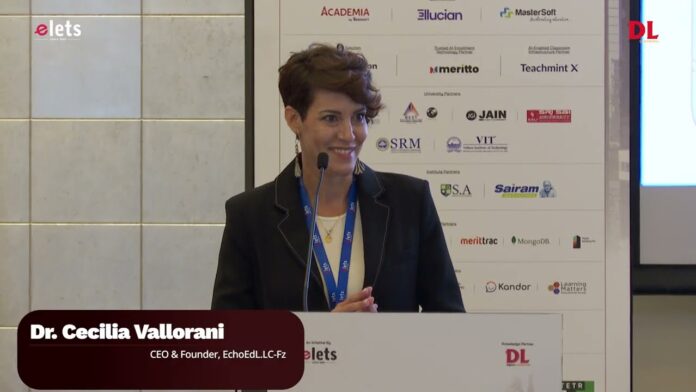
There is a fundamental aspect of education that risks becoming obsolete – the human voice. Dr. Cecilia Vallorani, CEO & Founder, EchoEdL.LC-Fz addresses this pressing issue with her innovative approach titled ‘sound movies’ at the 35th Elets World Education Summit, Dubai on 4-5 February 2026.
The Digital Pedagogical Divide

Our modern educational landscape is vastly different from the natural environments students engage in daily. Students are surrounded by sound, images, videos, podcasts, and voice messages, creating a multimodal digital ecology. Yet, traditional literature classrooms remain predominantly silent with students quietly reading from physical or digital texts. This creates a divide between students’ digital reality and the silent, print-based academic tradition they are expected to conform to, leading to the exclusion of learners who depend on auditory processing, embodied cognition, or collaborative meaning-making.
So, what exactly is a sound movie? At its core, a sound movie is a dramatic audio reinterpretation of a literary text, crafted by either students or professional speakers. It combines vocal performance, sound design, and digital editing to form a cohesive auditory narrative. Unlike audiobooks lacking dramatic intent or podcasts rarely focusing on literary content, sound movies encompass the best aspects of various audio formats, presenting literature in an engaging and interpretative manner.
Dr. Valorani’s presentation highlighted the unique value of sound movies against other formats such as audiobooks and radio theater. Through sound movies, literature gains a vibrant, interpretative dynamic by utilizing elements like vocal character exploration, sound design architectures, and a reflective process post-performance. An example comparison of an Anton Chekhov audiobook and its sound movie version showcased the depth this format can bring to the storytelling experience.
The foundational strength of sound movies lies in their integration of four theoretical frameworks: Orality Studies, Literacy Transduction, Dramatic Semiotics, and Digital Oral Storytelling. The transformative outcomes of this approach are profound:
- Inclusion: Students who once struggled become vocal directors, sound artists, and confident interpreters, elevating critical literacy through auditory interpretation.
- Identity Work: By performing stories, students explore their own identities. The human voice, as a core element, bridges personal connections within educational contexts.
- Joy in Learning: Sound movies provide a joyful, engaging literary experience, making education an enjoyable process.
Universal Design in Education
Sound movies offer a universally designed educational experience, fostering accessibility for multilingual learners and students with dyslexia, ADHD, or visual impairments – ensuring no learner is left behind. The method involves a five-step framework emphasizing scene decomposition, script adaptation, vocal performance, sound design, and publication, allowing students to engage deeply with texts and foster critical thinking skills.
Also Read: Revolutionizing Education: Nurturing Future Entrepreneurs
Navigating AI in Education
While AI can offer valuable support in areas like accessibility and creative exploration, it poses potential drawbacks such as emotional flattening and reduced cultural diversity. Therefore, the human voice remains integral, using AI as a supportive tool rather than a replacement.
The Future of Literary Education
As literature evolves, formats like the sound movie revitalize imagination and storytelling as shared human experiences, paving the way for an ethical, multimodal, future-ready literacy landscape. Dr. Valorani’s work stands as a testament to how innovative methodologies can reclaim storytelling as a core educational experience.