



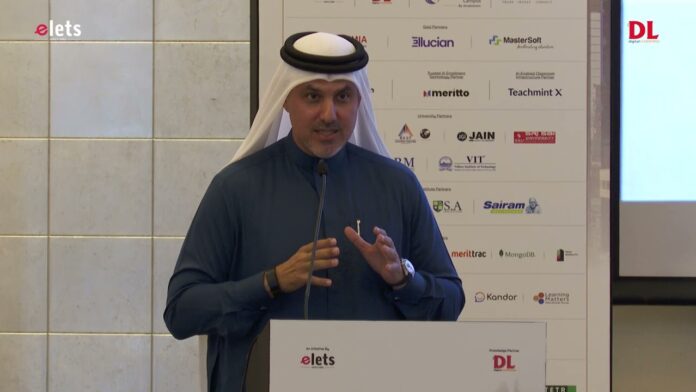
In a world that’s rapidly evolving, the education system stands as one of the most critical foundations for shaping future generations. The question many pioneers are now asking is: How can education prepare students for an unpredictable future? Dr. Adil Alzarooni, Chairman & Founder, Citizens School, Dubai, UAE shared his groundbreaking journey and observations that could redefine education for the 21st century at the 35th Elets World Education Summit, Dubai on 4-5 Febrary 2026.
Adil’s transition from engineer to education visionary began with a realization during his time in the healthcare industry. Encountering a significant event with a patient, he set out to create a school that would prepare children for their future. Delving deep into the purpose of education, he recognized the need for an all-encompassing approach that focuses not only on financial well-being but also on fostering entrepreneurial skills.

Understanding the Shift in Education’s Role
For over 200 years, education has largely focused on preparing students for employment. But as Adil discovered, a statistic from the World Economic Forum suggested that 40% of today’s nursery-age children will need to be self-employed in the future. With the advent of AI and technological advancements, this figure could rise to 50% or even 60%. This insight struck Adil profoundly, prompting him to rethink education’s role in preparing students for a world where failure is commonplace, especially in entrepreneurship.
The Critical Role of Failure in Entrepreneurship
One of Adil’s pivotal realizations was the education system’s ingrained aversion to failure. The stark reality is that nine out of ten businesses fail, and embracing this norm is essential for entrepreneurs. Adil’s vision involved creating an environment where children learn to manage failure as a stepping stone to success. In his entrepreneurial school, students engage in business-oriented projects where failure is not a setback but a valuable lesson.
Promoting Innovation and Entrepreneurial Spirit
Adil’s entrepreneurial school witnessed firsthand the transformation in students when they embarked on real-world projects. An entrepreneurship week revealed the power of experiential learning. In a classroom filled with 11 and 12-year-olds, students developed comprehensive business plans, marketing strategies, and even applications for games they reinvented. The startling difference in aspiration was evident between students who completed a project and those who did not. Those who experienced a full entrepreneurial journey were overwhelmingly enthusiastic about becoming entrepreneurs.
Challenges and Reflections on the Education System
While the successes of this educational approach are promising, he acknowledges the challenges that remain. The traditional mindset and programming in students by the time they reach universities make change difficult. Adil notes that the real challenge lies not with the students, but with reprogramming the perceptions of teachers and parents. Encouraging educators and guardians to embrace a new paradigm of learning, one centered on entrepreneurship and innovation, is a hurdle that requires patience and persistence.
The Uncertain Future and the Need for Courageous Inquiry
As exciting as these breakthroughs are, Adil expresses concern about the future. With young students already producing impressive products and services, the future economy and job market remain uncertain. This uncertainty necessitates reexamining fundamental questions about learning and teaching. The courage to question the very nature of learning is essential for evolving educational practices to meet new challenges.
Also Read: The Future of Education: Focusing on Skills Over Subjects
A Vision for Education’s Future
In conclusion, his vision for education extends beyond traditional boundaries. By encouraging students to embrace entrepreneurship and see failure as a learning tool, he offers a glimpse into a future where education molds adaptable, innovative individuals. The transformation he seeks requires a shift in mindset across the board, one that demands rethinking educational norms, embracing failure, and nurturing creativity and resilience in every learner.
The journey Adil shares is not just an educational experiment; it’s a call to action. It urges educators, parents, and policymakers to rethink what progress means for future generations. His story is both inspiring and daunting, highlighting the urgency of redefining educational frameworks to equip today’s students for tomorrow’s challenges.