 Rajasthan being the largest state (in terms of total area) in India covers 3,42,239 sq kms and has a population of 5,65,07,188 (census 2001). The state is largely arid and 76% of the population lives in rural areas. Out of the total population, 11088122 persons were estimated in 2005 in the age group of 6-14, representing 20 % of the state’s population. Administratively the state is divided into 240 blocks, 9187 gram panchayats (village level elected bodes) has 41353 villages. The district elementary education statistics collected in 2005–6 indicates that there are 97204 schools, of which 78106 (over 80% of total) are government run and only 19098 are privately run.
In 2002, GOI made the 86th constitutional amendment through article 21 A, which read thus- “ The state shall provide free and compulsory education to all children of the age of 6 and 14 years in such a manner as the state may, by law, determine.” This was a watershed in the history of India. The Government of Rajasthan, responding to this obligation, had launched several interesting programmes like the Lok Jumbush, Shiksha Karmi project, Jan Shala programme.
While the Lok Jumbush initiated the community to actively participate in the education process to improve the quality of education, the DFID-assisted Shiksha Karmi Project initiated education youth to mobilize the community and children to attend school. These programmes have been successful to a large extent in improving the school enrollment as well as increasing the overall literacy of the state. The Jan Shala programme was successful in improving the education level of slum children. The state also implemented national schemes like the Education Guarantee Scheme and the Rajiv Gandhi Patshala programme, etc. Keeping in line with the Government of India’s goals to attain the objective of Universal Primary Education in the country by 2010, the Sarva Shiksha Abhiyan (SSA) programme was launched in 2001-2002 that covers all the states and Union Territories in India.
In Rajasthan, the SSA subsumed all the previous programmes (Lok Jumbush programme, Shikha Karmi project, Jan Shala). Even though the SSA goals set out specific dates for achievements, the challenges in implementation are many, the task stupendous and almost Herculean. Although, the SSA rogramme has resulted in impressive results in Rajasthan, there is still a huge gender gap and a need to address other indicators of quality education and achieving desirable results. When the Rajasthan Education Programme (REI) was launched, inspired by the success of the Jordan Education Initiative (JEI), the state was confronting the challenge of improving the quality of education, bettering the enrollment, improving teachers quality, bettering the infrastructure at the same time empowering education to prepare the students for a competitive global society and various other issues that was affecting the overall achievement of its education goal.
The initiative was launched with an objective of creating a catalytic environment for fast track achievement of the Education for All goals. In REI, the state of Rajasthan proposed to emulate, adapt and learn from the JEI to adopt a public-private partnership model as a means to support and augment the state’s endeavors in education. The government of Rajasthan, had initiated computer education in 3600 econdary and senior secondary
“GeSCI role in REI is like an honest broker or a facilitator. GeSCI has an in-depth understanding of what works and what does in ICT in education. In REI GeSCIs role is to facilitate in identifying those components that effects that success of the programme, to push the partners especially the Department of Education to secure those components in place and fill the gaps in implementation process and management of the programme. At present along with the state government, we are trying to put this framework in place at the same time letting the programme evolve naturally. Changing the education system is an enormous task that is something not possible at such a short time. But I am quite sure that this programme will fringe and will encourage and push forward such a change”.
schools in the state to empower students, enhance the quality of education and build technological capacity of the students. However, for a state of the size of Rajasthan, he efforts made was far too inadequate. Consequently, JEI offered a viable strategy for the state to ccelerate the pace of education improvement through a mutually beneficial public-private partnership for education. In REI each partner is committed to fulfill certain objectives that will contribute to the attainment of the overall education objectives of the state, while the state government oversees the whole process, evaluates and monitors the activities of the partners and sees to it that the objectives and activities of the partners in REI matches with the overall education goals of the state.
The state government with other three core partners, namely the World Economic Forum (WEF), the Global e- School and Communities Initiative (GeSCI) and the Confederation of Indian Industries (CII), through their respective roles, are committed to facilitate and assist the state government in the implementation, monitoring and reporting of the individual projects within the REI. These core partners are also responsible to evaluate the success of each of the project so as to learn lessons from the experience. A ‘Partnership Document’ defines the roles of each of the core partners and the possible areas of Publicprivate partnerships. Astrid Dufborg, Executive Director, GeSCI explains their role as- Thus while GeSCI will primarily facilitate the strategic planning and implementation of REI and assist the government in structuring the i itiative for ensuring optimal value, the World Economic Forum (WEF) will mobilize international private organizations to join the REI and provide expert support in the management of the PPPs. In the words of Alex Wong, Director, Information Communications and Entertainment
 “REI one of the projects under the Global education initiative of World Economic Forum. WEF is working as a neutral worker. Our main role is to bring input form the international private sector like Intel, Microsoft, HP, CISCO, NIIT. Today in REI, these are the companies who are the members and partners. Our role is to facilitate collaborative public private partnership and in REI we have built this whole new way of multiple companies offering to the REI its services to help fulfill the state’s overall education goals”.
The partnership in progress
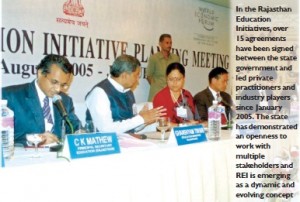
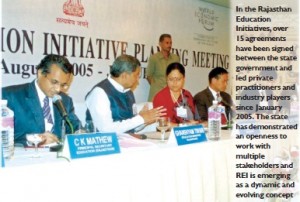
Since its conceptualization in January 2005 over 15 agreements have been signed between the state government and lead private practitioners and industry players. The commitment and the political will of the state to have an open policy has encouraged lead players to join this initiative. The state has demonstrated an openness to work with multiple stakeholders not only with respect to the implementation of the programmes, but has also involved the stakeholders to build an integrated participatory model of implementation of REI. Since all the partners, including the government are experimenting with a new and innovative way in delivery of education, the REI is a emerging as a dynamic and evolving concept.
The REI is inspired from JEI, but the challenges faced by Rajasthan were unique. Consequently, localisation and innovation had been an integral part of the REI. Rajasthan is trying to tackle its problems through strengthening models of teaching and learning methodologies through state curriculum and learning assessment models. Since November 2005 till April 2006, several programmes (both ICT and non-ICT) have been effective in several parts of the state. From a target set at the beginning of the programme as 70000 schools, the programme now realistically aims to ensure that the public privatepartnership model for education, demonstrate the success possibilities in about 700-800 schools. The programme objectives more focused to ensure better enrollment, quality training to teachers – both in-service and pre-service, reduce drop out rates and improve the overall learning objectives besides preparing the teachers and the children to gear up to the potentials of the information economy.
There are six ICT related programmes being implemented by private sector or civil society partners. They are: Azim Premji Foundation on Computer Aided Learning Programme is expected to reach about 200 schools in Tonk and Sirohi districts. The programme will extend in all the 32 districts. In 15 sites in Jhalawar, Tonk and Dholpur, the Hole-in-the-wall Education Limited with UNICEF will deploy joyful learning technique to improve academic performance, confidence level and increase collaborative behaviour among children. Intel will work in 26 districts over five years from 2005 to provide comprehensive IT session plan development training to government school teachers and expose them to computer technologies. The project is alled Teach to the Future. Intel will also assist in designing suitable ICT in Education policies. Partners in Learning programme of Microsoft India Private Limited will operate in 6 districts over five years up to 2010 to provide comprehensive IT session plan spanning over 12 days to government school teachers and expose them to latest computer technologies. The American India Foundation is working in 200 schools across Jaipur, Alwar, Dausa, Tonk, Sikar, Bharatpur and Ajmer in a programme called Digital Equalizer to provide teacher training and capacity building inputs to upper primary and secondary schools in their implementation of CALP. High End IT Training programme will be conducted by Cisco for one year for senior secondary class teachers and students.
This includes hardware and computer trouble shooting course, concepts in networking administration using open source. Educate Girls Globally is a programme undertaken in two educationally backward blocks – Sumerpur and Ahore of Districts Pali and Jalore, to ensure 100 percent enrolment and retention of girls in the age group of 6-14 years. Bodh Shala programme is being implemented in 324 un-served or underservered localities of Jaipur city and is implemented by Bodh Shiksha Samiti. Other activities include project GRACE, departmental computerization, solar PV power packs for CALP schools, schools computer education programme, foundation for excellence, scholarships through Akshayapatra, government scholarships for challenged girls of classes IX to XII, and adoption of indigent children for education, mid day meal programmes, low cost village 
“The Confederation of Indian Industries (CII) will garner resources and skills for the REI and mobilize its members, especially the small and medium scale enterprises to ensure the creation of local capabilities and capacities in making the REI sustainable. “
knowledge centres, adopt a school programme, e-content development in sync with curricula, back office administration etc. Again, one crucial success factor of the programme would be the level of buy-in that the local education officers had for the programme. Unless there is a feeling of ownership among the local stakeholders, be it the education officers at the district and the local level or the community at the village level, effective implementation would be impossible. Additionally,
The consultative process, Rajasthan Education Initiative first update meeting
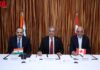
In April, 2006, the Rajasthan Government, Ministry of Education, with support from GeSCI had organized a two day conference/meeting to take stock of the progress made and challenges faced by the partners in REI and in the process develop a comprehensive framework for the effective implementation, monitoring and implementation of REI. As a precursor to this meeting, GeSCI had organized a two-day workshop as a pre-conference consultation with partners and practitioners to identify their challenges and concerns and processes that can be put in place.The main objective was to develop a common understanding of the partners in REI and to reflect on the status of the ecosystem, provide critical insights and feedback, define the public private partnerships and recommend the mechanism for drawing a framework for project management, monitoring and coordination with the partners. The Government of Rajasthan’s Education Principal Secretary reiterated the commitment of the REI to be aligned with the objectives of the overall Education for All objectives, which are being implemented under the Sarva Shiksha Abhiyan.
The two-day partners meeting was focused on collaborative planning for implementation of REI. The conference gave a platform to the partners to e press their views and concerns to the highest authority and chalk out a workable implementation module for the programme. The two-day GeSCI workshop followed by the two-day partners meeting identified several issues that needed careful consideration and planning. While REI has been successful in attracting committed private partners and stakeholders from outside the state to complement the key education activities of the state, several crucial components still needed to be put in place for the overall success and sustenance of the program. One component of the system that needed to be focused on was the ‘champions’ and the main ‘drivers’ of the programme. Across the board, among the partners there was agreement that teachers should emerge as the main drivers of this programme. Without shifting the focus from the child or the learner and keeping education learning-centric, rather than instruction-centric, attention has to be paid to motivate the teac ers to drive and sustain the programme. Teachers training needed to be standardised, especially in cases where there are multiple organisation involved in training teachers and adequate infrastructure/opportunities must be provided such that teachers can practice their skill that they gain through trainings.
there needs to be a guiding policy framework that that can not only chalk out the process of implementation of the program, but also define the specific goals of each partner, outcome measurement indicators and timeline of programme. Attention has to be paid to providing end-to-end solutions, be it the teachers training from learning to use the computer to using the computer to create content and ultimately using digital multimedia content for teaching or orienting the local education officers to spearhead or ‘champion’ the programme to training them to monitor t he programme. Rajasthan Education Initiative is an ambitious plan for leapfrogging from achieving ‘Education for All’ to strengthening models of teaching and learning and building global competencies in human resources.
The processes are positive and affirmative; be it the openness to collaborate with private players or building the Project Management Team to monitor, evaluate or measure the genuine impact of each intervention. So far, political will has also been in favour of the process. However, REI is still evolving, building in corrective mechanisms and putting frameworks in place. How far REI is able to build sustainable models for up scaling will depend as much on the state government’s and partners’ commitment as on buy-in of the local stakeholders.