Home Blog Page 1773

www.ict-in-class.net


The integration of ICT into learning and teaching on the primary and  econdary school level is a relatively new and complex field. It entails a new  form of  eaching and learning based on a greater individual  implication of the learner and  brings about a change in the role  of the teacher within the class environment. Teachers in both developed and  developing countries  are exploring optimal solutions and, thus, can always benefit  from relevant resources and an exchange ofexperiences. The Swiss Institute for  Media in Education and Culture  (educa.ch), involved in    he promotion and coordination of the integration of ICT in  the Swiss education system, in partnership with the Swiss Agency  for Development and Cooperation  (SDC) developed a thematic website titled ‘ict-in-class’. The  website aims at  providing an entry  point for teachers with no previous  or little experience in the  integration of ICT in class. The  website intends to achieve this through the creation of a concise  but comprehensive overview of the basic aspects to  upport teachers  more directly in their efforts to integrate ICT in their primary and  secondary school classes.  The partnership, educa-ict4d, aims to further, and encourage the dynamic and participative  integration of information and  communication technologies (ICT)  in class. The educa-ict4d partnership is based on the vision of the SDC to strengthen the integration of ICT in school education and, the desire of educa.ch to share its extensive  experiences in the integration of ICT in education in primary and  secondary schools in  witzerland. The current website structure was  based on the “production-accessuse” model for the integration of  ICT-based learning and teaching material in education. This model was developed by educa.ch in its  activities in Switzerland and describes the process by which  ICT-based teaching and learning material traverses the education  system beginning with the idea and ending with the evaluation of its use in class. This core  structure named “ICTbased Teaching/  Learning” is  complemented with  information pertaining to the wider context of  educational development  and ICT4D as well as information on ICT in Swiss education. Here,  educa-ict4d aims to provide some context for international  partnerships, which are  popular activities between educational  institutions and can also help to further the integration of ICT in education. The website is  available in German, French and  English. The website is a work in progress.  It will be completed over the next months  ccording to a previously developed concept.  Nevertheless, in the meantime,  educa-ict4d would welcome viewer’s feedback, ideas and suggestions. ?


Rajasthan Education Initiative- A vision for education

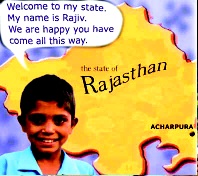
What could have just another meeting  between the chief   minister of a state in India and the   global leaders in World Economic   Forum Annual Meeting,  2005, in   Davos, turned out to be one of the   most comprehensive education  initiative in the country with ICT,    that promises to improve the1 lives  of thousands of  school children in   one of the poorest and lowest   literacy states in India. The  Rajasthan Education Initiative (REI) has broken records in operationalising the Chief Minister’s pledge in Davos and the state  overnment’s vision into action, in less than a year’s time. Rajasthan Chief Minister, Vasundhara Raje, the Education  Minister Ghanshyam Tiwari and the team of state administrators led by C K Mathew, Principal Secretary, School  nd Sanskrit Education of Rajasthan. With eight MoU signed so far between the state government and the global business leaders, this initiative, launched officially in November 2005 in Delhi is promising to achieve more than just raising the level overall education in  ajasthan. Inspired by the philosophy, approach and results of the Jordan Education Initiative (JEI), Rajasthan state government ventured on engaging global and local partners from the private sector, foundations and NGOs in innovative multi-stakeholder partnerships to  support education in the State of Rajasthan. Supported by the World Economic Forum, the Confederation of Indian Industry (CII), the Global e- Schools and Communities Initiative (GeSCI) and in partnerships with biggest name in the IT sector: IBM, Microsoft, Wipro, and  Cisco, the state Government embarked on improving schools in Rajasthan. The World Economic Forum, facilitated this public-private partnership. The programme aims to reform teaching and learning through state curriculum and learning assessment renewal,  supported by innovative facilities,  new equipments and resources and the deployment of news ways of learning through ICT.  Truly collaborative vision This programme aimed at  collaboration and participation at all levels from  conceptualisation to the implementation of the  programme. Two planning meetings, one held in August and other in October last year  exemplified the true participation that is the essence of the initiative.

The first planning meeting in August refined the objectives of   the programme along with signing   four MoUs. The REI signed MoU    with Microsoft under ‘Partners in    Learning’ programme, where   Microsoft set up a state-of-the-art lab to train 8000 teachers in the   next five years. The second MoU   was signed with Azim Premji   Foundation for ‘Learning     Guarantee Programme’ in two  districts, involving assessment of   the current educational level and   mproving the competencies. The    other two MoUs signed were with   Hole-in-the-wall Education Ltd   (HIWEL) and Educate Girls   Globally (EGG).   The second planning meeting held in October in Jaipur formalised four more MoUs along with identifying areas of concern in the initiatives that needed consideration. Presided by C K Mathew, (Principal secretary), Satyadeep Rajan (Word Economic Forum), Abhay Kumar Poddar (Confederation of Indian Industries) and Paul Callan (Global e-schools Initiative), the meeting deliberated on the various components of the programme, along with taking firm commitments of collaboration/ contribution from the organisations present and produce the Vision Document for REI.  MoUs were signed with  ntel for training of subject teachers in over  3600 schools. MoUs were also signed with CISCO for development of skills of teachers through existing computer facilities in the district, with America India Foundation for professional Development of teachers through computer    technology and with Bodh Shiksha Samiti, for capacity building of slum children in Jaipur city. The partners in vision The REI now has four key partners: Government of Rajasthan, World Economic Forum, Confederation of Indian Industry and the Global eSchools and Communities Initiative (GeSCI) – an initiative of the UN ICT task force. The REI plans to continue mobilising resources within India and from the international community as well as engage the World Economic Forum’s regional and global communities in the project’s activities. Although most of the resources (funds) are already in place, private participation will enhance the quality and professionalism. However as Vasundhara Raje points out ‘It wasn’t about money but the expertise the companies had: from mid-day meals and training to teachers to making students computer-literate’ that encouraged the Rajasthan Government to engage these diverse organisation. Non-profit organisations contributing to the REI include the Azim Premji Foundation, Akshaya Patra, American India Foundation, Aga Khan Foundation, Bodh Shiksha Samiti and Educate Girls Globally, which have all begun work in various districts across Rajasthan. The government of Rajasthan had announced its first IT policy in 2000. With the expected growth of Information Technology enabled Services (ITeS), the government of Rajasthan is in the process of drafting the IT and ITeS policy 2005-2008. This policy would focus on modernising and upgrading the skills of the ordinary citizens among others. The policy focuses on IT for the masses by augmenting computer literacy and education campaign in rural areas, subsidising computer education for the girl child and training teachers. The REI concurs to the state vision for education to develop skill of the young generation in the globalised  society. The vision: strategies The REI will work on a twopronged effort aimed at balancing the goal of achieving “Education For All” (EFA) with that of providing improved opportunities  to gainful employment in India’s fast growing knowledge-based  industries. One, technology based education will leverage the power of ICT to improve the learning  skills and competencies of students; and two, to create an enabling environment aimed at social responsibility programmes  for holistic development of the hild. Unlike Jordan Education Initiative, which focused on only technology interventions,  REI has both ICT   as well not  ICT-initiatives  in the programme. The REI’s efforts will concentrate on girls, rural  children,  urban  underprivileged children, and  children with special needs. It will be implemented over three years  after which the Government of Rajasthan  has committed to expand the project under its ongoing ‘Sarva Shiksha Abhiyan’ or Education  For All programme, which is scheduled to complete  by 2012.  Monitoring and evaluation of the educational outcomes will be conducted by an external  independent agency. REI launch at Delhi The REI was officially launched   on November 29, at the World Economic Forum’s India  Economic Summit 2005. The Hon Chief Minister of Rajasthan, Vasundhara Raje;  C K Mathews; Principal Secretary schools education, N. Srinivasan; Director-General,  Confederation of Indian Industries (CII) Stephen Nolan; Executive Director, Global  e-Schools and Communities Initiative (GeSCI), India,  Rangnath Salgame; President,  India and SAARC, Cisco Systems, India. Mohandas Pai; Director  and Chief Financial  fficer,  Infosys Technologies, India,  among others attended the launch. ?

Learning Lab : learning using mobile devices

The learning lab initiatives has experimented with mobile  echnologies to create an engaging learning environment for students. The experiments has indicated that mobile devices is a  calable technology assisted learning alternative to address the gaps in mainstreaming teaching

 
Mobile device based learning – the Learning Lab
initiative The Learning Lab initiative seeks to evolve a set of guiding principles for the implementation and use of Mobile ICTs, keeping in mind the educational challenges unique to the subcontinent. Our longstanding expertise in the ICT domain has also been valuable in our efforts to envision a range of possible use cases, applications and services for mobile devices, which are described below:

BookBox: Integrating education and entertainment

So how do you tell a Brazilian story in Hindi?
How do you use storytelling to teach a child to read or learn a language? How do you make reading educational as well as entertaining for kids? BookBox does just that! Based on what is known as  Same Language Subtitling (SLS), BookBox is a essentially a web-based jukebox of digital books in 18 languages from  round the world. SLS essentially involves same language  (audio) subtitling of the audio-visual program. In Book box SLS has been  integrated into a book/story.
BookBox synchronizes the text, audio, and visual media to create an  ducational and entertaining reading  experience for children. Children can relate the  phonetic sounds with the visual subtitles to accelerate reading skill   evelopment. Sophisticated eye-tracking  research has proved that when SLS is integrated into a “book”, reading happens  utomatically and subconsciously thus making stories not just interesting but also educational.  BookBox aims to not only enhance children’s basic literacy, but also  facilitate their proficiency in foreign languages.  BookBox was a result of experimentation with SLS-an  experiment that began and resulted in a project that taught early  literates and illiterates to read while watching popular Hindi film  songs in India. The above may sound very simple (or too complicated!) but for Dr Brij Kothari SLS has been a tool to address mass illiteracy in India. In  1996, he hit upon the idea to use SLS while watching a Spanish film  to improve his Spanish. In his own words –“I was watching a Spanish film with friends to improve my  Spanish. The Spanish movie had English subtitles, and I remember  commenting that I wished it came with Spanish subtitles, if only to help us grasp the Spanish  ialogue better. I then thought, ‘And if they  just put Hindi subtitles on Bollywood songs in Hindi, India would become literate.’ That idea became an obsession. It was so simple, intuitively obvious,  and scalable in its potential
to help hundreds of millions of people read — not just in  India, but globally”. Now a decade later Dr Kothari explains, “The idea  of SLS tends to divide people into two camps – those who think it’s too  simple to achieve anything, and those who understand that its simplicity and ability  to integrate into popular culture can fundamentally  alter the approach to the massive problem of low literacy”.  What exactly is SLS?  In a research paper on the same subject titled ‘Reading Out of the “Idiot Box”:  Same-Language Subtitling on Television in India’ written by Brij Kothari, Avinash Pandey and Amita  R. Chudgar, SLS is explained as ‘the idea of subtitling motion media in the same language as the audio. The audio track is reproduced verbatim and in a  synchronized manner’. The paper further clarifies ‘SLS needs to be distinguished from Same Language  Transliteration (SLT). An example of SLS is video in Hindi, subtitled word for word in Hindi (which uses the Devanagari script). The same media, subtitled in the Hindi language using the Roman script,  is not SLS but SLT. However, both SLS and SLT may be useful for  criptacy as long as the script is meaningful for the viewing neo-semi-scriptates (literates)…SLS has been primarily directed: to promote scriptacy skill improvement  in the first language among early scriptates’. Those in India who call recall ‘Rangoli’ the program featuring Hindi firm song sequences (aired on Sunday mornings in the National channel, Doordarshan), SLS features as Hindi subtitles (in Devanagari script) to Hindi songs. Starting this experiment with Chitrahar  another Hindi song based program, a simple addition of SLS gave weekly reading practice to almost 80-100 million early-literates in India using TV. So does SLS really help? Studies have evidences that SLS raises the literacy skills of all  early literates on a mass scale, through lifelong practice,  increases the frequency of literacy practices among: early literates, not in school (children  and adults), and emergent literates in schools or literacy  enters. SLS also motivates nonliterates
toward literacy, through entertainment and popular  culture, makes reading an
automatic and reflex phenomenon in everyday life,  creates a reading culture and an environment for reading. Dr Kothari assures that SLS is cost effective offers a financially sustainable model for lifelong  literacy skill improvement.
Why BookBox? Because children love stories!  Because SLS makes reading inescapable! BookBox builds on the children’s inherent interest in stories. With SLS that subtitles stories word to  word, children develop reading skill through
this text-sound correspondence. BookBox  also distinguishes itself by the cultural diversity of its story content by collecting stories from all around the
world or engaging local authors to create or adapt stories based on their individual cultures and traditions. In BookBox the  visual remain the same
while the narrator tells the story in different  languages. Thus a  Brazilian folk story can be told in Hindi or Japanese  and vise-versa! Thus while enhancing the
entertainment value of storytelling through multimedia, Book box  also provide automatic reading practices for  children. The stories are simple and they teach a moral. Available in DVDs,  BookBox stories are  titled in English as ‘the first Christmas, Four friends, Boo in the shoo,  Turtle’s Flute, Elephant Goes To City, The First  Well. BookBox got special  mention in the category of best e-content in e-learning in Manthan  awards (www. manthan awards.com)  in 2005

World Summit on the Information Society (WSIS), 2005, Tunisia

The World Summit on the Information Society (WSIS) phase II, organised by the International Telecommunication Union, took place in Tunis (Tunisia) from 16 to 18 November 2005. Leaders from over 70 countries and delegates of governments, businesses and  NGOs attended this conference. The WSIS focused on discussing  issues of promoting development through constructing the  information society through estrategies, e-commerce,  e-governance, e-health, education, literacy, cultural diversity, gender equality, sustainable development and environmental protection. WSIS, MDGs and education  Among other issues, the Tunis Summit showcased several  initiatives and deliberated on the potential and ways in which ICTs  can help to enhance outreach and quality in education; in  augmenting basic literacy as well as to build human capacities. There has been a spurt of ICT enhanced  lesson plans and processes that  make technologies more useful for educational purposes but can also build human capacity to use  technology for better access to knowledge. Education and ICTs were recognised as a fundamental basis for preparing for a  knowledge society. Various civil
society groups organised themselves into a Civil Society Plenary  (CSP) at every official meeting of the WSIS process, and advocated  their agenda through Civil Society Content and Themes Group and  the Civil Society Bureau. Identifying the priorities for  action Recognising the  criticality of education and capacity building in  constructing the knowledge society, a Task force on  Education, Academia and Research, set up under the Civil Society Group, identified  the education priorities for  knowledge sharing. The two key principles for education are  nowledge sharing and open access.  To further these principles, the Task Force identified four major  priority issues in education and research: • Teachers’ Education with ICT;  • Open Courseware; • Media and ICT Education; and • A New Status for Research  In support of open courseware, the Task Force pointed out that such  approach ‘can generate huge   avings in the long run and help developing countries to bridge the “digital divide” in education’.  However these open courseware, should be ‘submitted to serious accreditation and quality assurance processes’.  The Task Force also suggested the adoption of ‘free software and an exemption of Intellectual Property  Rights in matters of education, documentation and archiving in  non-profit context’.      The Task Force highlighted the need for media and ICT education for youth, with both a critical and a  capacity-building approach to help  he youth to learn to ‘inform and be informed, via the networks, in a learn-to-learn lifelong process’.  The task force pointed out that one needed to be ‘ICT literate and  information literate’ and “media and ICT education” literacy is  ‘a pillar of democracy and one of
the elementary rights of every citizen’.  The Task Force recommended that this specific education should be  introduced wherever possible
within national curricula as well as in tertiary, non-formal and lifelong  education. The Task Force pointed out that  research on ICT should focus beyond technological innovation  and market development to users and the social and cultural  implications of the Information
Society. However, ‘sociallyorient d research should not develop apart from, or just in addition to, but in close connection  with industrial research from the earliest stages.’ The Task Force also reminded that the scientific community should work in close connection with civil society, the industry and political institutions. The Task Force also tabled some
concrete strategies for international consideration and implementation • Lowering the cost of access to  nternet and ICTs for education • Against exploitative targeting of children and youth through ICTs. • An ‘open cognition platform’ for fostering education for general interest The Task Force called upon the private sector to increase their investment in regional IP backbones and access points. The Task Force also recommended the Governments and international  organisations to create an enabling environment for the provision of ICT infrastructure, particularly for rural and marginalised communities, especially for the
education sector. The education Task Force for long has been  advocating for a “open cognition  platform” for fostering education,
as a UN recommendation to be adopted by all countries. The Task Force made the following recommendations:  An Open courseware validation
body To help create a coherent body of  standards and formats, for coaccreditation and exchange across currently existing websites (and
extension to mirror sites in developing countries) that provide the primary teaching materials for courses taught at educational nonprofit institutions;  An international rationale for Media and ICT education
To train media and information literate people, in national  curricula. Such document must provide a modular curriculum,  with evaluation criteria and   rocedures and adequate teaching materials and resources, in local language;  An education exemption to IP rights for access to repositories of content  In the non-profit contexts of education and research, like schools, museums, libraries,  archives, etc., along the lines of the directive currently enacted at the  European Union; An international researchers’ charter  To promote the status of teacherresearchers and ensure their independence and low-cost access
to repositories of knowledge. The message was clear. Access to  knowledge is crucial for building human capacity. Access to knowledge creates well-informed and competent citizens who can participate and strengthen the knowledge society.

Sound schooling – Radio for distance education

Despite rapid developments in communication technologies in the last few decades, radio broadcasting remains the cheapest mode of mass  communication in India that can benefit  rural and deprived communities with low iteracy rate and little  excess to education

At a recent conference on Digital Learning in Delhi [18-19 October 2005], the participants sat bemused as Dr. Sugata Mitra of NIIT gave a very  engaging account of his ‘Hole in the Wall’ project. Dr. Mitra explained how Delhi slum children with no education and no  knowledge of English quickly picked up different computer  functions, when given
unsupervised access to a computer and the internet through a kiosk.  This project in ‘minimally invasive education’ was later extended to  rural India, prompting a rather disbelieving audience to ask how the Hole in the Wall computers could function in remote and rural  India, with erratic electricity supply, negligible telecom  penetration and next to no maintenance.  Dr. Mitra gamely reeled off a  catalogue of solar-powered UPS, self-rebooting, maintenance-free  PCs, VSATs and other marvels of  digital technology that could presumably keep computers running forever in the boondocks, but it sounded more like a Heath Robinson whimsy than a recipe for  ICT in education. Not surprisingly, the recommendations that emerged  from the discussions emphasized “the need to think of ICT in  education beyond computer aided learning and incorporate other technologies like community radio  and other media. These mediums would not only be cost effective  but also have a greater outreach  potential.” [Digital Learning, Vol 1 Issue1, Nov-Dec 2005]  Classrooms and radio have always gone together, and radio has been  used to teach everything from mathematics in Thailand (Galda, 1984) to civics education in Botswana (Byram, Kaute &  Matenge, 1980). The first School  Broadcast project in India was commissioned as early as 1937.  Over the years, various educational  radio projects have been carried out in the country, with mixed results.

Educational programmes on AIR  All the Primary channels of All India Radio (AIR)
broadcast educational programmes on a  regular basis on fixed time slots. AIR’s educational programmes are   imed at students as well as teachers of primary, middle,  secondary and senior secondary schools, and are generally  produced in collaboration with national educational agencies like NCERT (National Council for  Educational Research & Training)  and CIET (Central Institute of Educational Technology). The Language Learning programme, popularly known as  the ‘Radio Pilot project’, was  started in 1979-80 jointly by AIR and the Department of Education (Rajasthan). Its aim was to teach Hindi to school children as their first language in 500 primary  schools of Jaipur and Ajmer districts, on an experimental basis. The broadcasts were found to be  useful in improving the children’s vocabulary, and a similar project  was initiated in the Hoshangabad district of Madhya Pradesh.  Apart from AIR’s in-house educational programmes, the  Indira Gandhi Open University  (IGNOU) also broadcasts its educational programmes from AIR studios.  IGNOU-AIR Interactive Radio  Counseling (IRC) was launched in May 1998 for students of Open /  Conventional Universities. AIR Bhopal and IGNOU ran this as an  experimental programme for a year, to provide academic counseling in various subjects and  to instantly respond to students’ queries; but with its success, it was  extended to other AIR stations. Presently, Interactive Radio  Counseling is being provided every Sunday for one hour from  186 radio stations of All India Radio.  non-conventional education, addressing local educational, developmental and socio-cultural  needs. The stations broadcast in English, Hindi and the language or  dialect of the region, for 4 to 12 hours daily.  During the current phase of private FM expansion in India, which is  expected to cover 91 cities, it is reported that the government plans  to offer 87 FM channels to be used exclusively for education. Of  these, 36 would be used by IGNOU, while the other channels would be open to private players. 

Campus radio stations
In December 2002, the Ministry of Information and Broadcasting  released its ‘Community Radio  Guidelines’. Though nominally ‘community’ radio, the policy restricts the radio  licenses under this scheme to ‘well-established educational  institutions’. The  licensing process proved so cumbersome that  India’s first campus-based  community radio station was launched only by  2004 (Anna University’s 90.4   Anna FM). Against  optimistic projections of  1000 campus  stations coming up in a  year, only  75 odd educational institutions have applied for a campus  radio  licenses so far, and of these, 15 stations have become operational.  Most of the campus licenses have  gone to universities,  engineering colleges and mass communications  institutions, along with a   sprinkling of well-heeled schools. Transmitting over a range of 5-10 kilometres, their FM radio stations are expected to serve the  ommunity beyond the campus walls, and to produce programmes ‘on issues relating to education,  health, environment, agriculture, rural and community  development’, according to the government’s Community Radio  Guidelines (www.mib.nic.in). Needless to say, the campus  stations that try to live up to this confused mandate – and many of  them do – sound very much like  the public service broadcaster on which they seem to be closely modelled. Satellite radio for education EDUSAT, according to the Indian
Space Research Organization  (ISRO), is the first exclusive satellite for serving the educational sector. It supports radio  broadcasting, along with audiovideo on C-band and Ku-band, and  is built around the concept of  digital interactive classrooms and a multimedia system. The satellite has multiple regional  beams covering different parts of  India, which theoretically enables programmes to be broadcast in  relevant local languages – India has 18 official languages and over  1500 dialects. “India will require  10,000 new schools each year and meeting the teaching  needs on such a scale [by conventional methods] will be impossible,” Madhavan Nair, chairman of ISRO told  New Scientist at the launch of  the satellite. EDUSAT can provide connectivity to schools,  colleges and higher levels of education and also support non-formal education including developmental communication. The nationwide beams are being harnessed by agencies like IGNOU, NCERT and the All India Council for Technical  Education (AICTE), to reach hundreds of Receive Only  Terminals (ROTs) and Satellite Interactive Terminals (SITs)  located in schools and colleges, many in remote areas. Content generation is the responsibility of user agencies, but  it is a matter of concern that, over a year after the satellite was  launched, much of its capacity is  lying idle. Satellite access for radio  broadcasting is also  available on other platforms like WorldSpace,  which offers a ‘development channel’ to agencies like Equal  Access for networking community  FM channels (as in Nepal), or for directly broadcasting development  and educational programmes for community listening on
WorldSpace receivers. 

The promise of radio
U.K. Open University’s notable  success with educational radio has  demonstrated how invaluable radio can be for weak students, who  benefit from the medium as a  supplementary learning tool. But the use of radio for distance  education in India, as mentioned earlier, has had mixed results.  AIR’s educational broadcasts are constantly hampered by the lack of radio sets in classrooms, the difficulty of  coordinating school broadcasts  with class-room timings and more  significantly, by the lack of good  broadcasters who have a passion for  education and  conversely, of teachers who are  also good broadcasters. All the same, it
has been amply proved that radio  – rightly used –  can improve educational quality  and relevance, lower educational costs and  improve access to education, particularly for  disadvantaged groups. It is most effective when supported by  trained facilitators, group learning,
group discussion, feedback and the  use of multimedia approaches. There is no single ideal format for  educational radio. Innovative programming like those developed  by Sesame Workshop in Africa, for
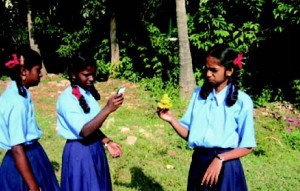
instance, offer some very  effective  approaches to   on-formal education over  radio. Recently, AIR agreed to a  proposal from  Sesame Workshop India  to provide airtime on  national and regional radio  channels for locally produced  versions of the universally  popular ‘Sesame Street’. The programmes would be aimed  at pre-schoolers, and would also  provide under-served children with  access to educational media, especially in rural areas.  India spends just 3.4% of its GNP on education. Over 35% of the  population is illiterate, and the  drop out rate in schools is  staggeringly high, with 40% of all school-going children dropping out  during the primary stage itself. The  percentage of dropouts goes up to 67% by Class X. The Supreme  School students participating in the  chool audio program in Karnataka  Court of India (in 1993) has declared education of children up  to 14 years to be a fundamental right, but school attendance  is related to the perceived importance of education by  parents, and also to socioeconomic factors. Despite rapid developments in communication technologies in the  last few decades, radio  broadcasting remains the cheapest mode of mass communication in  India, catering equally to the needs of the rich and the poor, rural and the urban masses and  reaching the remotest parts of the country. In a country where the  literacy rate is 65%, and fewer than 50% of homes are electrified, the  humble transistor radio plays a vital role in the country’s socioeconomic  and cultural development. Rural and deprived communities,  with low literacy rates and little access to formal education, stand  to benefit the most from distance learning through community radio.  If and when such communities are permitted to set up their own low  power radio stations – and 4000 such community radio stations are  possible in India, according to government estimates – then we  could witness a revolution in education far beyond anything dreamt of by the purveyors of  digital technology in a digitally divided country.  Using radio for education and
community development is part of  the 75-year-old Reithian ambition for radio broadcasting. Children  and youth can be easily and cheaply trained, and the goals of  universal primary and secondary education for all can be reached  more easily with broadcast support. Among the poor and  marginalized people of the country, radio could even create a new class of people – educated but illiterate

Bookshelf

Monitoring and Evaluation of ICT in Education Projects :
A
Handbook for Developing Countries Daniel A. Wagner, Bob Day, Tina James, Robert B. Kozma, Jonathan Miller & Tim Unwin Publication: infoDev, 2005 A Handbook for Developing Countries – is intended as an  ntroduction and guide for busy policymakers and practitioners grappling with how to         understand and assess the ICT-related investments underway in the education sector. The handbook comprehensively covers a domain of interests to help decision makers to develop a stronger knowledge base through Monitoring and Evaluation to make better investment and innovation decisions in ICT in education.

The challenges facing education systems in most of the developing world are formidable. Evidently, in recent years ICTs are being regarded as the solution to most of these challenges. ICTs are being used widely to aid education in many developing countries. However in view of the resource constraints in most of these developing countries, there may be potential great risks associated with ICT use in education in developing countries. Relatively little is actually known about the effectiveness of investments in ICTs in education in promoting educational reform in general. Little hard evidence and  consensus exist on the proper, costeffective utilization of ICTs to  meet a wide variety of some of the most pressing educational challenges The power of ICTs as enablers of change (for good, as well as for bad  is undeniable but if policy advice related to ICT use in education is to be credible, it need  to be backed up by a rich database of lessons learned, impact evaluations and cost data. The Monitoring and Evaluation of ICTs in Education handbook is specifically designed to meet the needs of developing countries and to answer some pertinent questions of implementation fidelity of an intervention. The handbook would help decision maker to understand the outcomes of intervention in terms student learning and new skills learnt, teachers outcomes with respect to development of technology skills and new pedagogical approaches and other outcomes in terms of increased innovativeness in scho l and increased access of the community to adult education and literacy (chapter two). The decision maker would also be able to identify ‘Core Indicators for Monitoring and Evaluation Studies for ICT in Education’ (chapter three) that relates to specific components of the ICT intervention and their implementation, and include both input variabls (such as classroom ICT resources, teacher training, and classroom pedagogy), as well as output variables (such as student learning of  chool subject, learning of ICT skills, and “21st century” skills. The chapter on ‘Developing a Monitoring and Evaluation Plan for ICT in Education’ would help policy-makers in understanding ways to assess results at the end as related to the original objectives set for the project through appropriate, realistic andmeasurable indicators. Policymakers  would also understand the need of ‘Capacity Building and Management in ICT for Education’ (chapter five) to develop the appropriate skills to deliver these programs effectively.The chapter on  Pro-EquityApproaches to  Monitoring and Evaluation: Gender, Marginalized Groups and Special  eeds  Populations’ guides decisionmakers to be inclusive in their approaches. Chapter seven  discusses the ‘Dos and Don’ts in Monitoring   nd Evaluation’ that  identifies what decision-makers  should do to  enhance the impact  and effectiveness of ICT4E  programs and the    oncomitant  things that one should not do.  In short, the book is an one   top  guide for policy makers and  practitioners on how to evaluate  ICT   nd Education Initiatives. ?

Space technology in education Indian context Shyamal Mehta

ISRO’s Tele Education satellite EDUSAT providing networks capable of  facilitating live lectures, web based  arning, interactive training, virtual laboratory, databas    cess for reference material/library… may be able to  revolutionalize education delivery process in India

Satellite communications technology offers unique capability of being able to
simultaneously reach out to very large numbers spread over large distances even in the most remote corners of the country. The Indian  Space Programme has always aimed to be second to none in the applications of space technology to deal with the problems of development in our society. ISRO has continuously pursued the  tilization of space technology for education and development. This article highlights the projects undertaken and lessons learnt in the use of  satellite communication to meet the challenge of education and development.
Efforts initiated by ISRO
Over a period of last 30 years,ISRO has initiated several projects/ programmes to cater to the country’s need for education,  training, and general awareness
among the rural poor. These efforts are discussed below. 
Satellite Instruction Television
Experiment (SITE)
The SITE project carried out in 1975-76 provided instructions in the fields of family planning, agriculture, national integration, school education and teacher
training. The ground hardware consisted of Direct Reception  Systems (DRS), for community viewing of the TV programmes. They were installed in six
States of the country in “clusters” of about 400 each for a total  of over 2400 DRSs. The instructional programmes (some  prepared by ISRO) were broadcast
for 4 hours every day covering science education programmes  production, various school programmes and teachers training programme (by the ministry of Education). The programme  re-trained over 50000 teachers was in two 2-week sessions.
Kheda Communication  Project (KCP) from 1975 to 1989

SITE demonstrated that the centralization, inherent in the technology of direct  roadcasting, was a limitation, hence the idea of  “limited rebroadcast” was
conceived, giving birth to the KCP. This involved setting up of a low  power TV transmitter in Pij village, Kheda district, Gujarat and  linking it to a studio and earth station complex, so that it could  relay local programmes (originated
from the studio) or the “central satellite” programmes received at  the earth station. This network used for local village problem  solving received the  IPDCUNESCO prize for Rural   ommunication in 1985.
INSAT system

The Indian national satellite (INSAT) System has been the major catalyst in the rapid  expansion of terrestrial television coverage in India. INSAT is being used to provide Education TV (ETV) Services for primary school children in six states. University Grants Commission (UGC) is  using this for its countrywide classroom programme on higher education (college sector). INSAT is being used by the Indira Gandhi National Open University (IGNOU) for distance education  progammes and Doordarshan for Science Channel progranmmes

Training and Development Communication Channel  (TDCC) ISRO experimented with  TDCC, which supports one-way video-two  way teleconferencing interactive networks for education and  training to introduce interactivity in teaching instructions. Today  TDCC is used exclusively for distance education and Interactive  Training Programmes (ITPs) bystates like Karnataka, Orissa, M.P etc. and by Open universities,  national organisations/institutions, IGNOU, Consortium for  Educational Communication (CEC) and Centre for  Management Education (CME) of all India Management Association and national banks  for providing training and education.  Jhabua  Development  Communication Project (JDCP) Jhabua  Development  Communication Project (JDCP) was carried out in  India in the Jhabua District of  M.P aimed at providing communication support to the  development  activities in the district and also in providing interactive training to  the field officials and the people in general. 
Gramsat Programme (GP)

In Gramsat Programme (GP) TDCC networks were upgraded and all  activities related to satellite  ased  development communication, education, training, healthcareswere grouped into a GP thereby  connecting each village, providing computer connectivity, data broadcasting,  and TV broadcasting facilities for applications like e- Governance, NRIS, teleconferencing, and rural education/ education broadcasting etc.  Disaster management, telemedicine, and recently Village  Resource Centre were added to the Gramsat networks.  Gramsat networks are operational in Gujarat, Karnataka,  M.P. Orissa and  Rajasthan (pilot), Andaman Nicobar,  Goa, H.P., Orissa, Chhattisgarh.  EDUSAT for education While the education institutions of the  country have continuously endeavoured to use the latest technology to support the process  of education, the demands have  been increasing, with the challenge of the day being to stay updated with the changing trends. To help  meet this challenge, ISRO has  taken up the ‘Tele-Education’ by launching EDUSAT, a satellite totally dedicated to the nation’s  need for education. It has a C-band national beam, a Ku-band national beam, and five Ku-band regional  beams facilitating imparting of education in regional languages. EDUSAT will strengthen education  efforts by augmenting curriculum  based teaching, providing effective teachers’ training, and community  participation. Networks based on EDUSAT consist of either receive only (one way communication)  terminals or interactive (two way communication) terminals or both  in national as well as in regionalnetworks. The networks are capable of facilitating live lectures/  power point presentations with student interaction, web based  learning, interactive training, virtual laboratory, video  conferencing, data/videobroadcast, database access for reference material/library/recorded  lectures etc., on line examination and admissions, distribution of administrative information, etc.  The Network is IP based and doesnot need expensive studio facility   end or hub as shown in the figure,consist of two cameras, two PCs, proper lighting, and DVD player (if needed) in addition to the indoor and outdoor units of the  hub hardware. The equipment needed at the interactive classroom  end, consist of webcam, PC, LCD projector, speakers, microphone,  UPS in addition to the satellite terminal. The classroom consisting  of receive only terminal requires a  PC, projector, speakers, UPS in addition to the satellite terminal. EDUSAT utilisation is divided into  three distinct phases: Pilot phase,  Semi operational phase, and Operational phase. Networks for education prior EDUSAT  Prior to the availability of EDUSAT, as a part of Pilot Phase, networks for education were
implemented at three universities :
Visvesvaraya Technological University (VTU), Belgaum, Karnataka, Yashvant Rao Chavan Open University (YCMOU), Nashik, Maharashtra, and Rajiv  Gandhi Technical University  (RGTU), Bhopal, M.P. using INSAT. Each university was given  its own teaching end and 50 interactive terminals (two way communication) and 50 receive  only terminals (one way communication). These universities are using this network  regularly to impart curriculum based teaching to their students using one way video and two way audio allowing them to interact  with the teacher via satellite from  the classroom with the help of live lectures, web based learning,  power point presentations etc. User interest In the semi operational phase, like in pilot phase, it is ISRO’s  responsibility to manage the  network in collaboration  with the users. So far over  100 proposals  from various user agencies  expressing  their desire to use the
network have  been received. These  proposals  cover full spectrum of education including: primary  education, secondary and high school education, degree college  education, professional/technical education,  distance education,  training, agriculture education, as well as healthcare related learning,  training and general awareness programmes by NGOs.  At present, using EDUSAT, networks for many user agencies  like IGNOU, CEC/UGC, CIET/ NCERT, AICTE, Blind People’s  Association (BPA) or Blind  school, Karnataka school network, VTU, YCMOU, Goa  University, Amrita VRC, Kerala/  Tamil Nadu are operational for a  total of about 1200 terminals or  classrooms. Here, BPA network deserves a special mention because of its  unique nature of  application. The  teaching end is located at the main office of BPA at  Ahmedabad and the classrooms are spread over the  state of Gujarat.

The network  functions in two distinct modes:
data broadcast and audio  broadcast. At the beginning of a class session, relevant data is broadcast using EDUSAT to all the classrooms which print out these  data in Braille format using Braille printer. Theses are distributed to  the students. The teacher then commences his lecture to the  students who already have the  Braille print out of the lecture in their hands. These two put together makes the learning for the blind  students a much more effective and faster. The EDUSAT based  networks of many state governments, universities and  other institutions are in various stages of implementation. In the operational phase, overall  management, day to day operation,  and network upgradation etc. will be the responsibility of a selected  nodal agency and the role of ISRO will be in the advisory capacity.  Acknowledgements The author wishes to thank Mr. B.S. Bhatia, Director, DECU/ISRO for his help in providing material  for this paper and Dr. K.S. Dasgupta, Group Director,  ADCTG/SAC/ISRO for encouragement.

e-Learning for small groups: The Diplo Foundation’s experience


The DiploFoundation is a small non-profit  rganization created by  theGovernments of Malta and Switzerland, co-located in Malta and Geneva. It’s mission: ‘to assist all countries, particularly those with limited resources, to participate meaningfully in international relations. Diplo promotes a  ultistakeholder approach, involving participation of international  rganizations, civil society and other actors in international affairs. Diplo’s activities include education and training programs, research, and  the development of  nformation and communication technologies for diplomatic activities.’ (www.diplomacy.edu) Diplo’s flagship course is its one year Post Graduate Diploma or Masters of Art course in contemporary diplomacy and use of ICT. Diplo is accredited by the University of Malta, with EU-wide  recognition. Limited to about 25 participants, the course draws  young men and women from around the world: working diplomats, students of international affairs, those working in international organizations, NGOs and others. Diplo offers scholarships to participants from  developing and transition countries, on the basis of funding from Swiss Aid, and support from entities such as the EU, the Commonwealth and other donors. In addition, Diplo runs an expanding number of short courses (usually of 10-week duration), and a series of programs covering Internet governance, plus diplomacy-related topics, aimed  at single countries, special groups,as also general participants. A common feature is that these courses are either entirely run through the Internet, or are offered as blended programs to participants from Europe, with a strong distance learning component. Teaching methodology The Internet-teaching methodology used has evolved through  experience, and consists of textbased learning, with very limited use of multimedia. A significant proportion of Diplo course users  are based in Africa, Asia, Oceania, places where broadband is still an unrealized promise, and the dial-up  connection, sometimes accessed by  articipants relying upon Internet  cafes is the simple reality. The  underlying  technical system and  the support infrastructure have  evolved over these  years, through  singularly dedicated work by  Diplo’s visionary Director, Jovan  Kurbalija, and his dozen-strong  team, based in Malta, Geneva and  Belgrade.  I   ined the teaching faculty of Diplo seven years back; that story  is one of chance   nd serendipity,  best reserved for personal  conversation! Let me, in this paper, first examine the relevance of e-  learning for  situations where    ntensive   acherstudent dialogue is imperative,  then narrate the  way we use elearning  at   iplo  and describing  another challenge  of e-learning —  the concept of the pure   selflearning’  course,  which some may  regard as the holy  grail of distance  learning, and others may see as   an unattainable goal.  Why e-Learning?  In   ome circumstances, e-learning is more efficient and economical  than   raditional learning, or ‘tlearning’. <!–Ads1–> Foreign ministry  mid-career training (when  most  personnels are on assignment  abroad ) and other ‘continuing education’   rograms, for example,  find a natural fit with the Internet. This method also proves less expensive for training locally the locally-engaged staff working in embassies abroad.  Another characteristic of diplomatic work is that much of it  involves craft skills. When the course participants are people with  many years   f experience, the ‘training’ is actually a mutual  learning process among the  lass,  where the faculty function as discussion catalysts and  facilitators, and   ven have much to learn from the course participants.  The Diplo method Diplo   as evolved its methods over  several years; described below is the current   echnique, in a process  that changes continually.<!–Ads3–> How does  our faculty-led  teaching work, with  a class size of 15  to 25 drawn from  10 or more countries,  distributed around the  world?  A typical module  consists of eight lectures and   wo  assignments, besides a final  exam. Under  universitymonitored standards,   uch a module typically  counts for four   units of postgraduate training. Diplo  uses sophisticated text-based  methods because many of its ‘class participants’,   s Diplo prefers to describe those enrolled in its  programs — do   ot have access to  broadband or multimedia modes.   After reading the lecture  osted on   the class web-page (usually of 3,000 to 4000 words), the  participants highlights some words or part of a sentence from the  lecture text   nd adds his or her   comment on it and the faculty add  his observations. The  lecture thus gets thoroughly reviewed by the  class. One can also view all the comments in their totality (without  opening each text-box), through a  ‘discussion tree’. The participants can also engage in a open-ended  dialogue, or   synchronous (i.e., not  in real time) exchanges, among the class and its   nstructor through a ‘lecture blog’. A part of the  participant’s final evaluation is based on the number and quality of  comment. All the comments are  ublic,  visible to the entire class,  but an option for private teacherparticipant   mment  hrough e-mails is also available.  Real-time online debate on points arising from  a particular lecture is incorporated in the e-learning process as the third major  ctivity     for each lecture. Thus each generation of course  members and  lecturers create a  new layer of meaning and     examples, enriching the initial   text. Unlike comments made in a traditional class, all the ecomments are  accessible anytime,  anywhere, and produce a   ermanent record as well. A  ‘resources’ button on the home page of the e-learning lecture site, takes one to a  ollection texts of   relevant documents as well as links   o other relevant web    sites.  Finally, at the end of a 7-day cycle, the teacher ‘closes the loop’ by  summarizing the key issues that the class discussed, and suggests some themes  hat participants may  wish to pursue on their own. The    iploFoundation’s experience shows that the process create a  sense of  community within this far-flung class which is further  augmented with group work among  class members, such as  assignments and simulated   egotiations. Such    chemistry  among the participants is the key   o this entire process, more so  when learning is no longer a  top-down process of dissemination  of basic  knowledge by the faculty to students, but rather mutual dialogue and shared learning . E-learning has to be supported by a  technical team that continually monitors the systems. A course director provides an extra pair of eyes for observing clas   nteractions, acting as the participant’s ally to resolve technical and other issues.  The self-learning format In some ways self-learning represents the ‘last mile’ of  distance learning, where the essence of a single lecture is  distilled to some 9 or 10 ‘frames’ or slides that a participant can scroll through, at his or her  convenience, with built-in questions and pop-up quizzes that  test the learning accomplished. At the extreme end of self-learning,  there may be no faculty participation at all, though it is quite easy to build in some faculty  supervision, depending on the circumstance.   came upon this method through   the Canadian Foreign Service Institute, Ottawa, who asked me in 2004 to convert a textbook I had written two years earlier into such a self-learning course of 6 lectures. We found that a course of 6  lectures could involve around 150hours of work in developing the formatted script, and an additional 700 to 800 hours to convert that into a full multimedia product,  making the process fairly laborintensive.That particular course took one year’s work. How does e-Learning  measure up? One may legitimately ask, is it really possible to overcome distance, replicating the instant, natural communication of the  traditional format? Can online learning match the rapport that a good teacher establishes with  students and   ce-to-face evaluation? Surely no videoconference or online chat room can reproduce the way a good guru assesses at a glance the class’s absorption of the ideas taught.

At first sight, such e-learning programs miss out on the rich interactivity described above. But in practice, once a self-paced program is designed, it is easy to add on faculty intervention, either in the form of exercises whose results go to a faculty member or  via periodic group exercises or simulations that break the apparent isolation of the self-taught format.  There is only one caveat: the faculty add-on is possible only  with server- based programs, not those distributed on CD-Roms.  As for the faculty-led e-learning programs, like those offered by Diplo, a surprising conclusion is  that in some ways the new format  is superior to the old one. Unlike traditional classrooms where the tutor is able to reply to only a few  queries within a stipulated period of time, e-learning classrooms supports a sustained facultyparticipant  engagement as evident  form the intensive scrutiny that each lecture undergoes.

A huge advantage is that lecture comments remain available for  subsequent reference or reflection. Moreover, teachers invest on  average 12 to 15 hours per lecture, much more than a traditional  teacher takes to prepare and deliver the face-to-face lecture.  Most of our participants also find that they end up spending more  than the average of six to eight hours of class work that our courses promise. This may be partly due to the keen involvement  that such courses arouse among all. Some e-learning systems also opt  for more asynchronous activities, including group exercises such as  class assignments and use video  links or other multimedia facilities, depending on whether a diplomatic  service can provide broadband connectivity to all its missions abroad. <!–Ads2–> What about a downside? One can visualize a few potential problems with e-learning. First, if the class fails to establish internal rapport, the entire process becomes very mechanical. Second, it is possible that if many  ndividuals from a single organization take part, and if  in addition the faculty is also drawn from the same organization,  here could be some inhibition among the class in setting out their honest views, especially in written format. Third, if the e-learning class is told that their class  performance will be used for major internal evaluations, such as  promotions, one can easily encounter breakdown or reluctant participation. The moral: treat the  new medium with caution, and do not overload it with an excess of  frills or expectations; treat the first experiences as experimental, learn  as you go along! In sum, the e-learning format is a fascinating addition to the  repertoire of professional education. It is a work-in-progress, with each course that is run,  offering new insights for better application of the format. ?

Now avail Gujarat University details on mobiles

On April 18, 2010 Gujarat Governor Kamla Beniwal launched a state university's directory that carries information about colleges and course which can be accessed on a mobile phone, in Ahmedabad. With this initiative the Gujarat University has taken a lead in providing for all the pertinent information regarding its colleges and courses on cell phone. The project has been executed by knowledge process services provider, Smile of India, along with its partner and professional services firm Klynveld Peat Marwick Goerdeler (KPMG), in association with the Gujarat University.

Through mobile phones with access to internet or General Packet Radio Service (GPRS) connection through the website of the Gujarat University or Smile of India, the directory can be easily downloaded and can be transferred through SMS and Bluetooth. It will give listing of all the cities, colleges, their names, addresses, phone numbers of all the colleges and departments affiliated to Gujarat University and will also update contact details of colleges.


LATEST NEWS