



Home Blog Page 706

Andhra government allocates over Rs 20,000 crore for education

The Andhra Pradesh government has announced that it will increase the share of funds for education in the state’s budget. The state government has also announced to make special provisions for assistance to unemployed youth in the state.

According to State Finance Minister Yanamala Ramakrishnudu, Rs 500 crore has been allocated for assistance to unemployed youth.

In the budget, Rs 20,384 crore has been allocated for general education and Rs 765 crore for technical education whereas Rs 398 crore were allotted for Skill Development schemes.

In comparison to the last financial year, total allocation to education sector has increased by more than 20% by the AP government. It is also noteworthy that the AP government has set aside a separate fund for technical education.

Elaborating on the idea behind allocating the “gender budget”, Ramakrishnudu said, “Gender budgeting is a process of incorporating a gender perspective at all levels of the budgetary process, assessing the needs of target groups and allocating resources. The government will undertake a comprehensive set of actions to improve the lives of women across all human development indicators.”

Andhra Pradesh is not the only state to focus on education for the financial year 2017-18; Delhi Government had also announced special focus on education in its annual budget presentation.

St Xavier’s college is set to reach new heights as a university

Kolkata campus of St. Xavier’s University is expected to be inaugurated in July, 2017. Chief Minister Mamata Banerjee and Lakshmi Niwas Mittal would inaugurate the university. It is expected that initially the university will offer four postgraduate courses.

The new campus of the university will spread over 17 acres of land. The campus would include two hostels for both boys and girls with a capacity of 1,000 students in each. The university campus would also house a football field, a sports academy, a swimming pool, a 3500 sq ft food court and a law institute and, St Xavier’s University and its Rajarhat will be.

“We are thinking of a scenario 50100 years down the line. We will need more space to start new age courses and accommodate more students,” said vice chancellor Father Felix Raj.

In its first academic session, the university will offer six courses. Around 650 students will be enrolled in these courses in the first year.

IIT-Kanpur to become cashless, partnered with Paytm

Indian Institute of Technology Kanpur (IIT-Kanpur) has entered in a partnership with digital payment company Paytm under the company’s ‘Cashless Campus’ initiative, official statement said.

In a statement shared by Paytm, the company said that QR code-based cashless payment solution has been enabled by the company within IIT-Kanpur. Offline touch-points are available across the campus including hostel canteens, medical store, tea stalls, book stalls and cycle repairing shops.

According to the company, the partnership will help students and teachers to make quick and easy payments without the worries of carrying loose change.

“Our ‘Cashless Campus’ initiative has proven to be a great success with the country’s youth. This is a clear reflection of the younger generation’s eagerness to choose digital payments over the hassles of cash”.

“IIT Kanpur would be a great addition to our extensive portfolio of premium institutions including IIM Ahmedabad, IIT Madras and Sree Ram College of Commerce among others that have gone cashless with Paytm. We strongly believe these cashless campuses would add a huge positive impetus to our vision of a cashless India,” Kiran Vasireddy, sr. vice president – Paytm said.

This move is in line with Paytm’s strategy of targeting major campus areas for cashless transactions, the company added further.

Number of Indian students to rise remarkably in varsities: Canadian Consulate General

With nearly 50,000 Indian students studying in various universities of Canada, the number is expected to grow remarkably every year, said Jennifer Daubeny, Consul General for South India.

Daubeny was recently in the Mangaluru to participate in a meeting organised by Kanara Chamber of Commerce and Industry (KCCI). She said, the number of students coming to study in Canada is expected  to increase significantly from this year onwards. “Most of the young graduates land in Canada for PG and certificate courses. They prefer educational institutions across country. It is because the education there (Canada) is affordable and of high quality,” Jennifer told to a leading newspaper.

In order to support students in the admission process, many Canadian educational institutions have set up their offices in India. Only in Bengaluru, six universities have set up their offices to engage actively with the Indian students. “We are also witnessing a new trend that students are moving to Canada for under graduate courses,” she said.

Interestingly, not only Indian students are going to Canada but Canadian students are also coming to India for higher studies, she said, citing Manipal University, which has signed several MoUs with Canadian educational institutions.

When it comes to working visas, more and more IT professionals are moving to Canada with their families. “Indians are the second largest immigrants in Canada after China,” she added.

Delhi University’s course voted best in QS World Ranking

Delhi University’s development studies programme has been ranked 16 in the latest QS World University Rankings.

The seventh edition of Quacquarelli Symonds’s (QS) analysis was released on March 8. In this edition of QS world ranking, world’s best universities are listed for the study of 46 different subjects based on the subject-specific university performance.

The University of Delhi has better its rank by two places in development studies which now provides India’s top four universities – one more than last year. Indian School of Mines (ISM) improving its category has moved to 24th for engineering – mineral and mining from 51-100 category. Indian Institute of Technology (IIT) Kharagpur has made its debut in the engineering – mineral and mining ranking with 35th position.

Indian Institute of Technology Delhi (IIT Delhi) ranked 49 for electrical engineering. From last year’s 22, the number of Indian institutions providing top-50 programmes has increased to 28, which is one of Indian higher education’s major highlights this year.

India also increases its overall share of places. Last year, its 22 universities were ranked 117 times, taking 1.27% of all available places whereas, this year, its 28 universities are ranked 151 times, representing 1.32% of overall places.

QS have also released their QS World University Rankings by Faculty after assessing university performance across five broad groups of subjects: arts and humanities, engineering and technology, life sciences and medicine, natural sciences, and social sciences and management.

In the faculty based rankings IIT Delhi is placed at the 71 in the engineering and technology faculty area followed by IIT Bombay at 78 in the same faculty area.

Architecture, planning colleges likely to come under urban development ministry

Government is planning to bring all architecture engineering colleges including all Schools of Planning & Architecture (SPAs) under the Union urban development ministry. Currently all  architecture institutes such as Mumbai’s JJ School of Architecture and Ahmedabad’s CEPT University are under the purview of the Union Ministry of Human Resource Development (MHRD).

“The panel felt the urban development ministry, which deals with urban affair issues is better equipped to cater to the needs of architecture education since bulk of planned building activity and main employment space of practising architects and planners is in urban areas,“ said a government source.

The council of secretaries headed by cabinet secretary PK Sinha last month recommended that these institutes should be brought under the Union urban development ministry. The step will ensure better synergy between what is taught in the institutes and how they are getting translated on the ground.

Any building activity in urban areas is regulated through various building bye-laws which are standardised by the urban development ministry.

The recommendations by committee are under reallocation of Architects Act, 1972 from MHRD to the urban development ministry. The Act provides for registration of architects, standards of education, recognition of qualifications and standards of practice to be complied with by practising architects.

“The proposal will now go to the cabinet for final approval,” a HRD ministry official said.

“The 52 member council is mandated to regulate not only architectural education but its practice throughout India, besides maintaining the register of architects,” an SPA official said.

Bengaluru colleges offering skill courses that job market demands

In order to fulfill the shortage of skilled graduates in the job market, Bengaluru’s colleges are going to offer new skill oriented disciplines. In a first, Jain University (JU) will offer B.Tech courses specialization in Data Science and Internet of Things (IoT). The two areas are disrupting the way businesses, governments and consumers interact with the world.

 “By 2019, it is estimated that there will be 1.5 million jobs in data science and IoT. Only a few institutes offer such a course, because of which there’s a huge skill gap,” said SA Hariprasad, director, JU school of engineering and technology.

A survey conducted by a Bengaluru based university revealed that colleges in the city are turning to new discipline arose due to skill gap that exists among the students of all disciplines including engineering, science and commerce graduates. Understanding the need, institutions like National Law School of India University and Mount Carmel College started master’s programme in public policy and master’s in nanoscience and technology to bridge the skill gap.

PES University was another first to launch an MSc in applied economics, which will treat economics as science. Centre for Developmental Studies at the university, steered by economist RS Deshpande, is setting up a laboratory same as the science laboratories where students will apply concepts and observe the results. “For example, students will create an imaginary country, prepare a budget and debate it. It’s different from the MSc economics offered at the Madras School of Economics and Indira Gandhi Institute of Development Research,“ said Deshpande, a former director of the Institute for Social and Economic Change.

Other than science and engineering disciplines, arts discipline has also seen adoption of new course as Christ University started a graduate course (BA) in western classical music along with psychology and English studies. The course is claimed only such course in the country.

IIT Kharagpur introduces “Study Away Programme”

Indian Institute of Technology (IIT)-Kharagpur has introduced “Study Away Programme (SAP)” to enable its students to study in topmost universities and technological institutes of the world for a session. Students can avail the opportunity during their graduation/post graduation time in the institute.

According to a leading news agency, “Semester Away Programme” of IIT Kharagpur is entirely different from student exchange programmes offered by various higher educational institutes in the country, including the.

P.K. Das, Dean, Post-Graduate Programme, said, “The university, a student choose to go to for his ‘Semester Away Programme’ does not necessarily have to be the ones with whom IIT Kharagpur has Memorandum of Understanding with. Once the students choose an institute, the students will be able to go and study there, said Mr. Das. The time period of this SAP programme can be one semester or a maximum of two semesters”.

“Here a student will be able to choose an institution in India or abroad and the courses offered by them. They would choose the courses, take the approval of the faculty and apply. The university does not necessarily have to be the ones we have MoUs with,” added Das.

Only the students having no academic backlog or pending disciplinary cases will be allowed to go in this programme. IIT Kharagpur has also fixed the application criteria for SAP, according to which third year B.Tech and second year M.Tech students with Cumulative Grade Point Average (CGPA) of 7 or above will only be able to apply for SAP.

Educational innovations across the globe


Committed to drive innovations and leadership in the education space, the WES-Bahrain 2017 special issue of Digital Learning magazine acknowledges and recognises outstanding achievers from world over. Following an independent and elaborate procedure, a team of experts evaluated and identified top entrepreneurs in education sector, innovators in the areas of teaching pedgogy, superior administrative and management practices, vocational education & training and assistive technologies in education, among others.

Edupreneur Award
Amit is a suave young entrepreneur and is determinedly committed to a journey which weaves ecological sensitivity in every aspect of its business and organisation.
His first initiative was setting up of a not for- profit organisation namely “Sidhartha Educational and Welfare Society” (SEWS). SEWS

was primarily focused on elementary education and did everything to reach out to the lives of those who were deprived of any education system in the country.

Project Sharda, his another initiative acknowledges growing international commitment and consensus on women empowerment to make the communities and societies better.

Edupreneur Award
Arjumand Zaidi is a veteran social worker, a geographer, an environmentalist and an eminent educationist with a vision to empower the ecnomically weaker people of our society in terms of education, health, hygiene and make them well aware about important social issues like conservation of environment and forests, Human Rights Education Etc. She is the founding director of St Xavier’s Convent School, Gomtinagar and an NGO – Holy Vision International to serve the society.

Edupreneur Award
Joseph K Thomas ventured into establishing a K-12 school with the objective of providing high-quality education to students and grooming them to become responsible citizens at Mount Litera Zee School at Mysore. His vision behind establishing the school was; nurturing global citizenship in young people, enriching teaching and learning, foster team building, innovation and critical thinking.

Edupreneur Award
A double gold medalist of Delhi University, Dr Bakhshi has to his credit to eleven books as author/co-author and many as editor.
He has been recipient of several awards and academic honours along with “Capital Foundation National Award” for distinctive and outstanding contribution to education by former President of India Dr APJ Abdul Kalam. He has also chaired many government and public educational authorities in India.

Introducing Innovations in Teaching Pedagogy
AGU has developed platforms using latest leading softwares combining them all to call it an E-Learning Campus. E-Learning Campus involves multiple projects to ensure better learning outcomes. Some of them are:
UNIO: A cutting Edge Award winning classroom technology that makes the entire teaching learning process PAPERLESS.
DXR: It is a web-based patient’s simulation software that acts as a virtual hospital environment ecosystem.

Edupreneur Award
Dr Vimal Rarh is one of the pioneers in implementing e-learning at higher education for University of Delhi and national level. She has already been conferred with many awrds like the Special Award for the category “Digital Content in Education” at International conference cum exhibition “ World Didac 2014, award for outsatnding contribution in the field of e-learning at the “Global Education Summit” held on 21-22 october 2016. Recently she was conferred with “Delhi Ratan” state level award for her contributions in the field of education.

Best Hospitality & Hotel Management Institute in India Indian institute of Hotel Management provides varied, exciting, interesting and different career options to prospective and promising enthusiasts. Continuous and constant growth, steady diversification in the industry, presents ample opportunities for higher growth and development. The students enjoy the atmosphere of learning with the state of the art infrastructure coupled with faculties rich in knowledge and foreign visit.

Introducing Innovations in Teaching Pedagogy
Manipal University tries to leverage technology in a big way. The students and faculty are encouraged to take on-line courses like MOOCs to enhance their domain knowledge.
Education at the university is fully geared up in terms of its preparedness to impart the right type of skills and knowledge. The University has set up an Entrepreneurship Cell wherein many students and faculty learn about innovation, incubation, technology transfer, patenting and IPR.

Innovative Interventions in Pre-School Teaching & Learning
Brain Gym’s Positive Active Clear Energetic (PACE) exercises to ‘Activate the Learning’. PACE is a learning readiness sequence of exercises that prepare a child to receive learning and help their differing capabilities to better integrate with the classroom dynamics.
Parent counselling (Targeted interventions) ‘Excelerate’ Reading Programme, a systematic pre-school reading programme developed in-house comprising a set of 3 booklets act as first readers.

Impelling Innovation in Science, English and Maths Education
Nehru World School uses experiential learning pedagogy in order to achieve this vision. Through Science, Technology, Engineering and Mathematics (STEM) education children get opportunities to engage authentically with learning.
Project work helps children collaborate and work on simulations of real life problems and situations. That creates interest and relevance.
Children engage in peer learning, discussion and collaboration.

Editor’s Choice for Academic Excellence
The school advocates continuous and comprehensive evaluation with an emphasis on holistic development of learners.
CIPS commits itself to providing a stress-free learning environment that will develop competent, confident and enterprising citizens who will promote harmony and peace.
CIPS defines appropriate approaches of academic activities to accustom students about the activities of international arena.

Global Collaborative Learning Environment
Activities right from the kindergarten section are designed to develop the skills of communication, critical thinking, confidence and collaboration. Students are encouraged to participate and excel in external exams of international standards like the International Olympiads, Microsoft exam etc. Latest technology is used to bring the world into the classroom and virtual field trips, Skype sessions and online competitions and connecting classroom project by the British Council are woven into the student’s schedule. The classroom teaching – learning process is ably supported by providing outdoor visits and educational tours and camps which broaden the students’ perspective of the world outside.

Innovative Interventions in Pre- School Teaching & Learning
At GIIS, the Global Montessori Plus programme (GMP) opens up the possibilities for each individual child to learn and develop at the pace which is right for each individual child. that make a significant beneficial difference in the learning process are: Multi-faceted learning through Multiple Intelligences; ‘i-Care’ Programme focused approach to create environmental consciousness; Excelerate’ Programme – An accelerated programme for literacy; Play and learn to encourage creativity; Value-based learning inculcating universal values and ethics.

Introducing Innovations in Teaching Pedagogy
The key facets of evolution of learning eco system at Golden Bells can be definitely classified at Multiple Intelligence (MI) based curriculum and the teaching pedagogy adopted through experiential learning. Students are taught in the most adaptive and unorganized way through the implementation of the MI profiling.

Introducing Innovations in Teaching Pedagogy
At DALIMSS, digitalized education through smart books creates the ambience to impart the skills. To motivate the passive learners, a learning chain is followed that involves the hierarchy of fellow students, subject teachers, principal and the management. Interest and participation has increased manifold. That becomes quite apparent in various competition and activities.

Introducing Innovations in Teaching Pedagogy
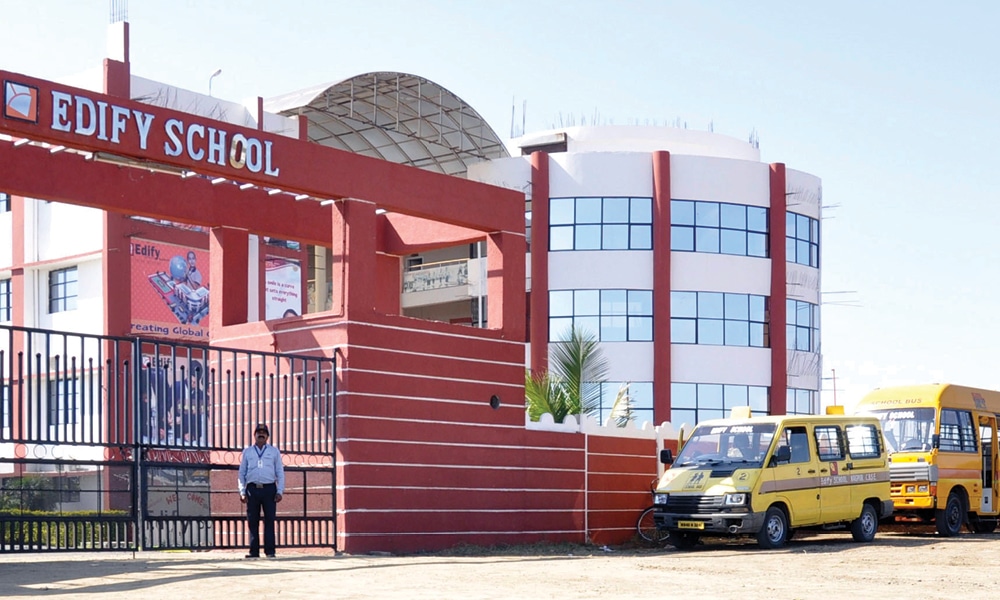
Edify school tries to develop a positive learning environment to inculcate discipline and leadership qualities among children. The school has an excellent infrastructure and equipped with Audio- Visual — Science and computer Lab, smart classrooms in all sections and temperature controlled classrooms. The school also provides specialized career counseling to its students and through “Students Exchange Programme”, the students get International exposure as well.

Innovation in Vocational Education and Technology World’s First “Speak and Learn” feature for learners to “Talk” to the app and practice English and other skills that have moved the classroom into the hands of the potential learners. “SkillFone” is completely multilingual with world language translation and voice support (Including Arabic)
Supports more than 100 skill courses Recently incorporated augmented reality and virtual reality innovations.

Innovative School Administrative and Management Systems
Learning Wings Education System (LWES) schools were the first to create human-friendly technological school support programs. First schools to work on Linux and use open offices. Schools are managed by set standard policies, the administration is shared and is layered between various areas of work. School decisions are taken by committees having representation from all, teachers, parents and administration. Heads of the schools supported by the staff with an aim of making learning joyous and fruitful.

Use of Assistive Technologies in Education
Copyrobo is the first full-service, consumer-oriented copyright service company applicable to clients throughout the world. Works on both Android and iOS platforms, as well as the web, as the first mobile timestamp application
Integrates with many popular services for ease of use, including Facebook, Instagram and Twitter
Introduces the Ownership Signature, a customizable ownership signature that is protected by the timestamp together with the original file.


CBSE’s “Exam Locator” app to help students in locating board exam centres

Intel Study An archetype for learning and teaching

With the board exams just around the corner, the Central Board of Secondary Education (CBSE) has come up with a mobile application to help students in locating their examination centre.

The app, named “Exam Locator”, facilitates students to find exam centres on the basis of their roll numbers.

CBSE board examinations for class 10th and 12th will begin from March 9 and the app will avoid the last minute rush of students to locate their exam centres. The app will have information on about 4000 CBSE Board exam centers.

“A student can easily find the address, images and geolocation of the designated exam centre on the map and get to know how to reach there,” a senior official of the Central Board of Secondary Education (CBSE) said.

How to use app?

  • After downloading and installing the app, students can register through their mobile number. After registration, students will receive a One Time Password (OTP) for confirmation.
  • The OTP will be used for the login
  • After login, students will be required to enter their class 10 or class 12 roll numbers to access the information
  • The app will display the student’s information and the address and image of the exam centre on the screen.
  • Students can use the mobile application’s map feature to find the route from their current location

LATEST NEWS