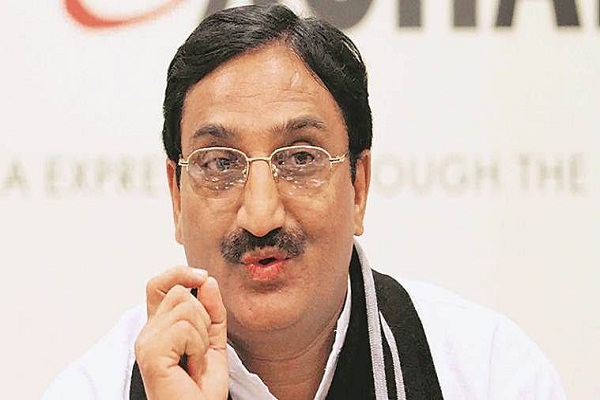
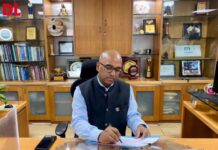
“As government officials, it is our duty to work in such a way that we can achieve the right results in the most cost-effective manner,” says Hari Ranjan Rao, Secretary to Chief Minister and Department of Information Technology, Government of Madhya Pradesh
The challenges in the education sector are huge, and we should avoid the tendency of getting bogged down by numbers as it makes it challenging to reach the ultimate objective. As government officials, it is our duty to work in such a way that we can achieve the right results in the most cost-effective manner. When it comes to education, we have a cause to worry, and also a cause to be optimistic. We are working with better goals in mind, but the task before us is so huge that we have to strive to do even better.
When teachers are guides
There is no doubt that IT is going to bring about a paradigm shift in education. In June this year, Shri Sam Pitroda was in Bhopal and we had a very good interactive session with him. One very pertinent pointthat he said was, “Let’s not presume that kids these days need teachers. Actually, children don’t need teachers anymore; they only need guides, enablers, and mentors. Give the modern kids an opportunity and they will learn things themselves.” This is a very profound statement to be made by man of Shri Sam Pitroda’s stature.
In a class, the teacher asks the kids how Lord Hanuman managed to find Goddess Sita. One child raised his hand and innocently replied, “Very simple, through Google search.” Solutions to many of the questions that arise in the child’s mind are found on Google search. The kids of today are computer savvy; they know how to look for answers on Google. So if we give them an opportunity, they will look for solutions.
All of us who have children at home know very well that whenever a new gadget comes to the house, it is the youngsters who are the first to master the nitty-gritties of running that gadget. You don’t need to teach a child how to operate a remote. The kids know that automatically. They don’t go to any classroom to learn how to operate a gadget. All we need to do is provide our kids with an enabling IT environment and they will be able to learn on their own. This is very easier said than done.
The problem is that so far, we have not been able to create that IT backbone that can reach out to majority of the children who are in need of education. In villages, the IT infrastructure is yet to make a mark in a significant manner. It is not in tier-I and II cities and towns that we are facing the crunch of IT infrastructure for education. The crunch is being felt in the remote villages, towns and districts. All the PPP projects in education that we have launched are unable to reach the remote areas, as we don’t have network in those areas.
Building digital networks
A vast majority of our education applications need the network to run in a proper manner. So, digital education can take the root only when the network is
able to expand to each and every part of the country. We have a State Wide Area Network (SWAN) in place in Madhya Pradesh that has now reached up to the block level. We are strengthening SWAN by the use of lot of technological innovations. We are also trying to expand it to our primary schools. Under this project, virtual classrooms are being set up in different parts of the state. In phase one of the project, we are connecting 313 block headquarters. In each block, we have picked up at least one school. About 100 colleges have also been picked up.
Each school or college is being provided with a virtual classroom with the entire set up consisting of a projector, an LCD screen, computer, microphone, etc. A studio has been created in Bhopal. The best teachers will be teaching in the studio and the lessons will get digitally transmitted to all virtual classrooms located in different parts of state. Through this, a much larger number of students will be able to tap into the teaching skills of the best teachers. It is possible that all the 313 virtual classrooms could be simultaneously attending the same lecture. As the system is interactive, the children will be able to ask questions and get answers from their teacher.
There are lots of challenges that we have to overcome to bring perfection in the digital system of imparting education. The primary challenge is to connect all the virtual classrooms with the studio. In about a month’s time, the system will be in place to cater to the needs of the few schools and colleges that we are connecting. However, it is not as if we have achieved the ultimate objective in education with this initial step. The truth is that the number of schools, which require this kind of technological solutions, is really large. About 4000 institutions require virtual classroom in government institutions.
Connecting schools
One good thing that has happened is the National Optical Fibre Network (NOFN). For laying the fibre optic cables, the government of India has signed a Memorandum of Understanding (MoU) with a number of states. The Government of Madhya Pradesh was one of the first states to sign the MoU with the Government of India.
There are lots of challenges that we have to overcome to bring perfection in the digital system of imparting education. The primary challenge is to connect all the virtual classrooms with the studio
The Government of India has approved on 25th October 2011, the setting up of the National Optical Fiber Network (NOFN) to provide connectivity to all the 2,50,000 Gram Panchayats (GPs) in the country. This would ensure broadband connectivity with adequate bandwidth. This is to be achieved by utilising the optical fiber existing up to block level and extending it to the Gram Panchayats.
If an optical fibre network is reaching the Gram Panchayat, many of the villages en route will also get connected. Madhya Pradesh has around 23,000 Gram Panchayats, all of which will be connected. Surely, this represents a landmark opportunity to revolutionise the education sector in the country. The concept of virtual classrooms can simply be replicated in 23,000 Gram Panchayats. This is a very cost-effective way of ensuring that children in even the remotest villages have access to quality teaching material.
Can you imagine the state’s best mathematics teacher can be sitting in classroom located inside a studio in Bhopal and he would be teaching students in 23,000 classrooms located across the state? This is the kind of revolution that ICT will lead us to.
A dedicated IT cadre
To bring efficiency in actual implementations of e-Governance, the state government has started creating a dedicated IT cadre. Now at every block and tehsil level, we have Assistant e-Governance Managers, and at every district level, we have District e-Governance Managers. They have been recruited through a process of online examinations that entail very little paperwork and many of them have already joined the jobs.
The private sector, too, has a lot of talent. But as a government official, how do
I take advantage of that talent? If a private company comes to me with a very efficient model for virtual classroom, I cannot straightway take that virtual classroom and start deploying it. The scales at which the government works are enormous. We need to go through a transparent procurement process. So, it is much better if the private sector, instead of bringing their products directly to the government, get their products tested with the private schools. Once the application gets popularised, a demand for the product will get created and then the government machinery can create an ecosystem and procure the solution through a transparent mechanism.










 Accreditation of educational institutions will make it easy for students to assess the quality of programmes, courses, infrastructure and faculty in an institute
 The lack of accreditation and the rising number of private varsities offering technical and higher education makes it difficult for admission seekers to judge the quality of education