Home Blog Page 1557

Asia News

Open University Malaysia goes international

With a delivery system based primarily on Information and Communications Technology, the Open University Malaysia (OUM) has ventured into the international arena. The first open and distance learning University in Malaysia is now providing consultancy and training services on e-learning to countries like Saudi Arabia and Bangladesh.

For this purpose, it recently

launched OUM International as its brand name and focus point for its international endeavours. OUM International will be the reference point for all international contacts with OUM as well as the unit responsible for conceptualisation of projects to meet the needs of international clients.

Indonesia expands Global Development Learning Network

Indonesia’s Ministry of National Education has opened up its ever expanding Global Development Learning Network (GDLN) to the world, in an ambitious effort to bridge the knowledge gap and bring Indonesia closer to the world through video-conferencing technology. GDLN Indonesia began as a modest network of four universities in 2002 with support from the World Bank. Through a strategic merger with the Indonesia Higher Education Network (INHERENT), the network now covers over 220 public and private universities and can also tap into distance learning opportunities from anywhere in Southeast Asia.

The first incarnation of GDLN Indonesia was the linkage between University of Indonesia to three regional university centers – University of Riau, Udayana University and Hasanuddin University.

Malaysia allocates RM 3 million for visually impaired students

Malaysian government is allocating RM3 million for providing visually impaired students access to Information and Communication and Technology (ICT) facilities. Education Minister Datuk Seri Hishammuddin Tun Hussein said although the allocation is meagre the government would consider reviewing the amount if needed. The grant will be used to close the digital divide between those with visual impairment and others by using the latest technologies available and improving teacher training and infrastructure.

Speaking at the 12th World Conference of the International Council for Education of People with Visual Impairments, the minister also launched the Education for All Students with Visual Impairment Global Campaign.

US pledges $2.5M for classrooms in Mindanao

The United States has pledged a $2.5-million bilateral aid package to build more classrooms and rehabilitate old school buildings in Mindanao in Philippines as part of USAID funded project Education Quality Access to Learning and Livelihood Skills (EQuALLs). The aid agreement was signed by US Ambassador Kristie Kenney and Petron Development Foundation chair Nicasio Alcantara.

Under the package, 120 classrooms would be built and 480 more would be rehabilitated over four years. During the current school year, 20 classrooms in the regions will be built and 54 will be renovated. Funds will also be allocated for improving infrastructure in schools.

Quality science education a must for prosperity in Bangladesh

Bangladesh has no alternative to using science education as a tool for improving the living standards of the people and for dealing with economic and environmental challenges it faces, experts at a roundtable on ‘State of Science Education in Bangladesh’
have said.

Science textbooks need to be simplified, teachers’ salaries need to be raised, and science graduates need to be motivated to become teachers, said speakers. They also suggested introducing a terrestrial television channel broadcasting educa-tional programmes, to reduce students’ dependence on private coaching centres.

Intel launches skoool.ph in Thailand

Intel Technology Philippines, along with the country’s Education department have announced the availability of the Philippines’ version of the skoool educational website (http://www.skoool.ph). skoool is a free online platform to help teachers and students learn key concepts in Mathematics and Science.

The Philippines version of the skoool.ph contains locally relevant educational content, which was finalised by the Bureau of Secondary Education (BSE) after evaluating the contents of skoool.com, originally developed by Intel Ireland. Only those lessons were selected that aligned with Education department’s curricula for high school levels.

India news

HRD proposal to universalise secondary education

With the Expenditure Finance Committee (EFC) clearing the proposed Rashtriya Madhyamik Shiksha Abhiyan (RMSA) recently, the way is cleared for the launch of a mission-mode exercise to universalise secondary education. Union Human Resource Development Ministry will now place the proposal before the Cabinet. Designed along the lines of the ongoing Sarva Shiksha Abhiyan (SSA) to universalise elementary education, the RMSA seeks to make secondary education ‘available, accessible and affordable’ to all 15 and 16-year-olds by 2017. Another target of the RMSA is to ensure universal retention by 2020.

The estimated cost of the RMSA has been fixed at INR 42,705 crore in the 11th Five Year Plan. Of this, INR 34,164 crore will be the Centre’s share. With the road map to universal retention being chalked out till 2020, the total spill-over beyond the current Plan will be in the range of INR 54,000 crore.

DU tie-up with CII for professional skills

Delhi University has joined hands with the Confederation of Indian Industry (CII) to provide professional skills to college students and address the skill shortages faced by the Indian industry. The partnership is aimed at providing industry endorsed professional skills through a six-month certification programme under the aegis of School of Open Learning and DU. There would be separate courses on IT and automotives. More than 200 students have applied for the professional skills project, an MoU for which was signed between DU and CII in March.

The objective of this partnership is to bridge the demand-supply gap for skilled workforce. The course curriculum has been developed in consultation with industry and would be delivered using methodologies like case studies, interaction with domain experts, case simulation and a two-month internship programme with industry.

Sulabh International to set up world’s first Sanitation University

Internationally acclaimed for its sanitation movement, Sulabh International will soon set up a Sanitation University in Gurgaon, Haryana. The land for setting up the proposed university has already been acquired in Gurgaon and other formalities for making it operational are in the process.

One of its kind in the world, the Sanitation university will be a deemed university and will be structured much on the pattern of London School of Economics. To come up in the next five years, it will be an institute that will impart education in cleanliness — environmental, health and societal. The institute plans to offer post-graduate programmes in various courses of sanitation to science graduates.

NCERT gets EduSat hub to boost teachers’ training

In an effort to facilitate better teachers’ training programmes across India, a ‘mini hub’ has been set up at the National Council of Educational Research and Training (NCERT) for dissemination of information via Edusat. NCERT Director Krishna Kumar inaugurated the hub set up by the Indian Space Research Organisation (ISRO) and said that thousands of teachers will benefit with the training provided through EduSat.

The move would enhance the NCERT’s efficiency and effectiveness to reach out to its target audience base. Earlier, NCERT used to depend on ISRO’s hub at Ahmedabad to air its teachers’ training programmes. Central Institute of Educational Technology (CIET) Joint Director Vasudha Kamat said the mini hub will help them set up direct link with 100 Satellite Interactive Terminals spread across the country. With the increase in the bandwidth, in addition to the 100 CIET centres, about 120 centres from the Consortium of Educational Communications (CEC) will be operative through this mini hub.

UP ITIs to be ugraded into centres of excellence

Uttar Pradesh government has decided to upgrade 125 out of 258 state-run Industrial Training Institutes (ITIs) into centres of excellence in order to create a workforce with specialised skills. The upgraded ITIs will be different from the conventional ITIs in respect of curriculum, duration of training, trade testing and certification. These ITIs will cater to specialised skill requirement in different sectors of industrial activity.

The ITIs provide technical training to those who have passed Class 10, offering diplomas for one- year and two-year courses. The upgraded ITIs will offer specialised training and courses in various sectors, including IT, automobiles and transport. For promoting technical education and job avenues, Uttar Pradesh has already undertaken an ambitious project of setting up 250 ITIs, covering every block of the state, through public-private partnership. To help it in establishing ITIs, the state government has sought inputs from a British consultancy agency.

Web Resource Center inaugurated at Patna Women’s College

Bihar Information and Technology Minister Anil Kumar inaugurated the Web Resource Center of the Computer Application Department at Patna Women’s College, calling the move ‘very progressive that would go a long way in educating the girls of Bihar’. Urging other colleges in Bihar to emulate Patna Women’s College, Dr Kumar said such efforts were highly commendable and helped bridge the gender divide that exists in the state and other parts of the country.

The Web Resource Center includes 40 computers and offers broadband Internet connectivity while also providing most popular software titles for the students. The Center is also directly connected with the University Grant Commission (UGC), National Council of Educational Research and Training (NCERT), Indira Gandhi National Open University (IGNOU), and Indian Space Research Organization (ISRO).

Gujarat ITI students to receive training from GM India

Gujarat government has signed a MoU with General Motors India to train students of the Tarsali Industrial Training Institute (ITI) in Vadodara. According to the agreement, GM India would develop and provide technical courses on automotive technology for Tarsali ITI students. The courses would leverage GM’s global resources and take advantage of expertise at GM’s manufacturing facility in Halol in Gujarat and the GM Technical Centre in Bangalore.

The company would also upgrade the existing infrastructure at the institute and assist in providing other course-related facilities. Minister of State for Industries Saurabh Patel said the programme would help provide skills required to ensure that Gujarat remains a favourable destination for domestic and foreign investors. The company would also sponsor trainees as apprentices in the organisation.

Nagaland varsity-IIITM-K link to boost education

Nagaland University and Indian Institute of Information Technology and Management of Kerala (IIITM-K) have been linked through India’s longest terrestrial connection over the Indian Railways optical fibre cable (OFC) network for enhancing technology education in the state. Launching the terrestrial link, Minister for Development of North East Region (DoNER) and Panchayati Raj Mani Shankar Aiyar said it was the first formal Education Grid between two academic institutions located in two of the farthest states of India.

The link will connect several premier institutions and extend the Education Grid to every village of the north eastern Indian state. With this, the state government plans to launch several open supported technology enhanced education programmes at all levels to reach quality education all over Nagaland. The link will be a principal driver in building the national education grid connecting universities for resource sharing, content, content generation on their core competence, e-Learning, tele-education and universal certification.

Haryana to give a boost to technical education

Haryana government has decided to increase the technical education seats from the existing 52,000 to one lakh by 2010 to establish the state as India’s show window for technical education. From 33,000 seats in technical institutes three years ago, Haryana today boasts of 52,000 seats. ‘Our aim is to take this number to one lakh by 2010,’ Chief Minister Bhupinder Singh Hooda said.

An additional 50 private engineering colleges will be added this year to the current 62 engineering colleges in the state. The largest of these additions are likely to take place in districts like Faridabad, Sonepat, Panipat and Gurgaon. Hooda said the state government has increased budgetary allocation to the Education department from INR 16 billion in 2004-05 to INR 32 billion this year. The government would also open a ‘Rajiv Gandhi Education City’ this year at Kundli, which will be modelled on Oxford University. It has already earmarked 2,000 acres of land for this education city.

Ban foreign education franchises: DEC

The Government of India is likely to pass a law banning educational institutions in the country from opening franchises abroad for running distant education courses. The Distant Education Council (DEC) has advised the Ministry of Human Resource Development (HRD) to stop such practices.

Several educational institutions, mainly private ones, are opening their franchises abroad. This is a bad practice and DEC is against it, Council Chairman V N Rajasekharran Pillai said. DEC is not against opening of new institutes by Indian institutions. But giving permissions to a local party (abroad) affects the quality of education, he said. The council has asked the MHRD to incorporate all these ‘points and concerns’ in a proposed Bill on Distance Education pending before it.


e-Blocks Learning English with stimuli

e-Blocks Learning

Human beings have been learning foreign languages for a very long time. Many find this task effortless and enjoyable whereas for others it is filled with frustration, anguish and annoyance. To help master a foreign language, numerous methods have evolved, many of which have come and gone. What is needed is a technique which is based on supportive scientific research, indicating how best to instil linguistic knowledge and to facilitate the use of the to-be-mastered tongue. In this context, an innovative product has been developed by Positivo Informatica, which goes by the name of e-Blocks, a programme for teaching English to children between the ages of two to ten years.

What is unique about this method is that it encourages people to utilise multiple senses simultaneously, promotes co-operative learning and makes use of a well established pedagogical principle in the field of education called “learning by doing.” The e-Blocks system consists of a software package, a sensory panel with 15 pockets, plastic blocks with various colours, letters, shapes imprinted on them, flash cards and reproducible activities, teachers’ guides with audio CDs. With the help of visual and auditory stimuli, children are introduced to letters, words and sentences. Children are then required to make a response based on the learning activity selected by the instructor. They are asked to make their responses by inserting the blocks into the pockets of the sensory panel. The programme then evaluates the students’ responses and provides immediate feedback to the students. Afterwards, at the end of the learning session, the programme generates a detailed performance report including numeric scores, and identifies areas in which improvement is needed.

e–Blocks makes it possible for students to learn individually or to work together collaboratively in groups of up to 6 persons. If the latter option is chosen, the programme requires students to consult one another before responses are made, which makes learning exciting, enjoyable as well as informative for every one involved.

e-Blocks was developed based on scientific knowledge in the fields of linguistics and cognitive science. It is used in numerous countries in the world. It has won several awards including the World Summit Award (WSA) in 2005 from the United Nations for the best e-learning solution in education. According to the WSA, e-Blocks is a perfect blend of technology and content which is what differentiates it from all other methods available for learning English as a language. Besides accumulating its multiple accolades, e-Blocks system has also received support from scientific research inducted in the field itself. For example, in a study conducted in the California public school system, the effectiveness of the e-Blocks methodology was evaluated by an independent company, Educational Support Systems Inc. The results of this investigation indicated that students who came from Spanish speaking homes and used the e-Blocks system scored significantly higher on the variables of letter naming, phonetic segmentation, oral reading fluency and retelling fluency compared to the control group consisting of non e-Block users coming from Spanish speaking homes. Further research is being continued to investigate to what extent e-Blocks is successful in assisting students to master English easily and effectively.

Based in Brazil, Positivo Corp was established in 1972.  Today, it is the market leader in education, as well as information technologies. It has a wide distribution network all across the globe and thousands of schools use Positivo’s educational tools. In India, Virtual Edutechnica Private Limited, Ludhiana, is the exclusive distributor of the e-Blocks programme.

SMART Board Interactive Whiteboard Built to Last

SMART Board

Nancy Knowlton
President and Co-CEO
SMART Technologies Inc
NancyK@smarttech.com

Just how long will a SMART Board interactive whiteboard last is a question that many educators ask. Most people budget for a three-to-five year useful life for projectors and PCs and expect about the same for the SMART Board interactive whiteboard. There are a number of things that you should know about our product.

Software Upgrades

A substantial amount of the utility of the SMART Board interactive whiteboard is derived from the software.

We provide free, online upgrades to the SMART Board software, so no matter when you bought your SMART Board interactive whiteboard you will always have the same, most up-to-date functionality as someone who purchases today.

This is particularly important for school jurisdictions, because there is never a financial decision to make about upgrading. Just download it and go.

Hardware Warranty

The warranty is a full five years, including electronics, cables and surface. There’s no small print to trip you up should you ever need warranty support. (Of course, the warranty does not cover abuse or deliberate damage.)

Useful Life

We are often asked about the useful life of the SMART Board interactive whiteboard. There is a calculation that can be made to provide a theoretical answer, but that’s all it would be. The reality is that SMART Board interactive whiteboards that were sold and put into use eight, ten and fourteen years ago are still in use today. With the free software upgrades, they are every bit as good as new product currently shipping from our assembly plants.

Construction of the Whiteboard

The SMART Board interactive whiteboard features a very simple construction which makes it extremely reliable once it is installed in a classroom. There are two sheets of resistive material, stretched over a large, flat surface and separated by a small air gap. When you press on the SMART Board interactive whiteboard’s surface, the two resistive sheets touch and an X,Y coordinate is registered.

The surface material of the whiteboard is a hardcoat poly-ester which is extremely durable. It doesn’t wear out.

The surface material keeps its tension over time because of the way that the SMART Board interactive whiteboard is assembled.

There are four pens/styluses that are provided with each SMART Board interactive whiteboard. There is nothing special about these tools – they are simply pieces of plas-tic that serve as visual cues as to their function. With the intelligence built into the pen tray (optical sensors detect a tool selection), all of the styluses could be removed from the pen tray and the interactive whiteboard would still function. Simply place anything (a business card will do) in the pen slots and it will function as usual.

Quality is Built In

SMART takes great pride in designing and building a quality product. One of the biggest compliments that we receive from our customers is about the reliability that they experience with our products in their classrooms.

We received our ISO 9001 registration in 1996 and we have been successful in maintaining that registration ever since. Our systems are solid, and our practices are sound.

Growing Library of Education Resources Beyond the software and hardware, there is a large and growing library of classroom-ready, teacher-prepared materials to go along with the SMART Board interactive whiteboard. And the best part – they’re free on http://www.education.smarttech.com

Getting Better with Age

There really aren’t many things that get better with age, but we’d like you to think that’s exactly what happens with the SMART Board interactive whiteboards that our customers own. Not only is the hardware durable and reliable, the fact that our customers can download the latest version of the SMART Board software means that you get new features and functions as they are added to the product.
Now, that’s built to last.

Corporate News: Aug 2008

RapideL-i introduces MS Powerpoint converter

RapideL-i, the internet-based rapid e-Learning tool has been upgraded to include a new feature to convert MS Powerpoint slides into e-Learning. This feature allows users to import static Powerpoint presentations into RapideL-i and, at the click of a button, convert the presentation into a SCORM complaint eLearning course. It also allows users to add pages created using RapideL-i into the converted course.

This easy-to-use feature will immensely benefit users who currently have some part of their training material in Powerpoint and wish to convert it for deployment on an LMS. Moreover, RapideL-i enables value additions to these converted courses by providing ready to use, customisable players/shells which can be tweaked to suit one’s branding needs.

Nortel equips NERIST in Arunachal with wireless connectivity

Nortel has equipped the North Eastern Regional Institute of Science and Technology (NERIST), a university in Arunachal Pradesh, with its wireless mesh and WiMax solutions to deliver wireless connectivity across the university’s two campuses in the mountainous area. This is also expected to provide complete mobility for its students and staff.

Users at both the campus sites can access the institute’s network infrastructure using the Wireless Mesh network solution, unifying the two campuses by a single secure network that can be accessed from anywhere in the university. The solution opens up opportunities for educational techniques like video conferencing, tele-classrooms, webcasts of lectures for distance learning, and mobile desktop/laptop-based video conferencing. Students can access resources wherever they are instead of having to go to a central location, like the library or computer center.

Intel announces education plans for Palestine

Intel has announced key initiatives in Palestine, including expansion of the Intel Higher Education Technology Entrepreneurship Program and the launch of a new multi-core computer lab at Birzeit University.

As part of its education initiative, Intel will develop a new multi-core computer laboratory at Birzeit University to enhance skills and aid programming knowledge targeted toward multi-core platforms. It will also offer its global programme on technology entrepreneurship curriculum and training to five Palestinian institutions and plans to sponsor a business plan competition for students to strengthen entrepreneur initiatives in the country. The company has also started work with the country’s Ministry of Education on a detailed multi-year plan to provide the Intel Teach Program in Palestine.

Microsoft to give R750 million software to SA govt schools

Microsoft will supply productivity and server software worth about R750-million to 26,000 government schools in South Africa, bringing modern information and communication technology to more than 11 million school students. A three-year agreement was signed in this regard, renewing the company’s original software donation agreement signed in 2002. Through this the country’s Education Department hopes to widen the reach of ICT and see more students leave schools being computer literate.

Under the programme, teachers are being trained to be computer literate and ready to integrate software in the classrooms. Each of the schools that participate in the programme will receive free licences for a range of software, including Microsoft Office 2007, Vista Business, Visual Studio Pro, Exchange Server, SQL Server and Microsoft Encarta multimedia encyclopaedia. In addition to teacher training, the company is committed to helping schools increase access to technology and build strong infrastructure that supports learning as well as administration of education.

Bharti Foundation to open 500 schools for underprivileged

Bharti Foundation, the philanthropic arm of Bharti Enterprises, will open 500 primary and 50 senior secondary-cum-vocational training schools for underprivileged children across rural India under its Satya Bharti School programme.

One such Satya Bharti School was inaugurated by President Pratibha Devisingh Patil at village Lordi Dejgara in Jodhpur, Rajasthan. The Foundation’s flagship programme is aimed at benefiting over two lakh children across the country by giving them access to quality education through innovative teaching material and classroom processes. The promoters of Bharti and its associates have committed a corpus of INR 200 crore for the Satya Bharti School programme’s roll out across the country.

iQ Academy Washington launches statewide virtual school for students

iQ Academy Washington has launched its online school for all students in grades 7-12 and is enrolling students statewide for the 2008 academic session.

This unique education option provides high-quality, tuition-free education, small group instruction and one-on-one feedback from certified teachers — all conducted online using a laptop provided by the school.  Students can excel at their own pace and work with Washington-certified teachers who are specially trained in online instruction.  Students will receive individualised attention and participate in dynamic student discussions online.

KarROX launches third IT empowerment scholarship in Nigeria

In its quest to create a pool of well informed and learned ICT professionals, karROX has launched its third IT empowerment scholarship in Nigeria for the third consecutive year with an investment of N100 million.

Under the scholarship, training will be offered on various software, networking and security modules with multiple platforms and technologies offered by ICT world leaders like Microsoft, Oracle, IBM, CompTlA, Sun Microsystems and others. The scholarships conducted in year 2006 and 2007 had received an overwhelming response with 60,000 students applying for it, out of which 12,000 were selected to complete specialised courses on ICT. The scholarships are given on the basis of applicants’ performance in the qualifying test. Up to 100% fee waiver, along with job assistance, is offered to those selected

Projectors With Brilliant Color Technology

Projectors With Brilliant Color Technology

With the proliferation of digital photography, consumers are capturing thousands of memories in digital media.  Most of these memories remain in the PC, but consumers want to share them with their families on the big screen. One of the challenges that consumers have is to precisely reproduce those captured moments on a large screen projector. Texas Instruments introduced Brilliant Color technology to provide DLP projector brands and end users with a broad set of tools to better represent those unforgettable moments.  In Q2 2008 80% of DLP projectors sold incorporated Brilliant Color technology.

The most important tools encompassed in the Brilliant Color technology suite are:

  • The use of multi-primary colors including yellow, cyan and magenta to expand the viewable color space
  • Lamp pulsing
  • Colour correction
  • Circuits and software algorithms ported from DLP Cinema applications

Multi-primary colour processing – Brilliant Color technology starts with RGB (Red, Green, Blue) video colour support like other technologies, such as LCD and previous generations of DLP projectors. Then it adds CMY (Cyan, Magenta, and Yellow) colour processing and white is added in some cases to increase white level.  These additional colours offer the capability to represent a desired colour output at higher brightness.  The results of such an innovation are colours that are closer to real life than ever before.  This innovation is somewhat similar to how computer printers evolved not long ago in which they added multiple colours with seven or more inks when consumers started to demand better colour photo printing.  In addition to an image that more accurately represents the source material, Brilliant Color technology gives manufacturers more flexibility to fine- tune their desired colour palette.  Figure 1-1 below shows how having twice as many colours from which to choose allowed Mitsubishi to emphasize green in one model while In Focus chose to more closely match Rec 709.

Lamp pulsing — Lamp pulsing allows manufacturers to pulse-width-modulate (PWM) the lamp at different frequencies to allow for a broad set of pre-configured selections without losing colour fidelity.  In simultaneous RGB systems, brightness can only be emphasized by loss of bit depth and reduced system efficiency.  By design, simultaneous RGB systems cannot support lamp pulsing given that lamp pulsing requires each colour be pulsed at a unique frequency in a unique time allocation.  On the other hand, lamp pulsing in sequential colour reproduction such as that found in DLP systems enables emphasizing different level of brightness on each source (RGBYCM).  The average power of the lamp is maintained by shifting the proportions of energy between various colours.

It is now possible to boost certain colours to achieve unique looks for various applications while de-emphasizing other colour sources.

Figure 2-1 illustrates how lamp pulsing can generate various colour preference modes without impacting the overall power of the lamp. The black line in Figure 2-1 represents the brightness of the lamp over time as it aligns with the appropriate point in the colour wheel.

  • Colour correction – Brilliant Color enables an extended list of options to  manufacturers and end users.  Colour correction algorithms enable more flexibility at the manufacturer level by providing a broader set of configurations without sacrificing power and fidelity.  Manufacturers can now offer a wider array of pre-configured image options.  End users have a broader set of tools to adjust colour to their liking.  It is now possible to change pre-configured settings and adjust colour fidelity for primary and secondary colours within those settings, to suit their personal requirements.  End users can select from a richer set of options closer to a professional display system.  In fact, a Brilliant Color enabled projector, can support over 250 unique configurations.
  • Circuits and software algorithms similar to those in cinema applications — DLP Cinema technology is incorporated into 98% of the digital cinema projectors worldwide. DLP Cinema offers tremendous colour flexibility by providing 3-D lookup tables and colour correction help systems. Similar circuits and algorithms are now available in Brilliant Color projectors to expand the options for colour optimisation.

In summary, Brilliant Color enables a much broader set of options for manufactures and end users to adjust colour to their individual needs. There are projectors in the marketplace that supports up to 10 different pre-configured modes without impacting average lamp power or colour fidelity. Other technologies which use just RGB only support a few modes with a direct impact to brightness and colour fidelity. In addition, end users have more options for configuring primary and secondary colors while RGB projectors support adjustments to primary colours only.  Having a BrilliantColor projector empowers the end user to fine tune colour preferences and truly bring those memories back to life on the big screen.

EDISTALEARNING,  A QAI Venture

Responding to the demand supply gap in industry, and with the intention of building capacity and capability, QAI, along with internationally renowned guru, Dr. Roger Pressman, have launched an online curriculum EdistaLearning to address the enormous need for anytime, anywhere, high-quality and cost effective training.

EdistaLearning is QAI’s education and training initiative and the exclusive platform that brings together subject experts and QAI’s consulting and training experience. The online curriculum facilitates knowledge, competence and skill creation in the domains of Software Engineering and Quality Management. It has over 45 e-Learning courses spanning across 13 domains such as Software Engineering, Testing, Estimation, Project Management, Quality, Configuration Management and many more. It’s online content is available to both individuals and organizations.

EdistaLearning brings learning to people rather than bringing people to learning. Several organizations in India and overseas have already subscribed to tens of thousands of licenses and are saving costs and significantly reducing cycle time.

EdistaLearning provides opportunities of a complete Career Path, Management and Performance Tracking of workforce and above all, homogeneity of content so that everybody speaks the same language.

Knowledge is Sharing…

educational reform

There is a need to develop a broader view of knowledge for dealing with the way in which new digital trends influence the underlying conditions in schools, universities, pedagogy and subjects… Digital Learning India 2008 conference aims at stimulating discussions on the latest advances in e-Learning, new applications of technology, new approaches to education.

As Socrates famously said, ‘The unexamined life is not worth living,’ our Digital Learning India convention, coming after a year along with eINDIA 2008, seems as good a time as any to pause and reflect.

This special issue of Digital Learning, to be released at the conference, highlights whether a broader view of knowledge and the digital revolution can generate new ways of how we perceive technology within a new educational reform, particularly in India. The focus is particularly angled towards the implications this May have for developing new practises for teachers, students, service providers and for the community at large.

To be successful, the synergy approach requires that the education community design new tools for the users whose feedback from concrete user scenarios is analysed throughout the process. Diverse users force the designers and service providers to really listen to their feedback while creating functional educational tools. The special issue in an effort in this regard. We have tried tracking important directions in educational research and have also tried to provide an overview of studies, commentaries,
opinions, etc highlighting the multiple relationships between technological and educational approaches.

Also read: A New Decade for Educational Transformation

We have also tried to contextualise the themes of the conference in this special edition. If it fails to be regarded as a description, then we hope at least it can be regarded as one possible understanding of the context.

We would like to thank all the speakers, conference chairs, the reviewers, and each and every member associated with our annual ICT for Education event. Our special thanks to all the experts and policy makers who have contributed to this special issue.

Happy reading!

Resurgent Rajasthan Intel Initiatives Accelerating Progress

Resurgent Rajasthan

From landscapes to lives, everything is changing in Rajasthan. Radiating unparalleled energy and optimism, the educational reforms in the state have gone a long way in driving social and economic progress. The Intel Initiatives with the state government have made it possible to accelerate this vision of 21st century education.

This transformation has been more revolutionary in the backward villages of Rajasthan where technological literacy has helped villagers deal with social and community problems like education and health, breaking social paradigms set for centuries. These bold initiatives and concerted efforts have opened up avenues and opportunities for growth, prosperity and self reliance, especially for women of the State.

Today the sand of the desert glows, rich, not with the color of the traditional past but the shining present.

Bharatpur, the premier Jat state in Rajasthan, is dotted with marvelous remnants of its royal past. Today, this historically rich but economically backward district is witnessing radical changes in its educational system. Through the Intel initiatives introduced in Aroda, a small village in Bharatpur, the poor farmers of the village see a brighter future for their children.

Education was not one of the topmost priorities in the village. A child at home meant an extra pair of hands to help in the fields. The transformation came about when the government school teachers were trained under Intel Teach. Using technology as a platform, (survey, rallies, door to door campaigns etc), these teachers brought about a change in the thought process of the villagers by making them aware of the benefits of education.

Laxman Singh, an Intel trained Master Trainer and his students, undertook a project where they created awareness on how an educated child could change the future of his entire family.

Their project not only motivated the elders of the village towards the necessity of education but also attracted more children to enroll in school.

Dungarpur district is the stronghold of the Bheels of Rajasthan. Predominantly tribal and extremely orthodox, their history of occupancy in the Aravalli’s ranges back to 4000 BC. Their thinking – seeped in superstition and orthodoxy – had over the years reduced it to an illiterate tribal community.
Parshant Joshi and Jitesh Pandya, two teachers in the Government Upper Primary School Sanchiya, Dungerpur, trained on the project based learning concept under Intel Teach, started an educational project focusing on how to get rid of the evils of superstitions.

This age old orthodox way of thinking, they felt, was a hindrance to the development of the community. The Master Trainers are working to make the community literate so that they leave behind their superstitious practices and adapt new ways of life.

Yogita Joshi and Kushal Gamot are students of the upper primary government school in Vassi Khas, Dungarpur district. They have made their school, village and family proud by being the first ever merit holders from their small village in the district level exams.

Thanks to the Intel Teach Program which their teachers were trained on, the students of the school were introduced to the Encarta edition on the computer.

They were taught to use it for their projects, to add to their knowledge of topics in science like cell division , digestive system etc. and  to increase the gamut of their education system.

The students inculcated the Encarta in their school routine. This extra effort showed in their work when both Yogita and Kuskla became the first students from Vassi Khas to have attained a merit rank in the District Level board exams for the 8th standard.

The story of success for this village school does not stop here. The Intel Initiatives taught the students how to explore, to work collaboratively and to acquire skills for the 21st century. The result was that the school got better results than ever before and shone in the district for getting 100% pass percentage in the district level exams.

Yogita’s father, a humble man who runs a general shop in the village has tears of happiness in his eyes.

‘I have dreams for my daughter. She has outdone her brothers and we hope to see her do really well in the future. Maybe one day she can get a job also.’

This is the changing face of Rajasthan. Literacy amongst women has gone up by 30% since 1981.The Intel Teach initiatives of Rajasthan are creating a youth who is geared to meet the demands of the 21st century and can look forward to new vistas of employment and opportunity.

Through these projects the teachers are training their students to understand the cause and effect relationship between progressive thinking and social and economic development.

 Vassi Khas, also a village in the district of Dungerpur, has high fluoride content in its drinking water which is far above the ‘safe for health’ parameters. Fluoride, is a toxin with a rating slightly higher than that of lead and appropriate warnings have been issued by the government.

Even though this poor rural community suffers from various kinds of water related diseases, illiteracy makes them ignorant to the dangers they face or to home based solutions they can find to their problem.

Giri Raj Singh, a teacher in the government school of Vassi Khas, has trained under the Intel Teach Program and plans to involve his students in a health based project which focuses on the dangers of excess fluoride in water.

The students will analyse and work collaboratively to find out what can be done to safeguard health, using methods which are cost effective and can save lives.

By tapping into the children’s interest in their community while developing their skills with creative technology driven projects, Gir Raj Singh is working innovatively to bring about development in his backward community.

Sudhir Bhargav, Principal Secretary of School and Sanskrit Education, Government of Rajasthan, very aptly sums up the contribution of Intel when he says: ‘The Intel Teach Program has not only made many of our teachers computer literate but also made them ambassadors of using technology for improving the delivery of educational services as well as to enhance the learning level.’

Science Education Today & Tomorrow

Science Education

Science today is taught in an abstract manner in most Schools across India, primarily using the Rote method of instruction and to a certain extent Apply and Understand method of instruction (Anderson’s Taxonomy), which essentially are lower order learning skills. From cognitive research done around the world, it is found that the rote method assimilating knowledge is actually counterproductive to learning.
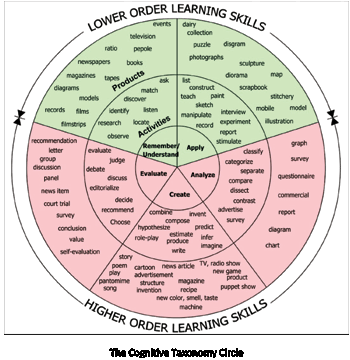
When we look closely at the human learning pattern, we humans learn by relating to different things and events with respect to what is being learnt. Putting it simply, learning the unknown happens with relation to the known. The learning process is further strengthened by reinforcement. Furthermore from the theory of Multiple Intelligence in Education, traditionally schools have emphasized the development of logical intelligence and linguistic intelligence (mainly reading and writing). While many students function well in this environment, there are those who do not. Gardner’s theory argues that students will be better served by a broader vision of education, wherein teachers use different methodologies, exercises and activities to reach all students, not just those who excel at linguistic and logical intelligence.

The process of relating to from familiar concepts/events/things and reinforcement actually helps in effective learning. Science should be taught as something which is very much part of everyday life, for e.g., like showing the child the science involved in pulling water out of a well, or every day examples about the levers etc. This aspect was found to be critical in learning the fundamentals of science, and this would lead the child to start thinking more analytically. Further, an essential part of learning science comes from experimentation, which enables the learner to actually comprehend what he has learnt earlier in a clear and precise manner.


Coming from the above, the use of multimedia resources in teaching science would actually overcome the abstractness of science teaching to learners. This would inculcate in the learner development of their higher order learning skills. In fact, Educational research has shown that information should be encoded both visually and auditory. When learning with multimedia, the brain must simultaneously encode two different types of information, namely an auditory stimulus and a visual stimulus. One might expect these competing sources of information to tend to overwhelm or overload the learner. This perhaps would be the case, if it were not for how working memory works. Baddeley and Hitch (1974) suggested working memory has two somewhat independent sub components that tend to work in parallel. This allows us to simultaneously process information coming from our eyes and ears. Thus a learner is not necessarily overwhelmed or overloaded by multi modal instruction.

In studies undertaken by Mayer and his colleagues testing Paivio’s Dual Coding Theory, along with multimedia, they repeatedly found that students given multimedia with animation and narration did consistently better on transfer questions than those who learnt from animation and text-based materials. That is, they were significantly better when it came to applying what they had learned after receiving multimedia rather than mono-media (visual only) instruction. These results were later confirmed by other groups of researchers.

Everonn’s products today are making Education more meaningful using multimedia as a Teaching aid, thereby providing learners with a wholesome learning experience (developing both lower and higher order learning skills). Features of Everonn’s products (www.classontheweb.com, i-Schools, vSchool etc) can easily be mapped to the Cognitive Taxonomy Circle diagram. 

Currently the Creative Head at Everonn Systems India Ltd., Tangirala Vishal is a graduate in Engineering from Chaitanya Bharati Institute of Technology, Osmania University. He started his career path as a graphic designer, and moved on to become Research Engineer in International Institute of Information Technology in 2002. At the Institute, he got various opportunities to design interactive multimedia modules on Mathematics and Science. He further moved on to start his own firm ‘Kriative Media’ where he has executed many noteworthy projects for major corporate like Krebs Biochemicals, Ferro Grenn Technologies, Banaras Beads Ltd, Poovaya & Co.

In 2007, he joined Everonn Systems India Limited as its Creative Head. A major contributor to various creative endeavours at Everonn, Vishal heads the animation team responsible for developing multimedia content as well as research on multimedia content development. Vishal has co-authored various books and also presented papers on using multimedia as a tool to impart school education.

Why do we need a National Policy on ICT in School Education?

ICT in School Education

Most developing countries do not have a concerted Policy on ICT in School Education. The reasons can be many; they have decided that they do not need a separate Policy on ICTs in Education, already have an IT policy with sections on Education or have a Telecom policy which has references to both IT and Education. The mere establishment of a written national ICT policy for School Education has value in itself, even though it is quite clear that ICT policies do not and cannot exist in isolation. They have to take into account a range of other policies and existing frameworks such as education policies, information policies, trade and investment policies, and cultural and linguistic policies. At a minimum, it conveys the message that the government is progressive and intends to pursue the utilisation of ICT in society seriously. Governments, because of their inevitable role in policy making should assume a leadership role in the implementation of ICTs in schools. They must aspire to become role models by putting policy into practice and creating sustainable mechanisms to keep the policy updated and dynamic, so that it can keep pace with the fast changing technology in the business world.

That is the ideal situation; the truth is that ICT evolution will take place ( as we have seen)  with or without a systematic, comprehensive and articulated policy. While there is no denying that some good will come out of the process, it is also a fact that it will inordinately delay the journey, cause huge wastage and leave out large tracts of communities that can most benefit from the use of technologies.

So why do we need a specific Policy on ICT in School Education? While there can be several reasons for this, some of the most plausible reasons are:

  1. A National Policy on ICT in School Education will enable the country’s government and its people to develop and participate in an “envisioning exercise” that provides a prelude to where we are headed with all this investment. It will help channelize government funding and the tax payer’s money into sustainable mechanisms of educational development which are likely to benefit generations of school goers.

  2. A National Policy on ICT in School Education will perforce have to provide a linkage with the country’s National Education goals and enhance existing education policies and frameworks. Traditional education delivery mechanisms are not meant to suddenly encourage incorporation of technology tools. Deep rooted, systemic changes have to be made so that the country’s education system can adopt and adapt to new age technology tools. This requires thorough assessment of the existing systems and a clear understanding on the capacity to which they can adapt to change. The policy development process, if it is an open one, will throw up all these challenges and seek to address these issues. Failure of most ICT pilot programmes to mainstream, scale up or sustain is caused by the single factor of not being linked to the over-arching, larger educational priorities of the country. For eg; The IT Action Plan  of the Government of India ( 1998), the Education Policy (1986 and subsequent amendments) and the National Curriculum Framework ( 2005) provide recommendations for what should be happening in schools, making generous provisions for promotion of ICT in schools. However, these recommendations are less likely to be implemented unless supported by a policy defing a robust implementation strategy. It therefore calls for a strong marriage between the IT Policy, the Education Policy and the National Curriculum Framework(2005)

  3. A National Policy on ICTs in School Education will encourage new technology tools to be used in teaching and learning. This will help in knowledge creation and knowledge sharing among key stakeholders and community of practitioners. ICTs are all about new collaborative learning tools and having free and open access to information. Undoubtedly, technology can succeed in influencing outreach, access and creating new tools for learning and teaching, but these are less likely to emerge on their own without the support of sustainable frameworks and policies.

According to the feasibility report by McKinsey & Company, the essence of the challenge is to transform today’s fragmented, supply-driven, largely uncoordinated pilot efforts for ICT in education into efficient, demand-driven, coordinated end-to-end systems implemented by strong partnerships involving all key players.

There are more reasons too for developing a National Policy on ICTs in School Education, some of which are elucidated below  :

A national vision on the use of ICTs will provide the country with much needed direction, focus, guidelines and aid to prioritize the initiation and implementation of ICTs in Schools. This will result in huge savings as large school groups (and even State school education departments in the present scenario of centralised decision making) can leverage economies of scale in their purchase of hardware, software and content. Specific norms and standards can be created for development and use of curricular content, Teacher training on ICT and for student assessment.

When large school groups take a collective decision, it is more likely to be governed by real need rather than by professed need articulated by corporations and businesses that have access to the ministry. These decisions are also more likely to involve communities of parents who are professionals and who can provide unbiased advice on most things the schools wish to purchase.

ICT is developing fast and most technologies can be harnessed to address endemic issues of access, equity and quality. Delay in adapting to ICTs can cause loss of precious time and deprive many school-leaving teenagers the possibility of exploring new career options that require a good understanding of technologies.

There are more reasons yet, all of them supporting the need for an “end to end framework” or a comprehensive National policy to guide the use of ICTs in Schools.

LATEST NEWS