




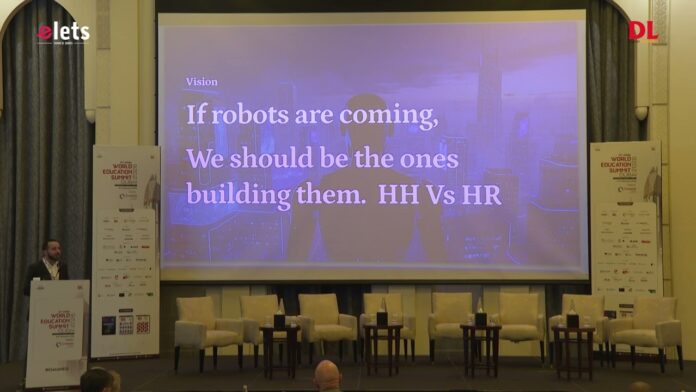
In the realm of artificial intelligence, the journey from software to hardware is a pivotal transformation. As the CEO of Besomi Group, Mohammad Hani, recently highlighted, this evolution towards ‘physical AI’ is significant and inevitable. In a rapidly digitalizing world, understanding the intersection between AI software and robotics hardware is crucial. This blog delves into the concept of physical AI, its potential impact on our world, and the educational steps being taken to bridge knowledge gaps.
What is Physical AI?
Physical AI refers to the application of artificial intelligence into physical, tangible forms, such as robots and devices equipped with sensors. Unlike traditional AI, which resides solely within digital boundaries, physical AI manifests in our everyday environment, capable of interacting with us beyond a computer screen. In places like the United Arab Emirates (UAE), which ranks third globally in AI infrastructure, this shift is becoming increasingly pronounced. As AI moves from theoretical applications to practical implementations, the focus is now on creating hardware that embodies AI’s capabilities.
The Need for AI in Robotics and Hardware
AI is not just about creating smarter software; it’s about empowering hardware to perform automated, intelligent tasks. Whether for healthcare, logistics, or defense, physical AI can transform these industries through robots and advanced computing devices. For instance, it could revolutionize medical procedures, as proposed by experts who believe robots could perform surgeries more efficiently than human surgeons.
Introducing the Arduino Unoq
One of the most groundbreaking products in this space is the Arduino Unoq, which functions as both a processor and controller. By combining real-time microcontroller capabilities with powerful processing, Unoq represents the next generation of AI development kits. It serves as an ideal educational tool for students and budding engineers to gain hands-on experience and develop technical skills in AI.
Educational Competitions and Learning Opportunities
To promote learning and innovation in physical AI, initiatives like the UNOQ Sandstorm Sumo competition play an essential role. Supported by Arduino and tailored for university students, this competition challenges participants to design autonomous robots capable of navigating intricate paths and overcoming obstacles. Such events not only stimulate creativity but also provide practical knowledge in integrating AI software with robotics hardware.
Preparing for a Future of Physical AI
The journey to a future dominated by physical AI is one that requires investment in education and infrastructure. As AI and technology evolve at a rapid pace, there’s a critical need for curriculums that promote experiential learning – where students engage with the latest technologies as they emerge. Recognizing this, institutions are developing flexible courses on AI and robotics, providing students real-world experience as they learn.
Also Read: Reimagining Higher Education: Building A Sentient Campus for the Future
Conclusion
With physical AI on the horizon, it becomes increasingly important for every nation and educational body to prepare for this technological leap. It’s imperative that societies evolve from being consumers to creators, harnessing the power of robotics and AI. By doing so, we can ensure that we not only keep pace with technological advancements but also become leaders in the next wave of innovation. As Muhammad Hani suggests, the potential of physical AI is vast, and it will certainly redefine how we interact with technology and the world around us.
Insights Shared by: Mohammad Hani, CEO of Besomi Group, at the World Education Summit Dubai 2026.