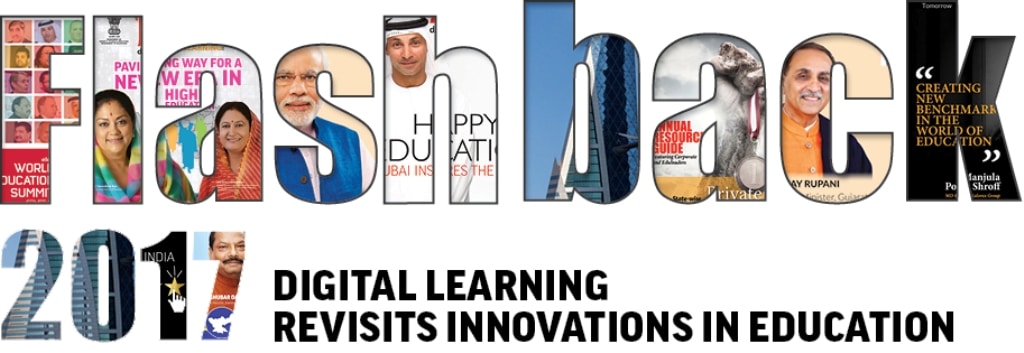
The 2017 has been an eventful year for the education sector, as the Governments have been infusing a variety of things through innovations in the education sector to make it more relevant for the student fraternity in the contemporary world.
Having played role of a lighthouse on the key developments, the digitalLearning magazine brings to you a flashback of the year gone as captured and observed through each of our monthly issues.
It is pertinent to mention this magazine also played a key role in bringing together world’s eduleaders at one platform through its print and web edition along with the premeir knowledge conferences. Let’s have a glance at the highlights of our different issues and conferences as observed by Elets News Network (ENN).
January Issue: KALOREX Nurturing 21st Century Learners
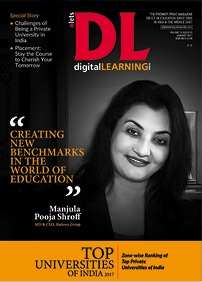 The first issue of January 2017 showcased the best education practices and teaching methodologies followed by Kalorex schools for the holistic development of its students. “The motive of Kalorex is to develop global learners equipped with 21st century learning skills,” stated Manjula Pooja Shroff, MD & CEO, Kalorex Group, in the cover interview. She explained their strategies and methodologies. She also threw light on the various philanthropic activities of the group. The interview also comprises the details of awards won by the group for its best educational practices and philanthropic work.
February-March Issue: Rediscovering Bahrain
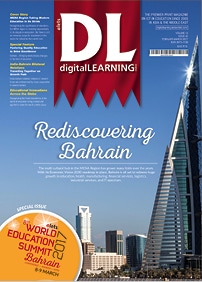 This was a special issue which revolved around World Education Summit (WES) 2017 Bahrain and recognised the global education ecosystem’s best practices. The summit was inaugurated by H E Dr Majid Bin Ali Al-Nuaimi, Minister of Education, Kingdom of Bahrain. The cover story of the February and March 2017 issue covered the improvements in formal education sector of Middle East and North Africa (MENA) Region. Governments across the region have invested heavily in the education sector and over the past 25 years witnessed a rapid expansion in primary, secondary and tertiary education. Despite all the development in the education space, the region has a lot of scope to grow in terms of bridging the gap between skill development and job market.
April Issue: Private Engineering Colleges Ranking and Annual Resource Guide
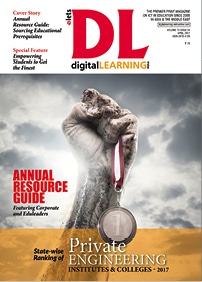 Finding out the most suitable institute or college as per one’s academic prowess and financial means most often proves a Herculean task, especially in engineering stream. Considering the complications of zeroing-in on the most suitable option, we decided to devote our Digital Learning magazine’s April issue to “State-wise Ranking of Private Engineering Institutes and Colleges -2017”, conducted by a perception-based methodology by a jury involving experts.
In addition, our cover story – “Annual Resource Guide: Sourcing Educational Prerequisites” – was a step towards furthering Digital Learning legacy providing better insights, enabling consumers to take an informed decision.
The issue also comprised the glimpses of “elets 8th World Education Summit Bahrain 2017” that witnessed a grand congregation of leading speakers and hundreds of delegates from as many as 12 countries from across the world.
May-June Issue: Transforming School Education Practices Trough Innovation
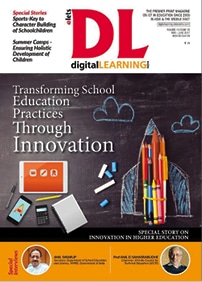 With a large number of schools adopting finest teaching-learning practices from across the world, our May-June issue tried to find out the practices that are improving and enriching educational experiences in the Indian schools through the cover story “Rehashing School Education Practices through Innovation”.
Through our three special stories “Ensuring Holistic Development of Children”, “ICT in Higher Education Taking Learning Process to the Next Level”, and “Sports-Key to Character Building of Schoolchildren”, the magazine attempted to touch upon some latent dimensions of the existing education scenario of the country.
Another prominent interview was of Prof Anil D Sahasrabudhe, Chairman, AICTE, who talked about the council’s various steps undertaken to improve technical and higher education in the country.
July-August Issue: Rajasthan Higher Education Souvenir
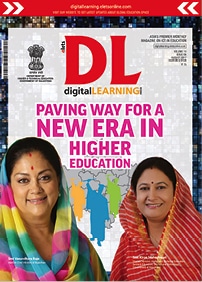 The July-August issue of Digital Learning magazine was published in association with Department of Higher and Technical Education, Government of Rajasthan. The Souvenir carried a number of prominent and distinguished who’s who of Rajasthan whose presence has brought remarkable changes in the Rajasthan education system.
An important feature of this issue of the magazine was congratulatory messages from the President Ram Nath Kovind, Prime Minister Narendra Modi, Union Human Resource Development Minister Prakash Javadekar, Rajasthan Governor Kalyan Singh and Chief Minister Vasundhara Raje.
With Rajasthan, one of most vibrant and progressive States of the country, focusing on its education sector in a big way, the Digital Learning magazine’s Cover Story — Rajasthan Higher Education Embracing Change for New Era of Opportunities — highlighted the growing charm for higher education among youngsters as an important prerequisite to grab highly rewarding jobs.
WES Delhi Special Issue
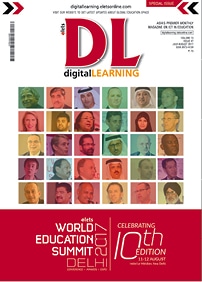 In this issue, we highlighted how a growing role of innovation and technology in education sector is becoming too overwhelming for members of any progressive society to ignore it. We stated how it is serving as a useful tool to help our schools, colleges and universities deliver the information and knowledge effectively.
Our cover story — WES Legacy: Bringing the Brightest Minds Together — was an attempt to explain and revisit the World Education Summit over the years and celebrate its 10th edition.
This special issue also contained insightful interviews of Kiran Maheshwari, Minister of Higher Education, Government of Rajasthan; Anil Swarup, Secretary, Department of School Education and Literacy, Ministry of Human Resource Development and Ashok Jain, Chief Secretary, Government of Rajasthan among others.
September Issue: India’s Top Preschool Ranking
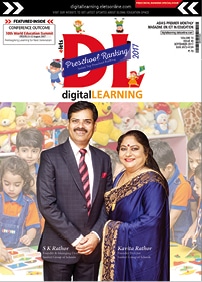 In the light of rapid growth of the preschool segment, the September issue of the magazine came up with India’s Top Preschools’ ranking for the second time.
Through “India’s Top Preschool Ranking 2017”, we endeavoured to explore various dimensions of the preschool segment. This year’s ranking was also intended to create an integrated and comprehensive database of diverse, high quality early childhood education and care services.
Our special interview on Sanfort — a pioneer partner of “Trinity College London” — was about bridging the learning gap in the early years of learning. The brand has around 150 preschools in 22 States of India and two abroad.
October Issue (Part I): Nurturing innovation encouraging Startups: The Gujarat Way
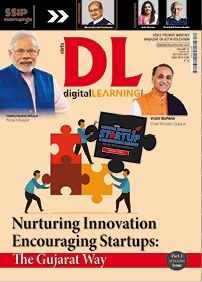 In the wake of a large number of highly impressive thesis and innovative ideas emerging every year, the cover story of our magazine’s October issue explored how the Student Startup and Innovation Policy (SSIP) transformed these innovations into new products and services.
A Hackathon Report also featured in this issue which showcased how a group of people recently tried to solve public problems through intellectual prowess away from any discrimination.
We also tried to explore the perspective of various distinguished stakeholders including Anju Sharma, Principal Secretary, Higher and Technical Education, Government of Gujarat, Prof Anil D Sahasrabudhe, Chairman, All India Council of Technical Education (AICTE) and K K Nirala as Director of Technical Education, Gandhinagar and others.
October Issue (Special Issue): Top Schools of India Ranking 2017
 This issue published the Top School Ranking-2017, a concise list of the best of schools across India which have been ranked in order of their performance on six parameters handpicked carefully. The benchmarks achieved by the schools in our ranking was done separately for five zones – North, South, West, East and Central.
When choosing a school, security of the campus is high on the priority list of most parents given the rising number of violent incidents against students. Our cover story, ‘Are Schools Safe for Children?’ in this issu, highlighted the various aspects of security at schools, and the measures that can be taken by the management to check the incidents of violence against the innocent kids.
November issue: Happy Education: Dubai Inspires the World
 As the United Arab Emirates (UAE) has embarked on a unique journey not many countries have treaded in the world, it’s steadfastly acquiring a distinction of being a global education hub with a difference. We endeavoured to highlight how the UAE’s new policies are focused on giving back to the world by making happiness and well-being the focal point of everything they do to improve quality of the education through the November Issue.
Our cover story in this issue, “Happy Education: Dubai Inspires the World”, explored the three key pillars of the UAE’s ‘Year of Giving’ – Corporate Social Responsibility, Volunteering, and Serving the Nation – to develop a knowledge-based economy as the best in the world.
December Issue: Rajasthan BuildingHigher Education Capital with Higher Education
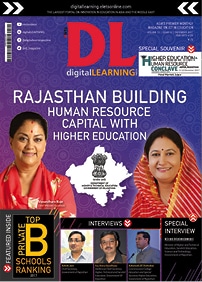 Rajasthan is among the top states in India in terms of number of institutions of higher learning. Given the high number of graduates and post-graduate students being churned out of these colleges and universities, providing meaningful employment through industry-academia partnership is of utmost priority for the State.
Our cover story “Rajasthan Govt All Set to Bridge Students-Industry Gulf” in this special Higher Education and Human Resource Conclave, Rajasthan issue covered various initiatives and achievements of the Government of Rajasthan in facilitating direct employment of students.
This issue also carried the B-School Ranking to help aspiring students to choose the right B-school for their education. The Top B-school Ranking 2017, being published for a second time, is a perception based ranking of over 300 B-schools in the country under various parameters.





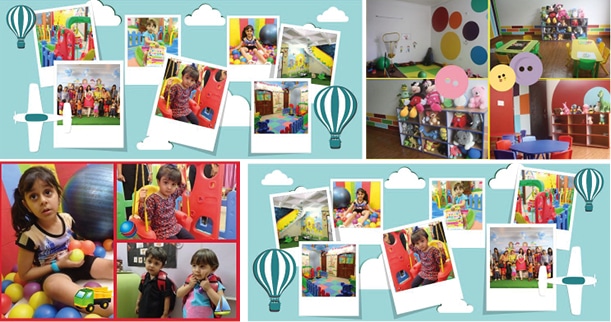
 The school provides the academically challenging curriculum with flexibility to meet the needs of individual children in these critical early years. The focus on teaching children in unique manner with the help of Montessori material establish strong foundation in reading, composition, mathematical skills and encourages individual creative expression and thus kids become independent learners at the early age of 3/5 years.